Lebanon has become the only active arena since the temporary cessation of hostilities between Iran and USA and the start of negotiations. It’s worth noting that this arena is seeing intense activity both politically and diplomatically, as well as on the military front.
The Negotiation Process Regarding Lebanon
The Iranian leadership declared that a halt to Israeli attacks on Lebanon was a precondition for negotiations with Washington. The US initially accepted this condition. However, it quickly reversed course, stating that the Lebanese issue was not on the agenda for negotiations with Tehran.
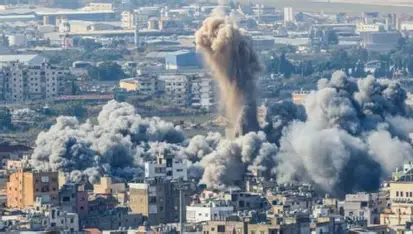
Following this, the Israeli army launched a fierce bombardment of Beirut and southern Lebanon on the very first day of the ceasefire. The airstrikes resulted in hundreds of deaths and injuries, mostly among civilians. Iran threatened a military response to Israel. It also stated that it would not participate in talks in Pakistan if attacks were to continue.
With the initial rounds of negotiations taking place in the Pakistani capital, the Israeli side—apparently under US pressure due to Iran’s firm stance on its conditions—agreed to reduce the intensity of the bombardment, but not to halt it entirely. This remains a major obstacle to efforts to end the war in the Gulf region as a whole.
Netanyahu Seeks to Isolate Lebanon from the Regional Context
It’s worth noting that a new trend has emerged in diplomatic activity in recent days. For the first time in history, Lebanese authorities have declared their readiness for direct negotiations with Israel. The stated goal is to end the war in their country and achieve a settlement. For his part, the Israeli Prime Minister supported this idea, stating that he had given instructions for negotiations to begin immediately.
However, Netanyahu’s pursuit of direct negotiations with the Lebanese side cannot be understood as a step towards a settlement. Rather, it is a continuation of his methods of managing the conflict. He seeks, firstly, to permanently entrench the division of power through a separate negotiating track that isolates the Lebanese issue from the broader regional context. Secondly, he seeks to use this track to impose his strategic objectives on the Lebanese front, whether in setting rules of engagement or in restructuring the security apparatus in line with Israel’s vision.
In this context, negotiations will proceed according to the logic of “extracting concessions” under pressure, turning the process itself into an unequal political standoff. It will be aimed at achieving goals that could not be achieved through direct military action.

In this context, the course of events on the ground will be the decisive factor, especially given that the Lebanese resistance, led by Hezbollah, has categorically rejected the negotiating approach.
Military Operations Continue
Just one day after the ceasefire in the region and the intense Israeli bombardment of Beirut, Hezbollah resumed daily military operations against Israel.
In its official statements following each operation, the party affirms that these operations are “in defense of Lebanon and its people, and in response to the enemy’s violation of the ceasefire agreement and its repeated attacks on southern villages, after the resistance adhered to the ceasefire while the enemy did not.” It further adds: “This response will continue until the Israeli-American aggression against our country and our people ceases.”
It is important to note that the Lebanese resistance is thus confirming that it will continue its operations until the Israeli bombardment stops. The party also issued another statement detailing the destruction or damage of 159 tanks, 15 bulldozers, 8 Humvees, and 5 armored personnel carriers, in addition to 8 drones, a helicopter, and a warship, from the start of the war on March 2nd until April 13th.
Finally, it should be noted that the Lebanese arena is the most unstable since the ceasefire between Iran and the United States. Events there are partially unfolding independently of the overall negotiation process, not to mention the potential for a larger regional war if it fails. This is due to Israel’s refusal to leave Lebanon alone.