
Darfur Express: Thus, the EU turned a blind eye to the violation of the arms embargo in Libya and Darfur
By Luca Gambardella – Originally published in il Foglio (Italy), 26 August 2025.
Translated by Brown Land News Investigative Desk
Introduction
(Disclaimer) The following text is a literal, word-for-word translation of an investigative article published by the Italian newspaper il Foglio on 26 August 2025, titled “Darfur Express: Così l’Ue ha chiuso un occhio davanti alla violazione dell’embargo delle armi in Libia e Darfur” by Luca Gambardella.
It has been translated as faithfully as possible to preserve the original meaning, structure, and wording. No commentary, interpretation, or editorial changes have been added. The purpose of this translation is to make the original investigation accessible to readers who do not read Italian.
Source: il Foglio (Italy), 26 August 2025.
For analysis and commentary on the findings of this investigation, please refer to the separate opinion piece published alongside this translation.
Investigation on the ship loaded with ammunition and pickups searched in Greece but allowed to leave for Misurata, Benghazi, and Tobruk for fear of migrants. The photos, the testimonies, and the letter of Irini to the presumed trafficker: “Thank you for the collaboration.” The case of the Aya 1 and its trafficking from the Emirates.
At the beginning of July, American intelligence reported to the command of the European military mission Irini a suspicious ship. The container ship Aya 1, a vessel flying the Panamanian flag, departed on July 1 from the port of Mina Jebel Ali in the United Arab Emirates. According to satellite AIS systems, its destination was Terneuzen, Netherlands. For the Americans, however, the cargo was destined elsewhere, to Benghazi in eastern Libya, and it was not transporting cosmetics, cigarettes, and electronic materials as stated in the documentation, but rather ammunition and hundreds of pickup trucks for military operations.
Satellite images viewed by Il Foglio indicate that on July 22, near Crete, the Aya 1 was approached by the Greek frigate Themistokles and the Italian Francesco Morosini, both of which are engaged in the Irini operation. The European mission, passed in July under Italian command, was launched five years ago with the purpose of watching over the arms embargo in Libya. This time, however, things went differently. According to at least four people informed of the facts, but who prefer to remain anonymous given the sensitivity of the matter, the searches on board the Aya 1 confirmed that it was indeed transporting hundreds of armored off-road vehicles and ammunition destined for Libya and from there to Sudan, to the Rapid Support Forces (RSF) commanded by Mohamed Hamdan Dagalo, better known as Hemedti, supported by the United Arab Emirates. Nevertheless, to the Aya 1 it was granted to continue its journey toward Libya. Il Foglio managed to reconstruct how and why Europe turned a blind eye in front of the violation of the embargo, but also managed to trace back to the man who made himself responsible for this arms trafficking from the United Arab Emirates to Sudan, passing through Libya.
It was first the Greek daily To Vima that spread indiscretions on the suspicious cargo on board the Aya 1. As foreseen by the rules of engagement – particularly weak – with which Irini is equipped, the command of the mission first had to ask the flag state for permission to inspect the ship. “The procedures to carry out this kind of searches are complex – explains a military source – For this reason, usually, when Irini obtains the permission to board a cargo it does things properly and above all it gives publicity to demonstrate that the mission works.” In the case of the Aya 1, however, Irini’s communication channels remained strangely silent, perhaps for fear of arousing too much clamor.
After having searched the container ship on the high seas, in the evening of July 27 the Italian Francesco Morosini escorted the ship up to the Greek port of Astakos, where it remained moored for the following four days. It is during this forced stop that an intense diplomatic activity began between Athens, Dubai, Brussels and Tripoli, a negotiation of which the Greek prime minister in person, Kyriakos Mitsotakis, at least according to the Hellenic press, would have been constantly updated. Jalel Harchaoui, of the Royal United Services Institute in London, explains to us that the question was rather delicate for Athens: “The Greeks are in the middle of a dispute with the leader of Cyrenaica, General Khalifa Haftar, regarding the flow of migrants from the east of Libya toward Crete which between May and June reached an unsustainable peak.”
“Not to mention the dispute for maritime borders and the mess of the European delegation chased out from Benghazi two months ago by the authorities of eastern Libya – continues the analyst – On one side, the Hellenic government did not want to annoy the American allies who had reported the ship, but on the other side they did not even want to irritate further Haftar.” According to what has been reconstructed, the solution found by Athens was rather elaborate. At first, it gathered the material that proved the violation of the embargo by the United Arab Emirates sending all the evidence to the Panel of Experts of the United Nations that deals with Libya. Immediately after, however, the Greeks asked Irini to authorize the ship to depart again and to deliver equally its cargo.
The expedient found to avoid unloading it directly at Benghazi, into the hands of the eastern authorities that are not recognized by the international community, was that of diverting it toward the west, that is making it first pass through the government of Tripoli, recognized by the UN. Questioned by il Foglio, a spokesperson of the EU Commission confirmed that, “after having received the necessary documentation from the Government of National Unity of Libya, according to the exemptions in force at the United Nations arms embargo, the ship was authorized to resume its journey in Libya.” In substance, Brussels gave the green light to the delivery of the arms by letting them pass through Libya and availing itself of the exemptions, often vaguely interpreted, that permit acting in derogation of the embargo.
Thus, on the first of August, the Aya 1 resumed the sea, but instead of making route toward Benghazi, as initially was in its plans, it directed itself to Misurata, in the west, where it docked on the 4th of August. Here, according to military sources who prefer to remain anonymous, a part of the pickups was unloaded, as also demonstrates a video recorded some weeks later along the road that from Misurata leads to Tripoli.
In the video (below) appear at least three car-transporters loaded with what seem dozens of beige Toyota Land Cruiser 79 and presumably also with some Toyota Land Cruiser V8, both models very widespread in the war ongoing in Sudan. To avoid complications, sometimes the mounting of the armor of the pickups takes place only once landed in Libya. An investigation conducted by the Center for Information Resilience (CIR) came out a few weeks ago and based on the analysis of the videos posted online by the Sudanese fighters themselves, demonstrates how these vehicles are employed by the men of Hemedti encamped south of al Jawf, in the Sahara desert and in full Libyan territory. From there were launched several military operations in northern Darfur that often flow into massacres of unarmed civilians. Last week, one of these offensives of the RSF led to the killing of about 1,500 displaced persons of Darfur in the refugee camp of Zamzam.
“The delivery of these vehicles to the authorities of Tripoli was a kind of tip, perhaps a reward given by the Emirates to the Libyan Prime Minister Abdelhamid Dabaiba for having allowed that the cargo was not lost and arrived all the same in Libya,” said to il Foglio a diplomatic official. Thus, a part of the vehicles was redistributed among the militias faithful to the government of Tripoli, predominantly to the benefit of Brigade 111 commanded by Abdul Zamad al Zoubi, deputy minister of Defense. The rest of the cargo instead departed again the following day toward Benghazi first and to Tobruk then, following an unprecedented route. Satellite images show the unloading operations in the Libyan ports of the east. From here, the journey of the pickups continued toward Sudan and to prove that the delivery arrived at destination there could be a video published last Sunday on X (Twitter). It shows RSF men driving more than a hundred Toyota Hilux traveling in the Libyan Sahara toward Nyala, in southern Darfur. A caravan that could be part of the cargo of the Aya 1.
Since the beginning of the conflict two years ago, the paramilitary militias of Hemedti can count on the military support of the United Arab Emirates, interested in the control of the trafficking in the triangle of land comprised between Sudan, Libya and Egypt. Among the preferred methods by the Emiratis to supply arms to the RSF there is the air bridge that departs from Ras al Khaimah and from al Ain, in the Emirates, and arrives in Benghazi or in Kufra, in the part of Libya controlled by their ally Haftar. From here, the loads travel toward the south to arrive at destination. Independent analysts like Rich Tedd, who for years has followed the supplies between Emirates and Africa, have found the tracks of this air bridge demonstrating how it feeds itself on an almost daily basis. “As far as regards the armored pickups, thousands of them pass through the Libyan desert toward Sudan, on average there is a load every three weeks,” confirms to us the diplomatic source.
The alternative to airplanes are ships. Usually it is difficult to intercept and inspect the cargo ships that transport arms by sea. “On Irini weigh the bureaucratic complications that make it difficult to stop and search a suspicious ship. And then there are the divisions among the member countries of the EU, that often use it as an instrument for their own personal ends,” a naval officer of a European Navy tells us. A bit like what happened with the Greeks in the case of the Aya 1. This time, however, the report of American intelligence had forced the Europeans to intervene, replicating what had happened in July of 2024, when the United States “suggested” to our Guardia di Finanza to search and seize a suspicious container landed at the port of Gioia Tauro and then revealed to be loaded with drones of Chinese manufacture destined for Libya.
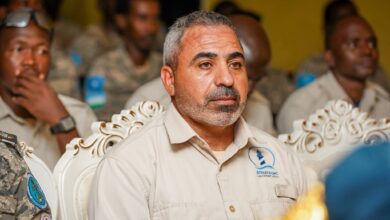
“When the Americans intervene to stem the arms trafficking in Libya it is because they have a direct interest,” explains a source. And in the case of the Aya 1, the direct interest has a name and a surname, that il Foglio managed to identify and that is the owner of the company that manages the ship. It is about a Libyan businessman, Ahmad Gadalla, defined by those who know him “a very dangerous man,” owner of several companies between the United Arab Emirates and Libya. Among these, there is also the Alushibe Group, a company that deals with logistics and international shipping with headquarters in Dubai and that, according to the Seasearcher archives of Lloyd’s List Intelligence, a portal that provides information on the ships in circulation, is the owner of UDS Shipping Services LLC, based in the Emirates and commercial operator of the Aya 1. At times Ahmad Gadalla calls himself Ahmad Alushibe, as is deduced by crossing the photos and the information obtainable online on the activities of his companies with a copy of the passport of Gadalla, of which il Foglio has come into possession.
The reason for the double identity of Ahmad could lie in some troubles had with the Emirati justice between 2016 and 2018, recounted one year ago by the broadcaster Libya 360. While he was trying to build for himself a network of business in Dubai, Gadalla entered into business with companies connected to organizations tied to Islamic terrorism. According to Libyan media, the report of the Americans would have led the Emirati authorities to arrest Gadalla and, at that point, it would have been Khalifa Haftar to intercede for him with the monarchy of Abu Dhabi and rehabilitate him. “The reason is that during the offensive against Tripoli, in 2019, the Emirates were one of the principal economic and military sponsors of Haftar. It is then that they realized that a man like Gadalla, active between the two countries and with his own network of contacts, could turn out useful to both,” recounts a Libyan source.
Il Foglio managed to contact by telephone Mr. Gadalla, who denied every accusation. “The fact is that I am a very important entrepreneur and I am seen as a problem by all the corrupt who envy me, because I am doing great things for my country. They are only trying to discredit me. I know nothing of these traffics neither with Libya nor with Sudan,” he explains to us while he says he is in Germany to conclude a contract of 400 million euros with Siemens – “but I do a lot of business also in Italy, with Danieli for example.” Gadalla also denies having been arrested in Dubai. “Some of my companies had to do with others that had problems. They investigated me and they did not find anything. They requisitioned my passport for some months and that’s all.” Regarding the double identity, he explains to us that it would be only an expedient “because Gadalla is a very common name, while Alushibe is easier to remember.”
In any case, over the years Ahmad has become one of the most influential businessmen in the east of Libya, with a leading role also in the Bank of commerce and development of Benghazi, led by Saddam Haftar himself. “He has a privileged position, so much that every time the Haftar need help or money – whether it be for investments, international traffics or contracts – they turn to him,” recounts the Libyan source. “I am the president of the largest factory in the world of green steel in Benghazi. Of course I know the Haftar, like anyone who does business in the east,” replies Gadalla.
“The Americans have been following him for a long time because he also has to do with Russians and Chinese in Libya,” explains to us a person informed of the facts. But not only. What most worried the Americans is the trafficking of diesel. Satellite images show the Aya 1 engaged in suspicious activities last March in Tobruk, in eastern Libya. In the photos below, the container ship is portrayed during loading operations of what seems to be diesel, as demonstrated by the 11 tanker trucks stopped at the dock in proximity of the ship.
The anomalies in this photo are two. The first is that Libya is a large net importer of diesel and it is therefore strange that a ship is engaged to export it. “Everything makes one think of an illicit trafficking,” says our source. The second anomaly regards the very nature of the Aya 1 which, as said, is a container ship, not a tanker. “The method used to transport the diesel is dangerous but effective if one wants to hide the load and it is that of resorting to flexible bladders hidden in their turn inside the containers – they explain to us – The ship would have been tracked several times by the United States during these suspicious traffics but to report it to Irini they wanted to wait until the load concerned arms and pickups. Perhaps because they had convinced themselves they could accuse it of something even more serious.” An error, judging by how events evolved.
“You must write good things about me, if you do not do it no problem, I grant you the right to do it but you see, I have nothing to hide. No arms traffics, nor of diesel – insists Gadalla – Think that those of Irini sent me a letter to ask me for forgiveness.” In fact, the Libyan entrepreneur forwarded to us the letter sent to him by the European mission, signed by our admiral Valentino Rinaldi, commander of Irini: “I express my gratitude to you for the kind collaboration demonstrated toward EUNAVFOR MED Irini,” writes the commander to Gadalla. “I kindly ask you to direct the Aya 1 to the port of Tripoli for the unloading under the supervision of the Government of National Unity of Libya. EUNAVFOR MED will provide for the immediate release of Aya 1.” The letter of admiral Rinaldi is a very important document for several reasons. The first is that, beyond the courteous and conciliatory tones, it is not a true letter of apologies. In no passage does Irini declare that on board the ship no material prohibited by the embargo in Libya was found. Moreover, it asks expressly to the Ukrainian commander of the cargo, captain Antonyuk Volodymyr, to make route toward Tripoli, but the ship instead will at the end direct itself toward Misurata, violating the indications of the European mission. Finally, in the missive it is ordered to unload at Tripoli, but the satellite images demonstrate that instead the ship delivered part of the containers also at Benghazi – if not also at Tobruk, considering that there the mooring lasted at least 19 hours – also in this case not respecting the orders of the European mission. It is thus that the affair of the Aya 1 could be resolved in the span of a few weeks, apparently in the best way for Gadalla, with at least part of the cargo delivered to the recipient in Sudan and with his ship free to carry forward its traffics. Right in these days, the container ship is sailing in the Gulf of Aden and makes route toward the port from where everything started, that of Jebel Ali, in the United Arab Emirates. But in the coming months the business of the powerful Libyan entrepreneur could be more shaky, given that, in the meantime, the Panel of Experts of the United Nations is compiling its report on the case of the odyssey of the Aya 1.
🔎 Read Commentary on the Findings
👉For deeper insight, see Darfur Express: EU’s Complicity, UAE Petro-Dollars, and the Road to Genocide in Sudan
An exposé that uncovers how the vessel Aya 1 became a passageway for Emirati weapons, Libyan facilitation, and European complicity, fueling one of the darkest chapters of the war in Darfur.
Brown Land News.
Where sovereignty is not negotiable, and truth defies revision.
Our Land. Our Voice. Our News