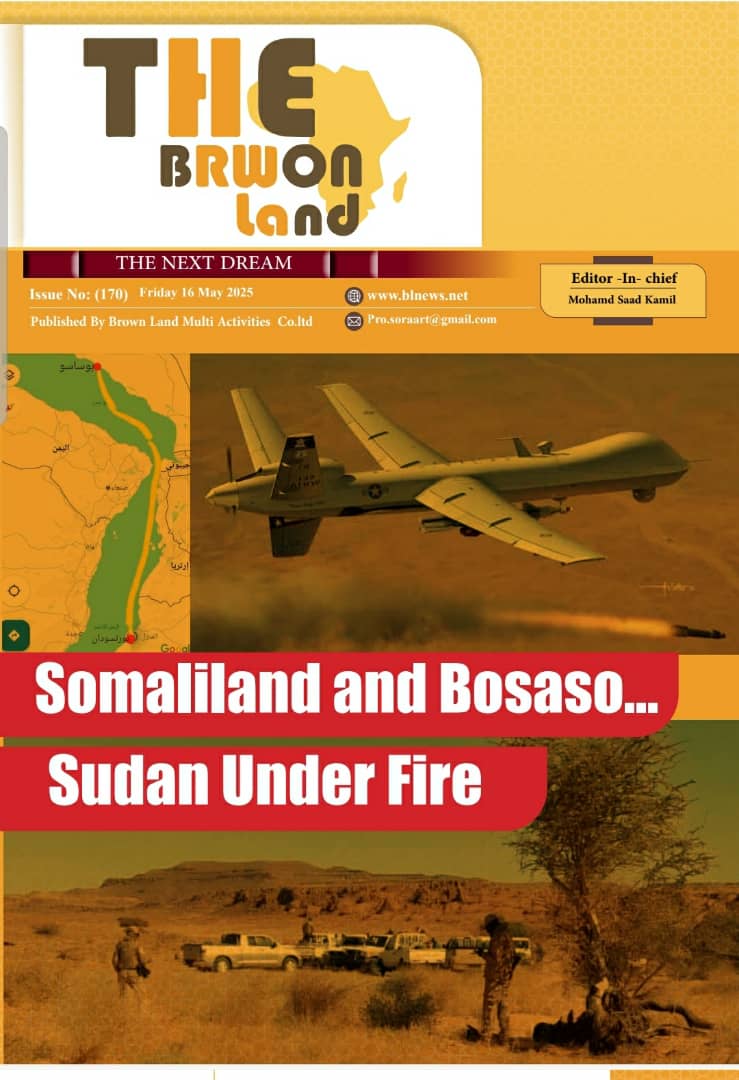
Somaliland and Bosaso… Sudan Under
Fire Investigation by: Mohamed Saad Kamil
Editor-in-Chief of Brown Land Newspaper
After a war spanning over two years that has devastated Sudan – a country already scarred since independence – and following the Sudanese army’s control over many areas where Rapid Support Forces (RSF) mercenaries had committed atrocities against civilians, the mercenaries began implementing what their leader, the notorious Hemeti, called “Plan B.”
During a speech broadcast on social media, Hemeti made clear this plan targets the destruction of Sudan’s infrastructure. Some analysts interpreted this as either pressure on the Sudanese military to accept negotiations or as following the UAE’s behavioral approach to destroying Sudan according to international logistical interests, previously implemented in some Middle Eastern countries like Syria and Libya and several African nations.
The attack was launched from one of the UAE military bases in the breakaway regions of Somalia, such as Puntland or Somaliland After a series of marching attacks targeting the safe and remote east of Sudan from the hotbeds of conflict, Lieutenant General Mahjoub Bushra, commander of the Red Sea Military Region, revealed during an official briefing to the diplomatic missions in the city of Port Sudan, serious details related to the terrorist attack that targeted the city with suicide drones, accusing the UAE of carrying it out from military bases outside the borders. General Bushra said that the technical and intelligence data analyzed after the downing of the planes clearly indicate that the marches came from the East, that is, from the direction of the Red Sea, and not from land to the West, explaining that this ” opens the door wide to the possibility of launching an attack from one of the UAE military bases in the breakaway regions of Somalia such as Puntland or Somaliland” He added:” these bases are known for their use in transporting mercenaries to the occupied airports of Nyala, Umm Jaras, and N’djamena, and have previously been used by Abu Dhabi in similar operations, “pointing out that”the UAE has advanced logistical and military capabilities that qualify it to launch precision naval attacks targeting the depth of the Sudanese from outside the borders. The military commander explained that” the attack was not random or direct, but was characterized by a sporadic and coordinated nature, aimed at distracting ground defenses, “stressing that”the first suicide marches were aimed only to activate air defense systems, in preparation for the arrival of a strategic March targeted the radars of the Flamingo and Usman Daqna bases.“This method of implementation shows the efficiency of the air defense system in Port Sudan, and at the same time shows that the aggressor is fully aware of our strengths and capabilities, and is good at planning a complex and multi-axis attack to bypass them,”Bushra said. General Bushra pointed out that this kind of attack confirms beyond any doubt that Sudan is facing organized regional aggression, and not just an internal conflict or a militia insurgency. “What we are facing is an external aggression led by the artificial enemy state in Abu Dhabi, using modern and expensive military tools to strike strategic Sudanese positions,”he said in a decisive tone. He warned against complacency in characterizing what is happening, saying: “ignoring this fact or complicity in its denial can only be explained by the fact that a person is false, stupid… or an agent”.
The guided planes clearly indicate that they came from the direction of the Red Sea and not from the land, specifically from the breakaway areas of Somalia such as Butland In order to understand the nature of the accusations against the UAE related to providing military assistance to quick support mercenaries through logistical and military supply and the provision of foreign mercenaries with the ability to operate weapons systems that cannot be operated by quick support mercenaries, most of whom are shepherds, (gypsies) are not good at writing and reading ‘ an introduction must help the reader understand what the commander of the Red Sea military the land is specifically from the secession areas of Somalia, such as Butland, so it is necessary to know the history of the region Politically and geographically, so that we can analyze the reasons and motives behind this unjustified attack on the Republic of Sudan, which has become obvious to the whole world, and through many signs that the UAE is behind the aggression against Sudan, whose government has announced the severance of diplomatic relations with it and considers it a state of aggression. Somaliland The Republic of Somaliland is not recognized by anyone and the UAE is establishing a military base in it, so what is Somaliland where the UAE is establishing a military base and has significant investments in it Somaliland, bordering the Gulf of Aden, declared secession from Somalia following the overthrow of dictator Mohamed Siad Barre in 1991.The move came after a bitter conflict between Berri’s forces and separatists who fought a guerrilla war in the province, a conflict that killed tens of thousands and destroyed many cities.Although it is not recognized by a state, the territory has an effective political system, government institutions, a police force, its own currency, and its capital, hirgisa, is the most important Berber city.The area, formerly a British protectorate, has also escaped Somalia’s spiral of chaos and violence.The president of Somaliland is Musa Abdi, who has been in office since November 2017, succeeding Ahmed Silanyo.He was Abdi, a former pilot, has been serving as interior minister since the nineties of the last century.
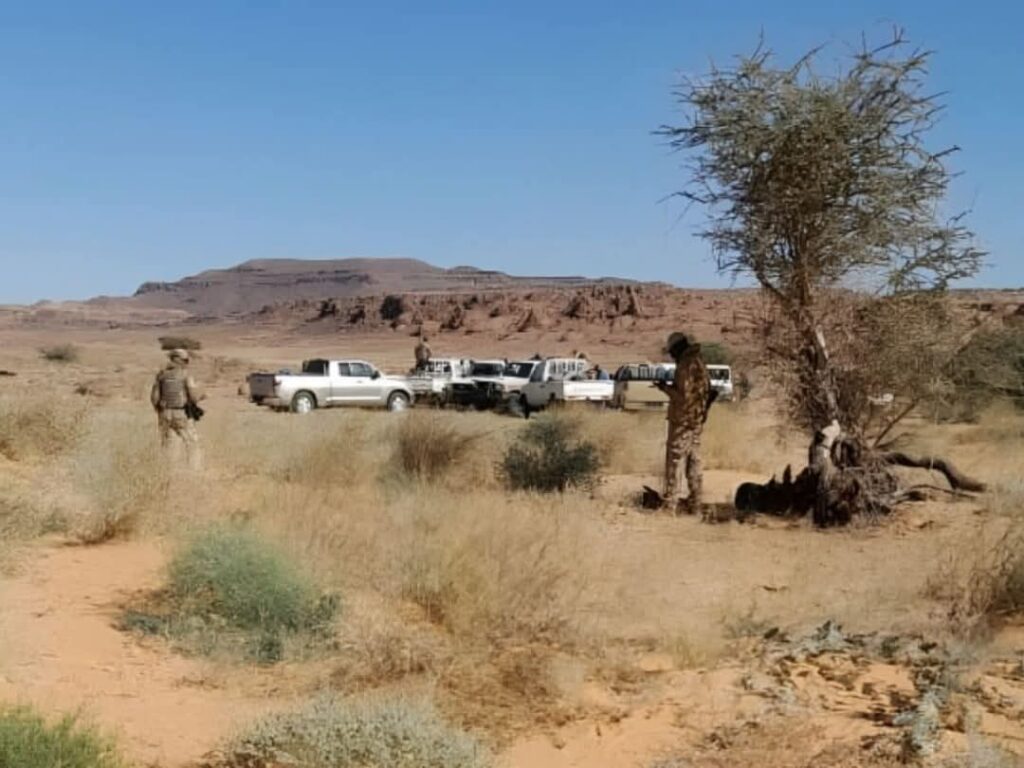
Somaliland The Republic of Somaliland is not recognized by anyone and the UAE is establishing a military base in it, so what is Somaliland where the UAE is establishing a military base and has significant investments in it Somaliland, bordering the Gulf of Aden, declared secession from Somalia following the overthrow of dictator Mohamed Siad Barre in 1991.The move came after a bitter conflict between Berri’s forces and separatists who fought a guerrilla war in the province, a conflict that killed tens of thousands and destroyed many cities.Although it is not recognized by a state, the territory has an effective political system, government institutions, a police force, its own currency, and its capital, hirgisa, is the most important Berber city.The area, formerly a British protectorate, has also escaped Somalia’s spiral of chaos and violence.The president of Somaliland is Musa Abdi, who has been in office since November 2017, succeeding Ahmed Silanyo.He was Abdi, a former pilot, has been serving as interior minister since the nineties of the last century. The Emirati role Although there is no state that recognizes Somaliland, the UAE has a significant presence in this region.In March 2018, Abdi announced that the UAE would train security forces in the region as part of an agreement to establish an Emirati military base there.He added that the base will ensure the achievement of economic and security development in the country, and will be a means of deterring militant groups in the region.In 2017, the UAE began to establish a base on a site at the airport of the city of Berbera in the region and was allowed to stay there for thirty years. Berbera is located less than 300 kilometers to the south of Yemen. Last October, DP World launched a USD 101 million project to expand the port of Berbera.Through the port, camels are exported to the Middle East and food is imported, among others.DP World said that the first phase of the expansion will include the construction of a 400-meter pier, as well as the development of a free zone, and that the Emirati company Shafa Al Nahda is the contractor of the project.”This investment in Berbera, and the expansion have a huge benefit for the country and for the development of its economy,”said Moussa Abdi. The first phase is part of the expansion agreement signed with DP World in 2016 and has a total value of USD 442 million.But the launch of the project comes amid opposition from Somalia, which considers that it violates its sovereignty. Senior officials said such agreements were an encroachment on Mogadishu’s legitimate authority. In an interview for the BBC with David Kirkpatrick, one of the New York Times journalists who recently prepared a lengthy report monitoring the extent of the intensification of the conflict between the UAE and Qatar in Somalia, he said that the UAE government’s attention has turned to Somalia as part of a plan to invest in the countries bordering the Gulf of Aden and the Horn of Africa (specifically Somalia, Djibouti, Ethiopia, Eritrea), this is in addition to the ongoing conflict in Yemen to extend influence over the region around the Bab-el-Mandeb strait.Somalia was not the UAE’s first choice. In 2006, the UAE launched its investments in the region with Djibouti, as Dubai Ports Company signed a concession contract with the port of “Doraleh”, under which it received an administrative and investment concession for a period of 50 years. At that time, a new port management company was established under the name of “DCT”, of which the Djibouti Ports Authority owned 67 percent, compared to 33 percent for Dubai Ports.But since 2012, the government of Djibouti has repeatedly tried to amend the agreement, objecting to several items, including its right to build other ports, and the UAE management of the port despite Djibouti owning the largest share. The parties failed to reach an agreement, until the Djibouti government terminated the contract in February 2018 due to its “conflict with the basic interests of the state”.Here, the UAE realized the need to look for alternatives in the region, after it became clear that other countries, including Qatar, Turkey and China, are seeking to replace them.In late 2016, DP signed with Somaliland
Concession contract for the management and operation of the port of Berbera for 30 years.Kirkpatrick says the UAE turned to cooperation with Somaliland and Puntland after failing to ally with Somalia’s internationally recognized government in Mogadishu, which is backed by Turkey and Qatar with aid and investments.He added that despite the security risks involved in these agreements, it was the opportunity for the UAE government to maintain its presence in the Gulf of Aden. Recently, Somaliland President Abdulrahman Mohamed Abdullah thanked the UAE for its continuous support to his country and expressed his aspiration to strengthen bilateral partnerships in various economic and development fields with the UAE. Abdulrahman Mohammed Abdullah, in special statements to the Emirates news agency “WAM” on the sidelines of the World Government Summit 2025, praised the pivotal role played by Emirati investments, especially through the DP World Group, in strengthening the economic infrastructure and transforming the port of Berbera into a strategic regional logistics center linking Somaliland with neighboring countries. He explained that DP World’s investment in Berbera port was not only limited to its development, but also extended to the establishment of the Berbera Free Zone and the Berbera trade corridor, which strengthened the economic link between Somaliland and Ethiopia, the neighboring country, and contributed to making Berbera an attractive investment destination.This investment has not only strengthened the infrastructure, but also added credibility to Somaliland’s stability and commercial attractiveness, encouraging more companies and investors to go there,”he said.Abdulrahman Mohammed Abdullah pointed out that the Berbera Corridor has contributed to facilitating trade between Somaliland and Ethiopia, which has an estimated population of about 134 million people, making it a vital hub for trade movement in the region، Especially in light of the facilitation of cross-border transportation and transportation operations. The nature of the relationship between the UAE and Somalia has usually been associated with the person who inhabits the “Villa Somalia”, the presidential palace in the capital Mogadishu. During the reign of former President Mohammed Abdullah Farmajo, relations between the two countries were strained to the point of rupture, and after the current President Hassan Sheikh Mahmoud assumed the presidency, the situation changed, and the UAE became the most influential country in the country. This raises many questions about the goals and repercussions of the UAE’s influence in Somalia. The Emirati presence, as usual, is in the opposite relationship with the Qatari presence in Somalia, where one country had influence and the other’s influence is diminishing. During Farmajo’s reign, the influence belonged to the state of Qatar, which was credited with the largest role in his assumption of the presidency through political money, a role that the UAE is said to have later played with Hassan Sheikh. The UAE’s influence in Somalia is in line with the reality of the country, as Abu Dhabi’s relations are not limited to the head of state only, but extends its influence to the parties, benefiting from liquidity, political competition and the nature of the federal system in the country. During the reign of former President Mohammed Abdullah Farmajo (2017-2022), Emirati-Somali relations deteriorated immediately after the results of the presidential elections, as the Arab conflicts between the quartet countries (Saudi Arabia, the United Arab Emirates, Bahrain, and Egypt) on the one hand, and Qatar on the other, forced the new administration to align with one side of the conflict. The choice was Qatar, which supported and financed Farmajo’s arrival to the presidency of Somalia through its controversial man, a former journalist at Al Jazeera, Fahd Yassin, who held important positions, including the head of the National Intelligence and security agency (NISA), until citizens called him the “owner of the Somali decision”.
Farmajo accused the UAE of ignoring the national sovereignty of his country due to moves to establish military bases in semi-autonomous regions such as Somaliland and Puntland without reference to the federal government, and support regional administrations demanding independence. The differences increased after the Somali parliament passed a law calling for an end to all UAE economic and military activities in the country in March 2018. In April of the same year, the crisis worsened after the Somali authorities confiscated the contents of an Emirati plane carrying almost 10 million dollars in cash, allegedly intended for destabilization operations in Somaliland and Puntland. For its part, the UAE denied these allegations, stressing that the funds were intended for the training of soldiers of the Somali army. In response it halted most humanitarian work in Somalia, closed a hospital built to provide free medical care, and suspended a military training program for Somali security forces. The UAE Minister of state for foreign affairs at the time, Anwar Gargash, explained that cooperation with Somaliland and humanitarian development initiatives do not mean the existence of diplomatic relations, pointing out that the Berbera port agreement in Somaliland was mediated by Somali officials in the previous government, without revealing their names or positions. The UAE required Mogadishu to submit an official apology to end the dispute, which happened after the appointment of Mohammed Hussein Rubli as prime minister at the end of the Farmajo era, which settled the issue of confiscated Emirati funds, and ordered their return. In turn, Abu Dhabi redirected those funds as aid to Somalia. Days after Rubli’s apology, the UAE sent tons of aid to Somalia, where he was facing the most severe drought crisis in a decade, starting a new chapter and a major shift in relations between the two countries. Somali writer and researcher on Horn of Africa Affairs, Anwar Abdel Fattah, described the relationship between Somalia and the UAE as based on economics and geopolitics, as the UAE competes in the Horn of Africa with Saudi Arabia, Egypt and Qatar, and the Red Sea and the Nile River are the scene of conflict between these regional countries. For the same reason, the UAE is spending millions to rehabilitate Somali troops, establish military bases and pay the salaries of Somali soldiers. These agendas became clear after the election of Somali President Hassan Sheikh Mohamud, where the Federal Government of Somalia officially requested cooperation with the UAE government to strengthen the capabilities of Somali forces, including providing them with weapons, ammunition and other necessary materials. The two sides signed a controversial agreement on the Fourth of January 2023, focusing on military and security cooperation and combating terrorism, including points that may affect the sovereignty of the country. The agreement includes (13) articles granting the UAE the right to use regional facilities, import military equipment, investigate and collect information, establish training centers for military personnel, provide and finance counter-terrorism forces, and others. At the time, opponents considered that “the agreement made Somalia an Emirati protectorate” similar to the agreements it concluded with parties in Libya and Yemen, which is believed to have played a role in the deterioration of the security situation in these countries. Among the points that many Somalis objected to, the agreement granted the UAE the right to pursue and investigate individuals involved in terrorism without referring to the Somali authorities, which could mean detaining people opposed to the UAE’s interests on terrorism charges, as they fear. Activists also expressed fear that the UAE will be granted the right to build military bases in Somalia and equip its soldiers with equipment and weapons, which may lead to the creation of an army led by and working for it. Under the agreement, the UAE can also activate air and ground attacks without informing Somalia, and it has the right to use Somali territory to attack organizations that threaten the security of the UAE. Researcher Anwar Abdel Fattah says the UAE also wants to find a hub to deliver logistical aid to its forces in Yemen via the Red Sea. A Somali army officer, who declined to be identified for security reasons, said that a daily report is sent to the UAE leadership about the security situation in Mogadishu, adding that Emirati figures interfere in the work of the security services by controlling the number of active units in the various directorates of the capital. The Somali officer continues that “the Emirati leadership uses the salaries of soldiers to ensure that the plan to stabilize the security of the capital runs smoothly” and that “these salaries serve as a tool of power in the hands of the UAE, which can cause a major disruption by not paying salaries, at a time when the government cannot afford it”. On the other hand, Somalia benefits from the air support provided by the UAE for counter-terrorism operations, as well as financial and training support through third countries such as Uganda, which contributed to increasing the number of active forces, which reflected positively on security and counter-terrorism. The most important issues that have caused problems in the past are the UAE’s significant influence in the unilaterally independent territory, Somaliland, and in the state of Puntland, which enjoys extensive powers under the federal system. Paradoxically, the territory and the state are the bitterest opponents of President Hassan Sheikh, a strong ally of the UAE. This influence continued to haunt the federal government during the period of the previous administration, and this presence is represented at the security and economic levels. In Somaliland, the two sides have a strong bilateral relationship and a remarkable development partnership marked by economic investments, especially in infrastructure projects. One of the key investments is the 30-year concession granted in 2017 to Dubai government-owned P&O ports, worth USD 336 million. The concession aims to expand and manage the port of Berbera, a strategic location within Somaliland, and some analysts believe that the economic links are part of a broader strategy pursued by the UAE to gain political influence in the Horn of Africa. Another aspect of the agreement concerns Somalia’s relations with Ethiopia in politics and economy, and the competition of Qatar ports, which received concessions in Djibouti after the expulsion of Dubai ports from it. In Puntland, the Emirati influence has a security and political aspect. Abu Dhabi has been supporting the Puntland Maritime Police Force (PMPF) since its formation in 2011 to counter the threat of pirates and illegal activities. But these forces have political goals, namely to protect the president of Puntland, Saeed Deni, an ally of the UAE in the face of the opposition, which is also supported by security forces.
The community’s view of the UAE
Fawzia Hassan Hashi, a Somali national, says she has concerns about Emirati policies in her country, calling her government authoritarian. She also points out the UAE’s contradiction that it is difficult for Somalis to obtain visas to enter the country while promoting its interest in the people and state of Somalia. For her part, journalist Mona Hussein points out that it is important to note the difference in the perception of Somalis from the UAE, which some see as a hostile country. She pointed out that the UAE’s regional interventions and its role in the conflicts in Yemen and Somalia help to form a negative image of it. She added:” some Somalis view the UAE military intervention in the region as a threat to stability, and unjustified interference in their internal affairs to benefit from the country’s wealth through friendly understandings with corrupt officials, generally contrary to the interests of the people, ” adding that it is important to realize that these views are not prevalent among Somalis, and that opinions differ in this regard, and there are many people who believe that the UAE role is positive and enhances economic partnerships. It is worth mentioning that the UAE has provided and continues to provide a lot of financial and humanitarian assistance to Somalia, and it also finances many humanitarian and development projects in the country, such as the project of producing electricity from solar energy in the city of busasu in Puntland state. However, the experiences of the UAE intervention in the region remain controversial, similar to the intervention in Sudan through its ally Rapid Support, which does not leave the minds of Somalis
Marches start from Somaliland to bomb eastern Sudan
Writer and political analyst
In a special interview to brownland newspaper, Sudanese political analyst Magdi Abdulaziz pointed out that yes, it is possible to link the UAE’s presence in “Somaliland” with some complex operations such as launching marches on Sudan under the banner of rapid support, due to several considerations of the UAE’s support for the Rapid Support forces, there are many accusations and reports pointing to the UAE’s military and logistical support for the Rapid Support militia in Sudan. This support has been documented by international and media organizations, including the provision of weapons and ammunition to them. The use of” Somaliland “as a zone of influence gives the UAE presence in” Somaliland”, especially control over ports such as Berbera, a strategic foothold in a sensitive area. This area can be used as a logistics base or as a transit point to support other operations in the region, including Sudan.Also, the nature of regional conflicts, regional conflicts often overlap and the interests of multiple countries are intertwined. The UAE’s support for a party to a conflict (the Rapid Support militia) may be part of a broader strategy to strengthen its regional influence and confront its opponents, which may be related to its expansion in other regions such as “Somaliland”. There are reports of the use of the ports of “Somaliland” reported that the UAE uses airports Somalia to transport weapons and ammunition to the Rapid Support militia in Sudan. Since the UAE has a great influence in Somaliland, this indicates the possibility of using this region to support other regional parties. Majdi goes on to say that the UAE’s expansion in the unrecognized “Somaliland” raises several risks to the security of the Red Sea:such as regional destabilization, as the competition for influence and resources between the UAE and other powers in the region, including Somalia itself, can lead to further instability and conflicts.Fueling tensions that extremist groups or non-state actors may exploit this instability to enhance their activities in the Red Sea region vital for global trade and also undermine anti-piracy efforts: Any conflict or regional tension may hinder international cooperation in combating piracy off the coast of Somalia, which increases security threats in the region and the impact on strategic waterways, which observers fear that foreign military expansion, including the UAE presence, aims to secure access to strategic waterways such as the Gulf of Aden and the Red Sea, which increases geopolitical tensions. Mogadishu has taken diplomatic steps to express its rejection of these moves, including cutting diplomatic and military cooperation with the UAE in 2018 in protest against its agreements with “Somaliland”. The Somali parliament also passed laws prohibiting DP World from operating anywhere in Somalia, as well as the position of Egypt and Saudi Arabia, which reports indicated concern among Egypt and Saudi Arabia about the UAE’s expansion in the southern Red Sea region. Historically, the region has experienced a rivalry for influence, and Cairo and Riyadh view the security of the Red Sea as a strategic priority. The participation of Ethiopia, which has disagreements with Egypt over the Renaissance Dam, in the exploitation of the port of Berbera in cooperation with the UAE may increase these concerns as Ethiopia, seeking to obtain a sea outlet, is trying to strengthen its cooperation with “Somaliland” and the UAE. Ethiopia has acquired a stake in the Berbera port development project. This partnership is of particular concern to Egypt, as it considers that any growing Ethiopian influence in the Red Sea region could threaten its interests and water security. In short, the UAE’s expansion in “Somaliland” is a source of great regional concern, because of its potential repercussions on the security of the Red Sea and the stability of the Horn of Africa region. Somalia strongly opposes this expansion, while Egypt and Saudi Arabia are closely monitoring developments amid fears of strengthening the influence of other regional powers in this strategic region.
Somaliland is Washington’s alternative ally in the Horn of Africa and Abu Dhabi’s dual arm Journalist and researcher
Writer and political analyst
Ammar al-Arki (Sudanese ) told brownland newspaper that Somaliland is Washington’s alternative ally in the Horn of Africa and Abu Dhabi’s dual arm for many years, “Somaliland” – the former British colony in northwestern Somalia – has been waging an fruitless diplomatic campaign to gain international recognition as an independent state. However, recent attempts have gained unprecedented momentum as a result of accelerated regional and international changes. In light of the growing disillusionment in Washington with the federal Somali government in Mogadishu, American voices began to increasingly sympathize with the independence project of “Somaliland”, especially because of its political stability and periodic elections, as opposed to the chaos of the South. The Somali government, despite sustained U.S. support for two decades, has failed to rein in the extremist group al-Shabaab, and has been embroiled in internal conflicts and repeated postponements of elections. This fragile performance deepened American frustration, and opened the appetite of parties in the US Congress, such as Republican Senator Jim Risch, to seek alternative partners in the region, considering that “the continued instability in the Horn of Africa and international competition for resources force deepening cooperation with partners such as Somaliland, committed to democracy and peace. On the other hand, despite the Biden administration’s adherence to the principle of the unity of Somalia, Somaliland’s allies in Washington have begun to move towards practical steps to strengthen its presence in the international arena, not only through official recognition, but also through what the Foreign Minister of Somaliland, an American citizen and a former doctor in Boston, described as “expanding direct engagement with countries, even without official recognition”. Strategic location and international competition The geographical location of Somaliland gives it a strategic advantage in the calculations of Washington and Beijing, as it is located along the vital Bab-el-Mandeb Strait, and within the range of maritime influence stretching between the Red Sea and the Indian Ocean. In 2017, China established its first foreign military base in Djibouti, only six miles from the US Base “Camp Lemonnier”, which has caused increasing concern at the Pentagon. This concern was reinforced after leaks that China was seeking to establish a new naval base on the Atlantic coast of Equatorial Guinea, prompting the United States to intensify its efforts to strengthen its existing sites and consider alternatives. In this context, Somaliland is emerging as a suitable option, according to Tibor Nagy, a former US Assistant Secretary of state, who said: “Djibouti exists, but you need an alternative plan, and Somaliland is an ideal option for Plan B”. The Emirati role: Washington’s agent and rising influence Although it is Washington that decides the grand strategies, the UAE is today the most prominent agent of American interests in “Somaliland”, and even contributes in practice to the consolidation of Western influence there. DP World, owned by the government of Dubai, controls 65% of the strategic port of Berbera, which has a long runway, one of the longest in Africa, and has previously been allocated by NASA as an alternative site for the landing of the space shuttle. The UAE, through its financial and diplomatic tools, not only invested in logistics, but also became part of the undeclared security arrangements, provided cover for a flexible US military presence, and directly supported Somaliland’s independence from Mogadishu. It seems to be playing the role of the “executive arm” of the West in the region, especially in light of the restrictions facing the United States in deploying its troops directly, or in dealing with officially unrecognized governments. Towards a direct American partnership Last August, a US military transport plane visited Berbera airport, with a team of military personnel on board to assess the port and airport, in an indication of the development of American interest. Somaliland also made an unprecedented offer to host Afghan refugees who cooperated with the United States, but the US State Department did not respond to the initiative. In Congress, a bill was put forward to study the possibility of direct defense cooperation between Washington and”Somaliland”, bypassing the Mogadishu government, although it has not yet been passed. Also in London, parliamentary movements in favor of”Somaliland” have increased, although the British government still adheres to its traditional position calling for an internal Somali solution. The bottom line Between the rivalry of major powers, the decline in the legitimacy of the central government, and the escalation of the UAE’s roles, “Somaliland” stands out as a geopolitical node that can be positioned in multiple contexts. It is a potential ally of the United States, a fulcrum in the face of Chinese expansion, and an accelerating theater of Emirati influence that indirectly serves Washington’s interests. While there are no signs of imminent official recognition on the horizon, the dynamics of informal engagement is constantly escalating, making “Somaliland” an accurate test of the future of American and Western influence in the Horn of Africa.
.. Airlift to support Rapid Support mercenaries
The government of Sudan has strong evidence of the existence of significant external support, which is still ongoing from external parties, headed by the United Arab Emirates, where air transportation is carried out through airports in the region, such as Umm Gers Chadian airport and the bossao base in Somalia, and the support with equipment and equipment takes its way by land from Chad and other points in the Sudanese The above was stated in the speech of Ambassador al-Zein Ibrahim Hussein, Sudan’s delegate to the African Union, before the session of the African Commission on human and peoples ‘ rights . Banjul may 2025 here is the full text of the speech Mr. President, representatives of countries, organizations and distinguished guests Allow me, on behalf of the government of the Republic of the Sudan, to thank the Office of the High Commissioner for human and peoples ‘ rights of the African Union for participating in the 83rd session in the plenary sessions held earlier.we thank the Gambian authorities for their good reception. Given the importance of the current situation in Sudan, I will go directly to the topic of concern for the benefit of participants and fact-seekers . Mr. President The beginning of the current war dates back to a coup attempt by the rebel Rapid Support forces on the morning of april these forces attacked the headquarters of the general command of the armed people’s forces( government forces ) and aimed in particular to kill the commander-in-chief of the Armed Forces, the chairman of the transitional sovereign Council in a step aimed at undermining the transitional constitutional order and preventing it from achieving its goals. The day before the failed coup, that rebel force in April sent heavily armed vehicles to occupy the airport of the city of Marawi, located aboutلم km north of the capital Khartoum .Meanwhile, the spokesman of the Armed Forces called on those rebel forces to return to their barracks and end the rebellion and escalation because they violated military orders. This coup turned into a full-scale rebellion that targeted military headquarters and civilian objects throughout the country .The rebellion continued to commit many unprecedented violations in the history of the country against the entire state and its civil and military, economic, cultural and social forces . Mr. President Because of these violations, the state did not stand idly by and established the National Commission to investigate crimes and violations of national and international humanitarian law . This is to investigate crimes and violations of national and international humanitarian law, represented by war crimes, crimes against humanity, crimes of ethnic cleansing and genocide .It is an independent working committee chaired by the attorney general of the state and includes professional competencies, legal experts and representatives of international law enforcement agencies .Its mandate includes an inventory of all violations committed since the outbreak of the war in أ April 2023, and the investigation and investigation of any violation contrary to national and international humanitarian law .The National Committee has made an inventory of all violations in the country, obtained documents and documented materials, received various lawsuits and complaints, and registered criminal cases related to By public right and private right she visited various sites . It has been confirmed to the commission and many independent international bodies that the Rapid Support militia (RSF ) committed war crimes, crimes against humanity, ethnic cleansing and genocide .For example, but not limited to what happened in the city of El Geneina and the Masalit people in West Darfur, and what is happening repeatedly around El Fasher and in Displaced Persons camps such as Zamzam camp, bushuk, Jazira and other areas of Sudan .Not the least is the civilian massacre committed by the militia in the west of Omdurman last week .In addition to all this, there are many crimes such as the treatment of prisoners contrary to humanitarian law, such as torture, murder and filming . The rebel Rapid Support militia has committed the crime of mercenarism by attracting foreign mercenaries from many nationalities, which amounted to more than ١٣ a country, according to statistics, some of them are neighboring countries in the region, and others from distant regions and countries outside the continent . The Rapid Support militia has committed violations against children and women, practiced extrajudicial killings, forced displacement, enforced disappearance and denial of freedom of movement to civilians. The militia also targeted civilian infrastructure, airports, communications and electricity transformers with drones and artillery shelling. They attacked foreign diplomatic missions and international organizations and blocked and confiscated humanitarian aid.They also attacked the headquarters of the National Human Rights Commission in Sudan, destroyed houses of worship, houses of worship, material cultural heritage sites, museums, the National Archive, libraries, and looted rare historical artifacts . The Rapid Support militia has attacked oil production facilities and disrupted the oil pipeline connecting Sudan with South Sudan and the production and export centers .Even prisons and civil police stations were not spared from militia practices, which led to the escape of thousands of prisoners sentenced for various crimes .The attacks also included wildlife sanctuaries . Mr. President The government of Sudan has strong evidence of the existence of significant external support, which is still ongoing from external parties, headed by the United Arab Emirates, where air transportation is carried out through airports in the region, such as Umm gars Chadian airport and the busasu base in Somalia, and support with equipment and equipment takes its way by land from Chad and other points in the Sudanese neighborhood to Sudanese territory . Mr. President، My government has filed a documented complaint against the UAE, which supports the Rapid Support militia, with the International Court of Justice .She also filed a complaint against Chad, which allowed the use of its territory and airports, to the African Union’s human and Peoples ‘ Rights Committee in Banjul .Sudan will continue to knock on the door of international justice and apply the foundations of National Justice at home through law enforcement institutions and submit reports to the United Nations through the Security Council and the Office of the High Commissioner for Human Rights . Conclusion Mr. President The National Commission for the investigation of crimes and violations of national law and international humanitarian law has issued its progress reports, which are available in Arabic and English, and its mission is still being held. Mr. President, the last thing that the rebel Rapid Support militia and its supporting forces did, after failing to control the country and the defeats it suffered, was to resort to an alliance with some political groups and with external support to establish a parallel government in the areas it controls through what was known as the Nairobi charter, which was condemned by international and regional organizations and countries, where the African peace and Security Council clearly and strongly expressed its rejection and condemnation of these parallel arrangements in its statement issued in March by virtue of the region wants to create separatist hotbeds and continue the conflict in the region . In conclusion, Mr. President of the African Commission on human and peoples ‘ rights, Sudan confirms its commitment to African solutions to the issues and challenges of the continent, including the situation in Sudan through a process led by the Sudanese themselves and supported by the African Union until this crisis ends and a secure transition is achieved.
The story of the busasu base
The port of busasu is the official seaport of busasu, the commercial capital of the Puntland autonomous region in northeastern Somalia. It is classified as a key port.[2] the port serves the Puntland region, and is one of the largest and busiest ports in Somalia. It occupies the first place in the export of livestock from Somalia. The modern port of busasu was built during the mid-eighties under President Mohamed Siad Barre for the purpose of shipping livestock to the Middle East. In January 2012, the Bosaso port renovation project was launched, where KMC was contracted to modernize the port. The first phase of the initiative saw the cleaning of unwanted materials from the shipyard and was completed within a month. The second stage involves the reconstruction of the seabed adjacent to the port, with the aim of accommodating larger vessels. On the sixth of April 2017, DP & P & O won a 30-year concession for the port of busasu in the land of punt area . USD 136 million has been invested in multi-purpose facilities for the management and development of a multi-purpose port project in busasu in Somalia’s Puntland state. “Work on the project” will include the construction of a 450-meter pier with a reserve area of 5 hectares, where drilling will be carried out to a depth of 12 meters with reclamation work using a dredging submersible. There will also be significant investments in Information Technology, terminal operating system (TOS), mobile port cranes and container handling equipment. The local community in the port area will also be relocated. The available data, including the well-known relationship between the UAE and the Rapid Support forces, and the deployment of Emirati bases in Somali areas outside the control of the federal government, raise serious questions about the nature of the activities taking place at these bases
Somali journalist Shafie Ahmed said in a statement to the investigation
Journalist specializing in international security
that although there is no conclusive evidence that the planes bombing the city of Port Sudan took off from the city of busasu, the available data, including the well-known relationship between the UAE and the Rapid Support forces, and the deployment of Emirati bases in Somali areas outside the control of the federal government, raise serious questions about the nature of the activities taking place at those bases. It is necessary to call on the Federal Government of Somalia to review these security and trade understandings, and to ensure that Somali territory is not used in any actions that may disrupt the stability of neighboring countries or expose Somalia to legal and moral accountability in the international arena. It can be said that “Somaliland” is part of Somalia, but recently this Republic – which unilaterally declared its independence – has taken several steps that could be described as reckless. The first step was the signing of a memorandum of understanding with the Ethiopian government by the former president of “Somaliland”, Musa Bihi Abdi, on granting Ethiopia maritime access to the Red Sea. This understanding has caused widespread controversy in Somalia and the Horn of Africa, and the Federal Government of Somalia has considered it illegal, and asserted that “Somaliland” does not have the right to sign agreements of this kind. It is believed that Somaliland was hoping to get official recognition from Addis Ababa in exchange for this step, which many Somalis described as a “precious gift” to Ethiopia. The second step was represented by statements attributed to senior officials in the new government, especially the foreign minister, in which he expressed the readiness of “Somaliland” to receive migrants from Gaza in exchange for obtaining international recognition from the United States and active countries such as Israel. These statements provoked widespread discontent within Somalia, both in the North and in the South. “Somaliland” is currently receiving clear Emirati support, although the federal government is aware of this,” Somaliland ” manages some files undeclared. The UAE has a large military base in the port of Berbera, and is developing it without any supervision or participation from the Federal Government of Somalia In general, it can be said that recently the government of “Somaliland” has taken rash steps both regionally and in relation to sensitive issues in the Arab and Islamic worlds. These policies provoked strong reactions in the region, and also provoked widespread anger on the Somali Street. It seems that the current government in” Somaliland ” has become a tool in the hands of external parties, headed by the UAE, to expand its regional influence. This approach may lead the region into a state of instability, at a time when the Somali people are looking for solutions that achieve their real interests, and not to turn “Somaliland” into an arena for settling regional scores that do not serve the interests of the Somali people, whether in the north or the South.
—————-
The British maritime security authority (Embry) has received complaints of heavy interference on navigation devices Electronic jamming or prelude to aggression, naval vessels report suspicious jamming off Port Sudan Recently,
journalist and political analyst Mohammed Wadaa revealed information
about naval interference on the Red Sea off the coast of the Red Sea
, which raises suspicions in the areas of influence of the UAE, such as the port of bossas, and using it to implement its agenda in helping the Rapid Support militia to bomb targets in eastern Sudan, where he mentioned in an article entitled Electronic jamming .. The hypothesis of maritime aggression The British authority on maritime security (Embry) has received complaints of heavy interference on navigation devices Electronic jamming or prelude to aggression, naval vessels report suspicious jamming off Port Sudan Electronic jamming urges caution against naval attacks on Port Sudan or the coast The technology used in the attacks on Port Sudan strengthens the relationship with electronic jamming on navigation devices The Rapid Support militia does not have the capabilities or equipment to cause this disruption The reports that have been monitored during the past period, reported a sharp and sudden jamming of navigation devices and guidance systems, which confused the crews of ships and exposed some of them to the risk of deviating from the safe sea routes ، The British authority on maritime security (Embry) did not identify the source of the disturbance, but advised ships to be very careful, and activate maximum maritime security measures while passing in this area, observers believe that navigation disturbances may indicate the use of electronic jamming techniques may be associated with attacks on eastern Sudan, especially in light of the involvement of many regional parties, led by the UAE in the Sudanese conflict, with its support and direct sponsorship of the Rapid Support militia , and it is known that the militia does not have these capabilities، The geographical location of Port Sudan, as a key transit point on the global trade route through the Suez Canal, makes any threat in this region an international concern, as it may affect the shipment of oil, containers and global supply lines ، This jamming and disruption of navigation devices occurred simultaneously with the attacks on Port Sudan, Kassala, Atbara and other areas with large numbers of suicide marches and at least one strategic March, and the Sudanese government’s accusations came to the UAE of carrying out these attacks and the existence of international convictions of the UAE’s involvement in the aggression, and this possibility is enhanced by the advanced technology used in the attacks, especially on Port Sudan, which reinforces the hypothesis of the relationship between electronic jamming and the attacks on Port Sudan ، At the same time, this confusion points to an Emirati naval aggression that has already occurred, or will occur, using naval ships or submarines, and perhaps the landing of troops on the coast , an action that is not ruled out, especially in light of the UAE’s insistence on kneeling the Sudanese people and occupying its land and controlling its wealth , and most importantly switching its predominant religion from Islam to the Abrahamic religion, this is a possibility that is in line with the state of insanity that dominates the UAE leaders , and the frustration that dominates the leaders of Israel، The UAE is deploying an Israeli radar in Somalia to support Hemeti’s forces in Sudan, where the UAE has reportedly deployed an advanced military radar system made in Israel in the semi-autonomous Puntland region of Somalia The UAE is deploying an Israeli radar in Somalia to support Hemeti’s forces in Sudan, where it is reported that the UAE has deployed an advanced military radar system made in Israel in the semi-autonomous Puntland region of Somalia to protect the busasu airport from possible attacks by drones and missiles launched by the Yemeni armed forces.Abu Dhabi is reportedly using busaso airport as a logistics hub to supply weapons and ammunition to the Sudanese Rapid Support Forces, which have been fighting a bloody civil war against the Sudanese armed forces for two years.It is reported that large cargo planes have conducted repeated arms transfers from Bossu to Sudan, where they recorded Up to five large shipments on some days. The move is part of Abu Dhabi’s broader strategy to enhance the security of its assets in East Africa, amid escalating regional tensions due to retaliatory strikes carried out by the Yemeni armed forces against targets suspected of being linked to Gulf Arab interests. The radar system, known as ELM-2084 three-dimensional with active electronic scanning technology (AESA), was installed near busaso airport earlier this year, according to satellite images dated March 2025. Diplomatic relations between the UAE and Israel were officially established on August 13, 2020 via the historic Ibrahim accords, which were sponsored by the United States. The official signing of the normalization Treaty took place on September 15, 2020 at the White House in Washington, D.C., in the presence of Israeli Prime Minister Benjamin Netanyahu, UAE Foreign Minister Sheikh Abdullah bin Zayed Al Nahyan and then US President Donald Trump. Thus, the UAE became the third Arab country-after Egypt (1979) and Jordan (1994) — and the first from the Persian Gulf, to establish full diplomatic relations with Israel. The ELM-2084 radar is an advanced system developed by the Israel Aerospace Industries (IAI) via its subsidiary “Elta Systems”. The radar is designed to perform three main tasks — detecting and tracking air threats, managing air defense systems, and supporting artillery fire — taking advantage of AESA’s three-dimensional technology to scan the atmosphere at high speed without the need to rotate the antenna mechanically. This capability allows the ELM-2084 radar to detect a wide range of aerial threats — including drones, ballistic missiles, cruise missiles, RPGs, and fighter aircraft — within a very short response time. Depending on its configuration, the radar provides a detection range of 100 to 470 kilometers and can track hundreds of targets simultaneously, which gives it a decisive operational advantage in modern combat environments saturated with threats.
Within the Israeli missile defense system, the ELM-2084 is a central component of such systems as the “Iron Dome”, “David’s slingshot”, and the “arrow”ballistic missile interception system. Its ability to accurately detect the launch of rockets and missiles from long distances and predict their points of fall enhances the chances of early warning, improving the prospects of intercepting targets before they reach their destinations. The ELM-2084 is designed to operate across diverse climatic and operational conditions, and is also resistant to electronic warfare tactics such as jamming and signal disruption. Its modular design allows it to be mounted on mobile platforms, which makes it extremely flexible for rapid deployment to protect airports, border areas and critical national infrastructure. Despite the scale of the UAE’s military operations, the Somali national authorities have remained conspicuously silent about the UAE’s expansion in Puntland. It is reported that the president of Puntland, Saeed Abdullah Deni, has authorized the UAE’s activities without official approval from the Somali federal government or from the Puntland regional parliament. According to two Somali sources, these arrangements were described as a “secret agreement”, even senior Puntland officials remained uninformed about the full scope of the operations. Rapid Support forces The RSF is the most powerful paramilitary organization in Sudan, originally originating from the notorious Janjaweed militias during the Darfur conflict before being officially integrated into the Sudanese security apparatus. Since the outbreak of the civil war in April 2023, the RSF and the Sudanese armed forces have been engaged in bloody urban and regional battles, killing tens of thousands of people and forcing millions of Sudanese civilians to flee to neighboring countries. The conflict has caused deep international concern, given Sudan’s critical geographical location between East and North Africa and its proximity to the Red Sea shipping routes vital to global trade. Led by General Mohammed Hamdan Daglo, known as “hemedti”, the RSF is believed to have received logistical and material support from several foreign powers, including Gulf countries. The UAE’s use of bussaso airport as a supply line for the RSF stands out not only as a sign of the complexity of the growing regional geopolitical entanglements, but also highlights how internal unrest in Sudan is increasingly destabilizing the Horn of Africa. Regional analysts see the UAE’s actions as part of a broader strategy to strengthen influence in East Africa, although at the same time it increases the risk of Somalia being drawn into regional proxy conflicts. The UAE’s alleged support for the RSF is driven by a combination of Strategic and economic interests. It is worth noting that Dubai is a major destination for Sudanese gold exports, as a large part of it is believed to be controlled by networks linked to the Rapid Support forces outside official channels. This link provides the RSF with vital revenue streams, while giving the UAE access to a strategic and lucrative resource. In addition to gold, the UAE has invested heavily in Sudanese infrastructure projects, especially in port facilities along the Red Sea, and through its support to the Rapid Support Forces aims to protect and expand these economic investments. By strengthening the Rapid Support forces, Abu Dhabi seeks to consolidate its political and economic influence in East Africa and the wider Horn of Africa region, in line with its long-term foreign policy ambitions. The UAE and Sudan also have a long-standing military relationship, having cooperated in conflicts such as the Yemen war. Thus, the support of the RSF can be considered an extension of existing defense ties. While the UAE government officially denies providing any military support or weapons to the RSF, mounting evidence and international criticism suggest otherwise, raising new concerns about Abu Dhabi’s role in fueling the devastating conflict in Sudan. 500 dollars for fighting: the UAE recruited Somali youth in Rapid Support and secretly transported them to Sudan via bussou In a new development, the UAE has transferred Somali youths to fight in the ranks of the Rapid Support militia, Abdulaziz Farah said, a Somali expert said that dozens of Somali youths have disappeared, and Farah revealed exciting details related to the disappearance of these youths from the coastal city of bussau, and the families confirmed that they had recently received calls from their sons, informing them that they had been transferred to inside Sudan. According to the information, these young men were lured with promises of monthly salaries of up to 500 dollars, only to discover later that they became part of the Rapid Support militia, in a scenario reminiscent of the UAE’s “Black Shield” experience, when Sudanese youth were deceived in 2020 by claiming employment to later immerse them in the battlefields inside Libya.
The United Arab Emirates has been exploiting vulnerable areas on the African continent (Central Africa, Chad, Somaliland and Puntland) under the guise of combating terrorism to carry out its illegal activities in these back gardens
The writer and political analyst Suhaib Hamid stated in his statement to the brown land newspaper

that The hypothesis confirmed today is that the UAE is exploiting vulnerable areas on the African continent (Central Africa, Chad, Somaliland and Puntland) under the guise of combating terrorism to carry out its illegal activities in these back gardens. An example is the suspicious presence of the United Arab Emirates in both the Republic of Somaliland (not internationally recognized) and Puntland, which belongs to the state of Somalia adjacent to the Northern Shelf of the Gulf of Aden and bordering Somaliland from the South. The UAE has established a military base at Berbera airport in Somaliland, and under this cover, it has carried out the activity of transporting weapons through this airport to um Geras in Chad, an activity that is still in force today. Also, under the guise of fighting al-Qaeda, the Islamic State and maritime piracy, the UAE influenced the Somali government by providing it with security assistance, as it helped to pay salaries and train the maritime police of the Puntland region, which was established to fight maritime piracy, where its tasks were later changed to combat terrorism. The United Arab Emirates has deployed a special force near the busaso airport in Puntland province to support the region’s maritime police force. Through this force, the United Arab Emirates has slowly come to control this isolated airport in many illegal acts, including using it as a base for flying to strike the administrative capital of the state of Sudan (Port Sudan) during early May of this year ٢٠٢٥. The Sudanese government must submit an official protest to the Somali state regarding the UAE’s encroachments through Somali territory, despite the fragility of the Somali government’s control over Puntland and Bari province in particular. The Sudanese government should not lose sight of the current Egyptian role in the state of Somalia, where the relations of all friends must be used to defeat the Emirati threat from the territories of fragile regions in Africa, including the state of Somalia.
Exclusive Statement to Brown Land Newspaper from Anti-Corruption Expert Witness Eng. Abdiasis Farah Said, a Resident of Bossaso

Before fleeing to Mogadishu for fear of persecution by the authorities, Abdiasis Farah Said witnessed numerous events implicating the UAE in using the port and airport of Bosaso as a military base to support Rapid Support Forces (RSF) mercenaries in their brutal war against the Sudanese people.
Eng. Abdiasis Farah Said stated:
“It is true that the UAE is using Bosaso Airport to transport weapons and soldiers. However, regarding the recruitment of Somali soldiers, I am still investigating and do not yet have 100% concrete evidence. So far, I only know of two families whose sons were recruited. Relatives informed me that one was already sent to Sudan, while the other’s mother refused to let him go and instead sent him to Nairobi for safety reasons.”

“Three months ago, I left my city, Bosaso, and came to Mogadishu to expose to the world what the UAE is doing there. Most Somalis are deeply troubled by this and condemn it—but the President of Puntland is loyal to the UAE.”
“I am happy to assist you and provide all the information I have because we are working on the same cause: fighting for the rights of Somalis, Sudanese, and the region as a whole. The videos I sent you are authentic. One shows Colombian soldiers arriving at Bosaso Port about two weeks ago, secretly recorded by a passenger traveling from Addis Ababa to Bosaso via Ethiopian Airlines. The other video shows a Russian plane used by the UAE to transport weapons to Bosaso and Colombian mercenaries—as well as mercenaries of other nationalities—to Chad and Darfur. For nearly a year now, the UAE has been using Bosaso Port for these purposes.”
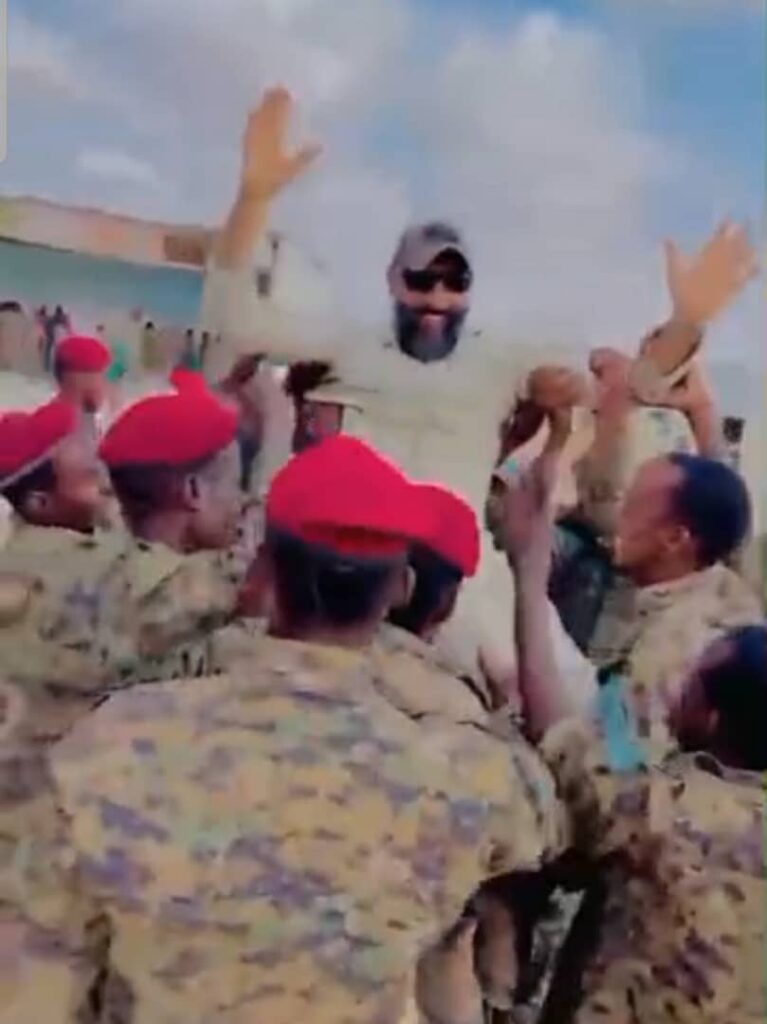
The other one is called mansuur from UAE the one they are lifting him up
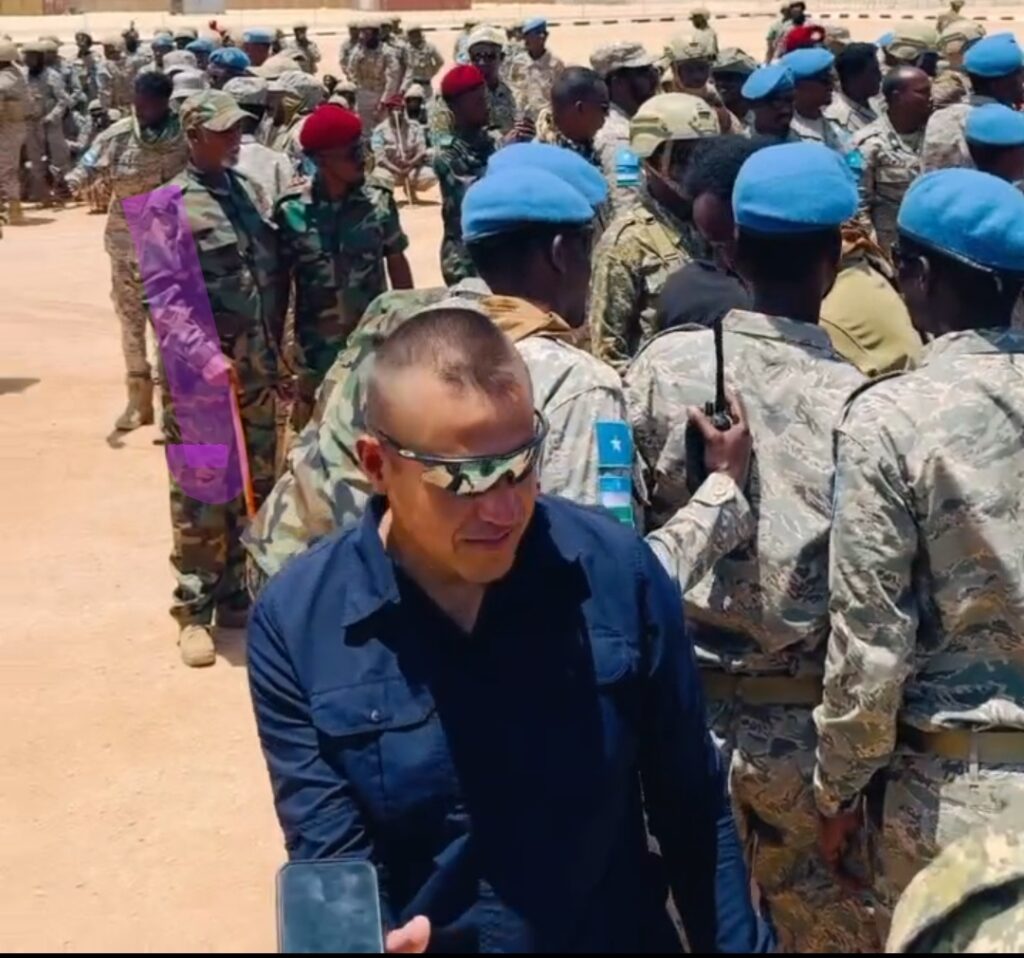
The other one is called mansuur from UAE the one they are lifting him up
“I left Bosaso because if you live there, you cannot speak out or post anything on Facebook. The Puntland government will arrest and punish you just to please the UAE. That’s why I fled to Mogadishu—to inform the world of what is happening and to prevent Somalia from being dragged into Sudan’s war.”
“I have local sources confirming that the UAE is recruiting Somalis to fight in Sudan. One soldier reportedly contacted his mother, confirming his presence in Sudan. I also received information that two weekly flights from Addis Ababa to Bosaso—every Tuesday and Saturday—transport Latin American soldiers, mostly Colombians, via Ethiopian Airlines. These planes carry hundreds of soldiers. All residents, including myself, see these planes heading to Sudan at night. The loud noise of these aircraft is heard across the city, making it clear that the UAE is using Bosaso as a launchpad to send weapons and mercenaries to Sudan.”
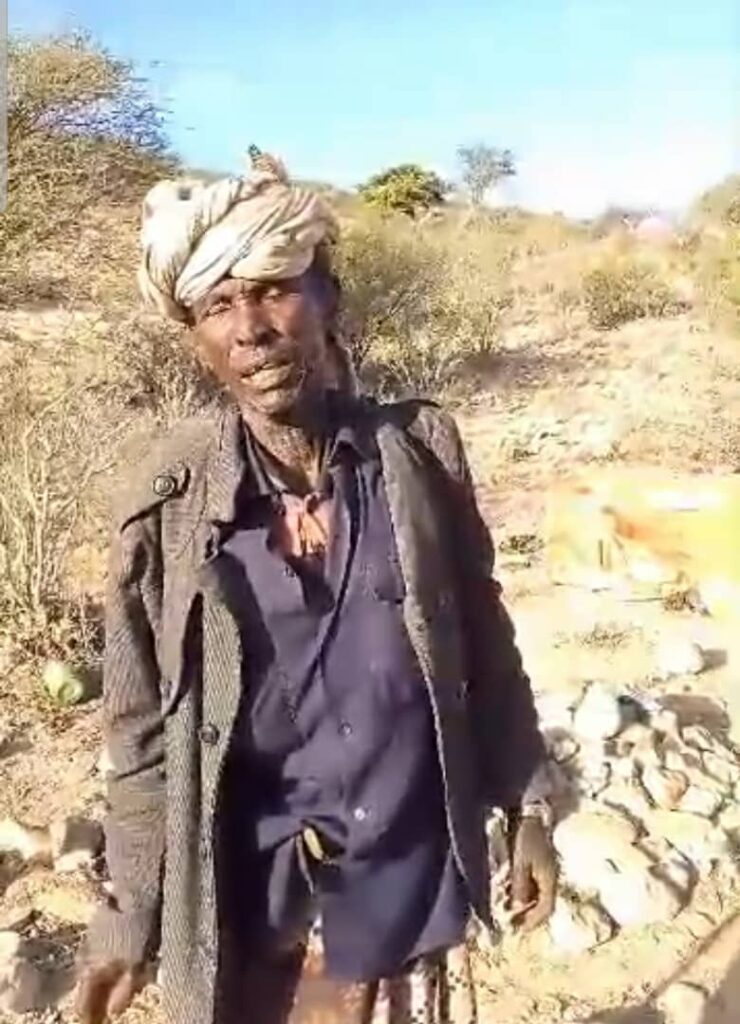
“Additionally, I have information that the UAE is bringing armed drones to Bosaso, claiming they are to help Puntland’s government combat ISIS in Somalia. However, two families from my clan living in the outskirts were mistakenly targeted in a drone strike—even though there is no ISIS presence in the area. The government has yet to explain why civilians were attacked. This is clear evidence that the UAE has drones stationed at Bosaso Airport, which could potentially be used to strike Sudan. Connecting the dots, it’s possible to prove that these drones are being deployed from Bosaso to target Sudan.”

This is prove that UAE bring many columbians in Puntland state.Some columbians training somali soldiers and some of them are sent to sudan from Bosaso
“Previously, I sent the following message to the UN in an attempt to expose these facts, but I have yet to receive a response.”
Dear UN Human Rights,
I am writing to bring to your urgent attention a series of unlawful drone strikes conducted by the United Arab Emirates (UAE) in Puntland, Somalia, with the full approval of the Puntland government. These deadly attacks have resulted in the tragic loss of innocent civilian lives, yet both the UAE and Puntland authorities have remained silent, failing to acknowledge or address these grave human rights violations.
On January 27, 2025, a UAE drone strike in Sixna killed five civilians and wounded three others. Again, on Febraury 12, 2025, another UAE drone attack in Miraale, Cal Miskaat killed eight civilians and left several more wounded. These repeated violations of international humanitarian law and Somalia’s sovereignty demand immediate international intervention.
Despite the clear civilian casualties, the Puntland government has not condemned the attacks, making it complicit in these killings by allowing foreign military operations on Somali soil without accountability. The UAE has also refused to acknowledge its responsibility, showing complete disregard for human life and international norms.
We Urge Immediate Action From the United Nations and Human Rights Organizations:
• Launch an Urgent Investigation – An independent, international inquiry must be conducted to establish the full facts and hold those responsible accountable.
• Demand Justice for the Victims – The UAE and Puntland authorities must be held accountable for these unlawful attacks, and those responsible should face prosecution for war crimes.
• Ensure Reparations for Victims – The families of the deceased and the wounded must receive full recognition, compensation, and support.
• Stop Further Civilian Killings – The international community must pressure both the UAE and Puntland government to immediately halt any further drone operations that endanger innocent lives.
These deliberate and reckless attacks must not be ignored. We urge the United Nations, human rights organizations, and legal bodies to take urgent action to prevent further atrocities and ensure justice for the victims.
Please let us know how we can assist in pushing for justice and accountability. The innocent lives lost deserve recognition, and those responsible must be held to account.
Please find the attached videos for your review. They are evidences of the casualties.
Sincerely,
Abdiasis Farah Said
From the Auther
From the above, it is evident that Somaliland and Bosaso are deeply complicit in supporting the Rapid Support Forces (RSF) militia, while Somalia’s federal government remains powerless—despite the long-standing historical ties between Sudan and Somalia. In the face of Emirati dominance, Somalia can take no meaningful action.
Furthermore, the analysis suggests that these regions may transform into future hubs for orchestrating conflicts and wars across Africa, serving as operational bases for external powers pursuing destabilization campaigns under the cover of regional partnerships