Burhan’s Visit to Turkiye: Reasserting Legitimacy and Repositioning Sudan Regionally.
Mubarak Mahgoub Musa
The recent summit reflects a shared determination to consolidate a strategic partnership and to support solutions that safeguard Sudan’s unity and territorial integrity.
In this context, Sudan’s external diplomatic engagements should not be viewed as routine protocol visits. Rather, they must be understood as integral components of a broader struggle over the country’s future, and as deliberate efforts to reposition Sudan within a regional and international landscape still marked by hesitation and ambiguity toward the conflict.
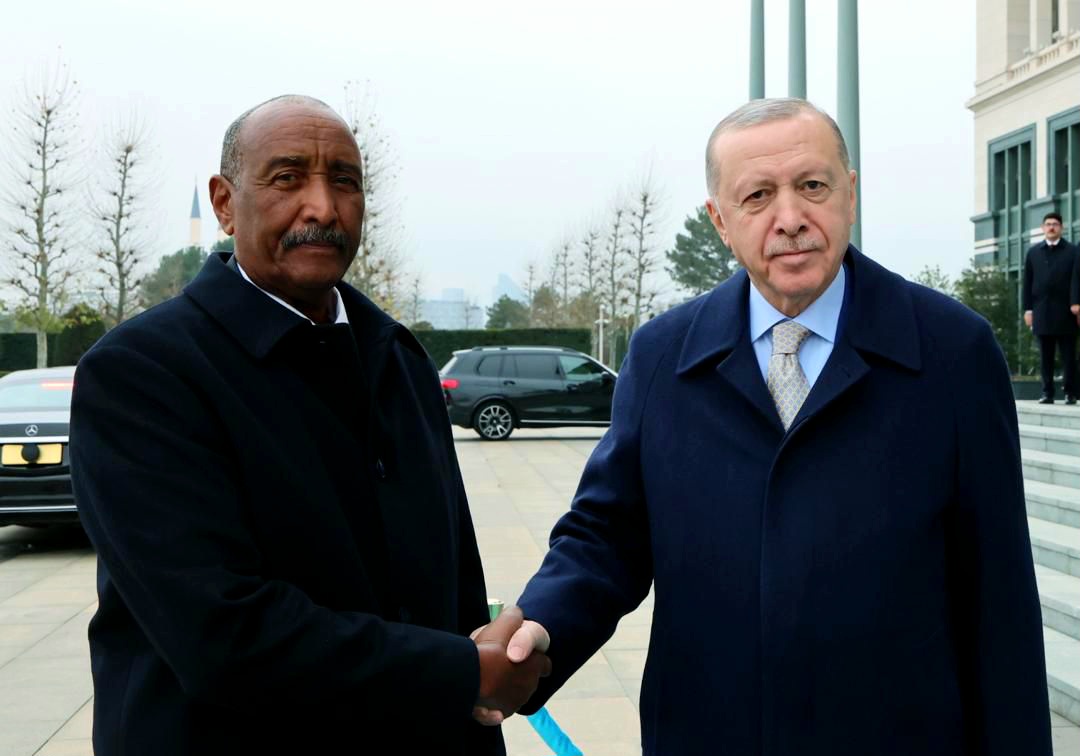
President Abdel Fattah al-Burhan’s visit to Turkiye, comes at a particularly sensitive juncture; It sends a clear message that Ankara is prepared to place its political and military weight behind Sudan’s internationally recognized government.
To that effect, President Erdogan’s public emphasis on strengthening cooperation in defense industries, underscores a cornerstone of Turkish support, particularly in light of Turkiye’s growing role as a reliable military partner through advanced drone technologies.
Beyond defense cooperation, Turkiye has expressed readiness to serve as a hub for training, capacity-building, and skills development.
Such approach heralds and fosters, long-term technical and operational linkages between the Sudanese Armed Forces and the Turkish defense ecosystem.
At the economic level, it is no secret that Turkish companies are seeking opportunities in gold and mineral exploration, as well as investment in Sudan’s vast agricultural lands—initiatives that align with Turkiye’s food security objectives while creating deeper economic interdependence between the two countries.
Amid an existential war imposed on the Sudanese people—with the involvement of regional and international actors—Sudan’s foreign engagements acquire heightened strategic significance.
Every high-level meeting and official image carries a political message that extends far beyond diplomatic courtesies.
These engagements form part of a wider battle over legitimacy and narrative framing.
Since the outbreak of hostilities, the Sudanese Armed Forces have not only confronted a militarily supported adversary, but have also faced a concerted effort to undermine their legitimacy through misleading narratives that attempt to portray the RSF militia as a parallel political actor.
It is within this very context that Burhan’s visit to Turkiye assumes particular importance: it represents in one hand, a clear attempt to dismantle the flawed “balance between two sides” narrative and to reaffirm that the Sudanese Armed Forces remain the sole national institution entrusted with defending the state, its people, and its constitutional order.
It also reinforces on the other hand, the legitimacy of the existing government, both sovereign and executive.
In parallel, Prime Minister Kamel Idris has been advancing a complementary diplomatic track, articulating Sudan’s position within the corridors of the United Nations Security Council and presenting a coherent vision for a comprehensive political solution grounded in state legitimacy.
With the same momentum that characterized Sudan’s engagements in Jeddah and Cairo, the response to President Erdogan’s invitation reflects Khartoum’s firm conviction that these capitals are central to shaping the final chapter of a war that has been prolonged by external interventions, many of which have fueled the conflict to serve narrow interests at the expense of Sudan’s stability.
Turkiye has consistently stood in support of Sudan’s legitimate state institutions and its national army, calling for firm action against those who threaten Sudan’s security, unity, and sovereignty.
Available indications suggest that extensive coordination preceded this visit, aimed at formulating a practical roadmap to end the war, building on agreed reference frameworks within the Saudi–Egyptian–American diplomatic track.
This aligns with Sudan’s aspirations to restore its security and sovereignty in a manner that contributes positively to regional stability.
The composition of the visiting delegation further underscores the importance Sudan attaches to logistical and defense support. After a prolonged and intense conflict, rebuilding and modernizing defense capabilities has become imperative—a legitimate sovereign right in both peace and wartime.
Equally significant, discussions addressed post-war planning, reconstruction challenges, and opportunities for international support.
In this regard, Turkiye, with its well-established expertise and proven record in reconstruction and development, emerges as one of the most credible partners for Sudan’s recovery phase.
Upon concluding the visit, General Burhan reiterated Sudan’s appreciation for Turkiye’s steadfast support of Sudan’s security and territorial integrity.
He also briefed the Turkish leadership on the latest developments and on the practical, comprehensive proposals put forward by Prime Minister Kamel Idris before the international community.
While only limited outcomes have thus far been made public, the deep historical ties and shared interests between Khartoum and Ankara provide a strong foundation for sustained engagement.
Last but not the least, there is growing optimism that Turkiye—alongside Saudi Arabia and Egypt—could form one vertex of a pragmatic triangular framework capable of contributing meaningfully to resolving the Sudanese crisis and restoring the Sudanese state.