The Embassy of Sudan in Djibouti Holds Briefing on Developments in Sudan’s War
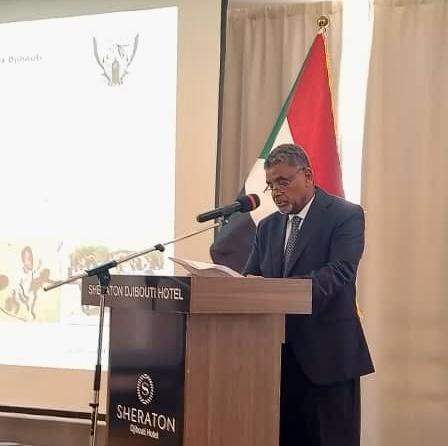
DJIBOUTI — On Thursday, April 24, 2025, the Sudanese Embassy in Djibouti convened a briefing for Djibouti’s diplomatic corps to outline the latest developments in the conflict raging across Sudan.
The session began with an overview of the campaign plan that the rebel Rapid Support Forces (RSF), backed by external support, had hoped to execute. Discussions then turned to the current military situation on the ground and the RSF’s widespread human‑rights abuses and atrocities, as well as the negative repercussions these violations have had on civilians and civilian infrastructure.
In his address, Ambassador Mohamed Saeed Hassan described the RSF’s April 2023 uprising as the gravest challenge Sudan has faced since independence. He warned that the rebellion threatened the very existence and unity of the Sudanese state, driven by foreign agendas seeking to fracture the country. “The primary objective of this revolt is to alter the identity of our state through demographic engineering and the systematic destruction of key production and service centers,” he said, noting that the militia has enlisted mercenaries and criminals from across Africa and beyond.
Ambassador Hassan asserted that the conflict would not have persisted without malign external interference, which continues to supply the RSF with weapons and matériel. He confirmed that Sudan has formally lodged a complaint against the United Arab Emirates—first with the UN Security Council and subsequently with the International Court of Justice.
Brigadier General Alaa Eldin Abdullah, the embassy’s military attaché, then detailed the Sudanese Armed Forces’ methodical campaign. He emphasized that operations were not rushed in order to minimize casualties. Following the transition from defensive to offensive operations, he reported substantial gains and significant losses inflicted on RSF forces. “Despite the RSF’s propaganda, the battlefield reality belies their claims,” he stated, pointing to their retreat from attacking military positions to focusing assaults on peaceful villages.
Regarding the siege of El Fasher, Brig. Gen. Abdullah noted that the Sixth Infantry Division continues to log daily successes, inflicting heavy material and personnel losses on the enemy. He stressed that it is the civilian population—not the army—that suffers most from the RSF’s blockade. He added that the Armed Forces, holding the initiative, are fully prepared to advance across El Fasher and wider Darfur, promising results that will satisfy all Sudanese, particularly the people of Darfur.
Counselor Omar Issam closed the briefing with an analysis of the RSF’s war‑driven fallout and its regional dangers. He revealed that the militia has distributed far more weapons than it needs, many of which have leaked into black markets and fallen into terrorist hands. He disclosed that the RSF has released over 19,000 inmates—including ISIS affiliates—and underscored Sudanese intelligence’s ongoing, high‑professionalism cooperation with allied services to track and neutralize extremist networks.
Counselor Issam also condemned the mercenaries recruited from West Africa along ethnic lines, some of whom are linked to terrorist groups, for perpetrating mass killings, rapes, looting, and widespread infrastructure sabotage. Discussing the current blockade of El Fasher, he explained that the RSF intends to forcibly displace residents—a tactic mirrored in Khartoum, Al‑Gezira, El Geneina, and, most recently, the Zamzam camp, where elderly, women, and children were all targeted and medical teams assassinated. He dismissed RSF claims that Zamzam was a military base, clarifying that the camp is home to non‑Arab (Fur and Zaghawa) communities, likening the atrocities there to those committed in El Geneina.