Mediation or Machination: Kenya’s Role in Sudan’s Proxy War
Beneath Kenya's public posture as a peace broker in Sudan lies a deeper architecture of entanglement that links narrative diplomacy with covert logistics and proxy warfare. This multi-part investigation traces how neutrality gave way to complicity, how mediation masked militarization, and how a regional actor once trusted with dialogue now stands accused of enabling war.
Part II: War by Other Means
The Testimony, the Gold Corridor, and the Cover-Up
What Kenya called diplomacy was, from the start, war in disguise.
By Sabah Al-Makki, Assistant Editor

What Kenya called diplomacy was, from the start, war in disguise. Part II unearths the architecture behind the façade: a covert axis linking Nairobi, Abu Dhabi, and the RSF militia, where gold funds warfare, protocol masks rebellion, and statecraft becomes a smokescreen for complicity. This is not a tale of misjudged diplomacy.
It is the blueprint of betrayal—engineered through laundered gold, forged invitations, and the ceremonial elevation of a militia leader into a statesman.
At the center: Former Deputy President of Kenya Rigathi Gachagua’s televised confession, naming President William Ruto not as a bystander but as the RSF’s silent commander. A secret 2020 flight to Sudan’s gold corridor—unlogged, unacknowledged, and unexplained. A red-carpet reception in Nairobi for a warlord already dissolved by republican decree and declared a rebel by Sudanese law. These are not allegations floating in the ether.
They are anchored in timelines, aircraft, financial transactions, and diplomatic choreography.
The evidence no longer whispers. It indicts. This is not the failure of diplomacy.
This is war by design—waged through proxies, financed by plunder, and protected by the veneer of state legitimacy.
It is war by other means—refined, repackaged, and sold as peace.
Part I : The Veil and the Vault revealed the crumbling façade of Kenya’s claimed neutrality in Sudan’s war. Beneath the choreography of summits and statements, Nairobi played host to a militia accused of ethnic cleansing—staging the Rapid Support Forces (RSF) so-called “Government of Peace and Unity” on Kenyan soil, even as it presented itself to the world as a regional mediator. What was framed as diplomacy was, in truth, the stage-managed legitimization of insurgency wrapped in the language of peace. But behind that performance lies a deeper reality—not one of miscalculation, but of design.
I. The Smoking Gun
Gachagua’s Testimony and the Triangle of Complicity
What was once inferred through circumstantial patterns is now being explicitly alleged from within Kenya’s political elite. In April 2025, former Deputy President Rigathi Gachagua delivered a direct and public indictment, accusing President William Ruto of orchestrating a transnational gold laundering scheme designed to finance Sudan’s Rapid Support Forces (RSF).
Gachagua outlined a structured mechanism: gold extracted from RSF-controlled zones was smuggled through Sudan’s western corridor, funneled through Kenya’s financial system, and re-exported, primarily to the United Arab Emirates (UAE). The proceeds, he alleged, were recycled back into RSF operations, sustaining arms procurement and battlefield logistics. Gachagua exposed a critical node in the supply chain of proxy warfare: if munitions were the smoke, the gold-fueled financial network was the furnace keeping the war burning.
Ruto Named as RSF Commander
Most incendiary was Mr. Gachagua’s portrayal of President William Ruto as the “real commander of the RSF”—not as a metaphor, but as an allegation of direct financial and logistical authorship. He claimed the operation began in 2023 when President Ruto instructed him to extend a diplomatic invitation to Mohamed Hamdan Dagalo (Hemedti), then Vice President of Sudan’s transitional Sovereign Council and RSF commander—the request exploited protocol norms, enabling President Ruto to act through his deputy.
Mr. Gachagua complied, received Hemedti in Nairobi, and delivered him to the president before being dismissed from the meeting. He later concluded that the engagement was purely commercial and had nothing to do with Kenya–Sudan politics or bilateral relations. When a second visit was proposed, Mr. Gachagua refused, citing RSF atrocities and international sanctions. He alleges that his signature was then forged to reissue the invitation. The visit was withdrawn only after a confrontation. Mr. Gachagua has since called for international sanctions—not against Hemedti, but against Ruto; Mr. Gachagua framed President Ruto as the RSF’s principal enabler—a threat to Kenya’s constitutional integrity and a symbol of how sovereign credibility had been subordinated to the imperatives of private capital and foreign influence.
U.S. Senate: Kenya Enabling Genocide Under the Guise of Diplomacy
On February 22, 2025, Senator Jim Risch, Chair of the U.S. Senate Foreign Relations Committee, issued a rare and forceful rebuke of Kenya’s conduct. Citing U.S. recognition of RSF-led atrocities in Sudan as genocide, Senator Risch condemned Kenya for aiding a militia under the guise of peacemaking, describing it as “an unthinkable attempt to obscure the truth.” He warned that such diplomacy would not halt the massacre—it would prolong it. The statement marked a significant escalation in international criticism, positioning Kenya not as a neutral facilitator but as a state actor complicit in the diplomatic normalization of a militia formally designated as genocidal.
Strategic Alignment: The UAE Loan and the Price of Facilitation
These revelations unfolded against a broader sequence of events. In February 2025, shortly after Kenya hosted the RSF’s self-declared “Government of Peace and Unity” in Nairobi, the UAE—publicly named by Kenyan Government Spokesperson Dr. Isaac Mwaura as the RSF’s principal sponsor—approved a $1.5 billion commercial loan to Kenya. Initially announced as a phased facility, the funds were later confirmed for immediate disbursement.
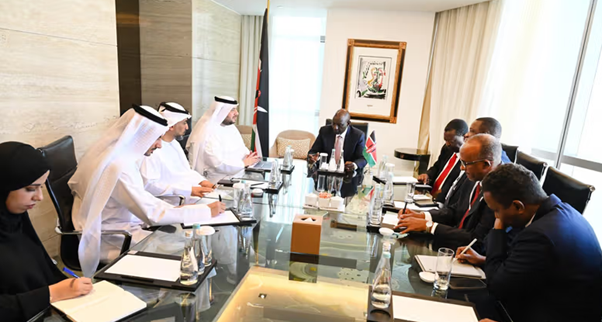
The sequence was precise: political facilitation followed by financial recompense.
From Facilitation to Conspiracy: Forgery, Finance, and Sovereign Breach
Supported by open-source financial records, contract data, and corroborated timelines, Mr. Gachagua’s account situates Kenya not as a passive observer but as a central axis in a trilateral structure: RSF militia operations, Emirati capital, and Kenyan facilitation.
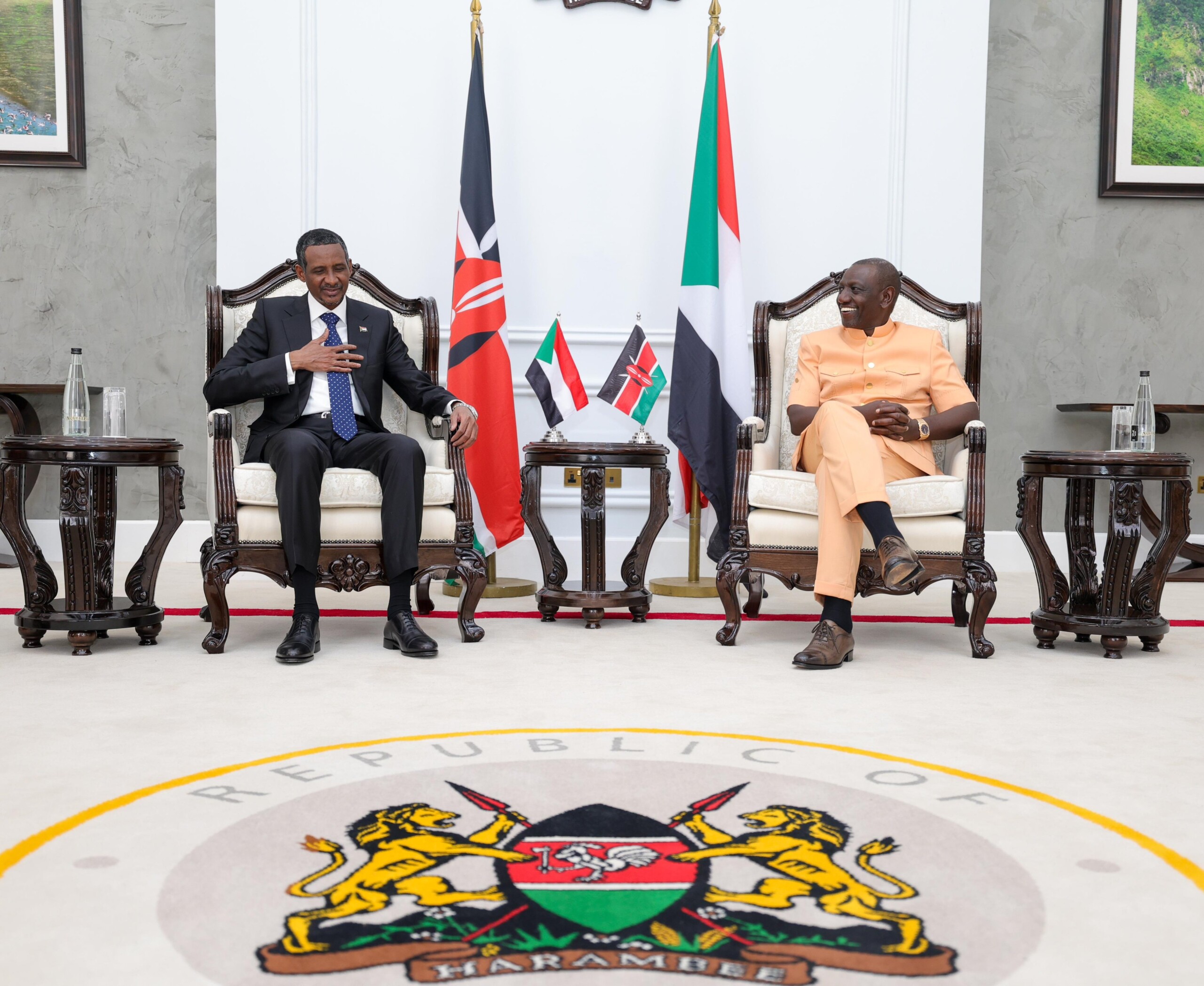
The charade reached its diplomatic crescendo in January 2024, when President William Ruto received the RSF militia commander Hemedti in Nairobi. Draped in ceremony, flanked by Kenya’s security detail, and standing before Sudan’s national flag, President Ruto elevated a designated militia leader—already dissolved by Sudanese republican decree and declared a rebel commander—to the stature of a political equal. What should have been a moment of condemnation became an act of rehabilitation. The symbol of Sudanese sovereignty was appropriated to dignify a man formally accused of war crimes and genocide—transforming diplomatic optics into political fiction.
The allegation that the forged signature of a sitting deputy president was used to grant diplomatic access to a sanctioned warlord transcends scandal—it appears, in retrospect, less like accusation and more like confirmation. For the enablers did not stop. They adapted, improvised, and ultimately succeeded in what the forgery had once attempted: laundering legitimacy. What was once unauthorized was later formalized. Nairobi’s reception of Hemedti in January 2024 was not an aberration—it was the culmination.
This was not a meeting—it was an anointment. And it crowned not peace, but impunity.
What emerges is not diplomacy but the anatomy of proxy warfare—veiled in the semantics of multilateralism and the language of mediation, yet rooted in extraction, patronage, complicity, and impunity.
II. The 2020 Sudan Excursion
Kenya’s Covert Diplomacy and the Genesis of a Proxy Axis
Before Nairobi assumed its role as a launchpad for RSF militia diplomacy—and well before rivers of laundered gold coursed through Kenyan banks—a quiet maneuver unfolded in early 2020 that revealed the embryonic architecture of a transnational proxy alliance. On January 14, 2020, then–Deputy President William Ruto undertook a clandestine visit to Sudan—an event omitted from all official records yet, in retrospect, laced with strategic consequence
A Flight Unlogged, A Mission Unspoken
Mr. Ruto departed Wilson Airport aboard a privately chartered jet (tail number 5Y-SIR), landing in Khartoum before being ferried via a Sudanese police aircraft to Atbara—a pivotal gateway to River Nile State’s disputed gold corridor. No public announcement was issued. No diplomatic communiqué was released. Kenya’s embassy in Khartoum received no advance notice—a conspicuous breach of protocol and a tacit admission that formal state architecture was being intentionally bypassed. It was only after independent journalists reconstructed the flight’s trajectory that the episode surfaced. Their findings confirmed Mr. Ruto’s presence in Abidiya, near goldfields such as al-Salam and Serbabr—territories that would later emerge as central nodes in the RSF’s shadow extractive economy.
Statecraft Abandoned: Military Intelligence as Interlocutor
The reception for the visit was coordinated not by Sudan’s transitional authorities but by the military-appointed governor of River Nile State—a procedural aberration that stripped the mission of any pretense of diplomatic legitimacy. This was not statecraft; it was covert alignment executed through military intelligence channels, principally the RSF, and deliberately insulated from institutional oversight.
Sudan’s so-called transitional government was already fractured and compromised at the time. Hemedti held the titles of Vice President of the Sovereign Council and commander of the RSF, while the civilian component functioned mainly as a façade—either acquiescing to RSF dominance or actively collaborating with it. One faction would later reconstitute as the RSF’s diplomatic front, formalized in the Nairobi summit of RSF militia proxies under foreign sponsorship; the other, now rebranded as “Sumud” under the resigned Prime Minister Abdalla Hamdok, survives in rhetoric alone—its political capital depleted, its silence on RSF militia atrocities deafening.
The structure of the visit—bypassing all national institutions not controlled by Hemedti—left no ambiguity: Mr. Ruto’s counterparts were embedded within the RSF’s militia infrastructure, not Sudan’s sovereign apparatus. While no definitive evidence confirms a face-to-face meeting with Hemedti, the convergence of events renders denial implausible. The visit coincided with a violent mutiny by Sudanese intelligence operatives that temporarily shut down Khartoum’s airspace, extending Mr. Ruto’s stay and granting his entourage unusual latitude within one of Sudan’s most militarized and gold-rich corridors.
Blueprint of a Criminal Convergence
What was publicly dismissed as a routine regional visit now appears, in retrospect, as the genesis of a criminal-political architecture—the first stitch in a transnational tapestry of clandestine finance, illicit extraction, and paramilitary sponsorship.
The destinations, silence, and terrain all aligned with RSF’s interests. What emerged was not diplomacy but the early scaffolding of a tripartite apparatus: RSF-controlled mines, Kenyan logistical platforms, and Emirati refineries. A corridor of capital and complicity was quietly charted across borders, shielded by sovereign immunity.
Unmarked Cargo: Allegations of Covert Extraction
Allegations soon surfaced that the mission entailed more than discreet diplomacy. Multiple Sudanese media outlets reported that boxes of bullion or cash were discreetly loaded onto Mr. Ruto’s aircraft during the unsupervised stop in River Nile State. Though never formally investigated, neither the government challenged nor refuted the claims.
Aviation and government sources highlighted two procedural anomalies:
- Absence of customs clearance for the return leg;
- Missing cargo documentation.
The aircraft’s direct access to unsecured gold zones deepened suspicion that Sudan’s informal gold economy was being siphoned and exported under diplomatic pretenses.
Sudanow, on February 2, 2020,succinctly stated that the local press reported that the jet may have carried boxes of bullion or cash back to Nairobi. Yet, no inquiry was launched, and no audit was initiated. The institutional silence was deafening.
Mr. Osama Daoud Abdellatif, chairman of DAL Group, Sudan’s most prominent private conglomerate, was named among those. Media reports alleged he may have facilitated logistical aspects of the visit. Mr. Abdellatif issued an immediate and categorical denial, branding the allegations entirely baseless.
An Episode Suspended Between Secrecy and Signal
Despite denials, the episode’s opaque contours—vanished flight logs, bypassed diplomatic protocols, and the absence of formal inquiry—have left it suspended in a liminal space between secrecy and signal: neither fully confirmed conspiracy nor casually dismissible coincidence.
Even without hard evidence of bullion aboard, the mission’s coordinates—its timing, terrain, and deliberate concealment—defy the hallmarks of statecraft. What unfolded was not a diplomatic visit but the foundational act of a covert alliance—its architecture later rendered visible inflows of gold, arms, and war.
Conclusion
The Illusion of Mediation, the Anatomy of Betrayal
What Kenya paraded as diplomacy was, in truth, the scaffolding of a proxy war. Through covert flights, forged invitations, financial incentives, and alliances veiled in protocol, Nairobi did not mediate—it maneuvered. The evidence is no longer circumstantial: President Ruto’s unlogged mission to Sudan’s gold corridor, the RSF’s red-carpet reception in Nairobi, the UAE’s billion-dollar reward, and Mr. Gachagua’s public reckoning all converge on a single point of rupture.
This was not peacebuilding. It was political laundering—where mediation became misdirection, and diplomacy became cover for complicity. A choreography of statecraft was performed to mask a choreography of extraction.
Beneath every forged document and unspoken deal, a new doctrine emerged: that sovereignty can shield impunity, and neutrality can be weaponized. Kenya did not blur the line between facilitation and conspiracy—it redrew it.
What began as diplomacy now stands as design. And behind the veil of peace, the architecture of betrayal reveals its true shape.
Prelude to Part III
The Trial That Never Was
Before the gold and the guns, there was a case.
Before the summit halls and secret flights, there was a courtroom.
And at its center—one man.
Before Nairobi became a launchpad for rebellion, there was another stage—one draped not in applause, but in ashes. Kiambaa was the opening act. The Hague was meant to be the reckoning.
Part III traces the genesis and making of the man whom Mr. Rigathi Gachagua would later describe as “the real commander of the RSF.” Long before Sudan’s war ignited, he stood accused—not in whispers, but in court—of orchestrating mass violence in Kenya’s heartland. But that case did not collapse under doubt. It was dismantled with surgical precision.
It was not innocence that saved him—it was choreography.
Witnesses vanished. Statements flipped.
And the courtroom became a stage not for justice, but for its burial.
He walked free. The evidence did not.
Part III doesn’t reopen the file.
It follows the smoke that still rises from it.
What was buried in The Hague did not disappear.
It metastasized—changing names, currencies, and continents.
And somewhere between Kiambaa and Khartoum, the blueprint was written—an architecture of impunity.
🔎 New to this Series?
Mediation or Machination: Kenya’s Role in Sudan’s Proxy War
👉Part I – The Veil and the Vault
Kenya’s Dual Role in Sudan’s Proxy War—From Diplomatic Mask to Material Complicity
A diplomatic façade begins to crack. What appears as mediation reveals a deeper entanglement: covert alliances, foreign sponsorship, and Kenya’s silent complicity in laundering rebellion.
👉Part III – The Trial That Was Never
The ICC Didn’t Acquit—It Quietly Capitulated
As the courtroom emptied and witnesses vanished, justice was not denied—it was rewritten. The case against Ruto didn’t fail. It was dismantled. This is not a verdict. It’s a doctrine.
👉 Part IV – Laundering Power
The Kenya–RSF–UAE Triangle: Gold, Guns, and GeopoliticsFrom gold bars to ballot boxes, mediation tables to military corridors—this is how war spoils became currency in the marketplace of diplomacy. What began as covert financing morphed into regional realignment. The RSF supplied the force, Ruto provided legitimacy, and Abu Dhabi bankrolled the operation.
This is no longer war by other means.
This is laundering power.
About the Author
Sabah Al-Makki is a Sudanese writer and Assistant Editor at Brown Land News. Her work explores political violence, international law, cultural resistance, and social awareness through the lens of Sudan’s unfolding realities. She challenges dominant narratives by centering the voices of Sudanese citizens—both within the country and across the diaspora—whose perspectives are often excluded from global discourse.
Her writing interrogates the definitions of war, peace, and justice, insisting that true change begins with dismantling colonial paradigms. Sabah confronts the structures that sustain conflict, silence, and imposed transitions through cultural, cognitive, and philosophical resistance.
She writes from within the storm.
Exclusively published by Brown Land News.
Where sovereignty is not negotiable, and truth defies revision.
𝐎𝐮𝐫 𝐋𝐚𝐧𝐝. 𝐎𝐮𝐫 𝐕𝐨𝐢𝐜𝐞. 𝐎𝐮𝐫 𝐍𝐞𝐰𝐬.