Sudan’s “Government of Hope”
From Vision to Framework: Interpreting the Architecture of a Reimagined State
In a moment of sovereign reorientation — or more precisely, recalibration — Sudan’s newly appointed Prime Minister Dr. Kamil El-Tayeb Idris Abdelhafiz sets forth not yet a blueprint, but a conceptual framework: one that seeks to reanchor authority in civic ethics, institutional dignity, and national coherence. This article reads the speech as a participatory overture to legitimacy, not only in what it promises, but in how it invites co-authorship of Sudan’s emergent political architecture.
By Sabah Al-Makki, Assitant Editor

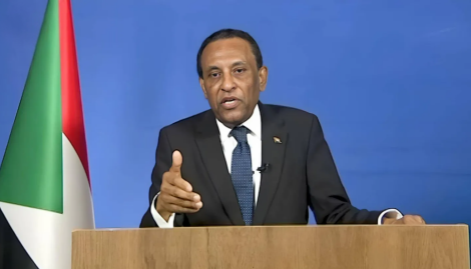
In an inaugural address delivered amid the crucible of war and the institutional disarray of a nation searching for equilibrium, Sudan’s Prime Minister Dr. Kamil Idris delivered a speech of notable symbolic weight, introducing what has come to be called the “Government of Hope.” Far from a perfunctory outline of executive formation, the address positioned itself as a normative intervention: a proposition to reimagine governance not as the administration of crisis but as a project grounded in principle, civic merit, and inclusive national consciousness.
Measured in tone yet ambitious in scope, the speech did not claim to resolve complexity but to name it — and frame its response. What emerged was less a finished architecture than a conceptual scaffold: a blueprint that articulates purpose defines ethical boundaries, and deliberately leaves space for institutional maturation, civic participation, and the disciplined labor of state reconstitution still ahead.
Reclaiming the State Through Ethical Governance
Threaded through the Prime Minister’s address is a discernible ambition not merely to govern differently but to reconceive the moral contract between state and citizen. This is not a technocratic adjustment but a normative recalibration — a conscious effort to shift the foundations of authority from factional allegiance to ethical legitimacy. It offers the contours of a new civic compact in Sudanese governance.
The envisioned government is cast not as an extension of partisan will but as a moral institution whose authority derives from its fidelity to principles: honesty, justice, transparency, tolerance, and competence. These are not ornamental values; they are offered as the organizing grammar of a renewed political lexicon — one capable of resisting the corrosive effects of transactionalism that, for decades, have emptied Sudanese governance of public meaning.
Most striking is the speech’s decisive rupture with identity-based politics. In a polity historically disfigured by sectarian fragmentation, regional asymmetries, and the instrumentalization of belonging, the assertion that citizenship alone constitutes the basis of political participation is not merely inclusive — but also foundational. It signals a reconstitution of the state itself: from a contested zone of appropriation to a shared civic domain anchored in the national consciousness. By decoupling authority from inherited identities and re-rooting it in universal belonging, the speech does not merely describe a government — it sketches the early contours of a republican project: one in which sovereignty is not claimed by force or faction but entrusted through moral clarity and civic dignity.
Technocracy with a Civic Mandate: Structuring Governance as a Strategy
The proposed governmental configuration comprising twenty-two ministerial portfolios reflects comprehensive ambition and methodical intent. Ministries such as Digital Transformation, Energy Transition, Environmental Sustainability, and Strategic Planning signal a deliberate pivot toward anticipatory governance: a vision that seeks to embed Sudan’s post-war trajectory within a developmental arc attuned to global imperatives and national potential. Anticipatory governance is a forward-looking approach that anticipates and plans for future challenges and opportunities rather than reacting to them as they arise.
In parallel, ministries dedicated to Justice, Religious Affairs, and Social Protection suggest an ethical orientation that recognizes that legitimacy in a fractured polity must be restored not only through institutional architecture but also through social repair. These ministries are designed to uphold and promote ethical values such as justice, compassion, and social equality, thereby contributing to the restoration of trust and the reintegration of marginalized communities.
The proposed creation of new institutional scaffolds, including an Integrity and Transparency Authority and a National Council for Strategic Planning, illustrates a growing consciousness that governance must be codified in durable systems, not personal charisma. These initiatives are designed to institutionalize principles of integrity, transparency, and strategic planning in Sudan’s governance, ensuring that these values are upheld regardless of leadership or political climate changes.
Of particular note is the Prime Minister’s open invitation to independent Sudanese professionals — regardless of party affiliation, regional provenance, or identity markers — to contribute their expertise to the national project. If institutionalized with procedural transparency and normative consistency, this inclusive approach could mark a paradigmatic shift from a system long animated by patronage networks to one rooted in public service competence. More than a policy gesture, it may well constitute the embryonic stage of a new civic contract — one in which state authority is not re-centralized but re-legitimized through merit, inclusion, and institutional dignity.
Framework, Not Fulfilment: The Need for Ongoing Elaboration and Civic Engagement
For all its moral coherence and institutional aspiration, the Government of Hope remains — as it must, at this historical juncture — a framework rather than a fully realized edifice. It offers a vision shaped by ethical clarity and inclusive nationalism yet leaves key procedural and structural components open to civic co-authorship, institutional development, and adaptive refinement.
Foremost among these is the absence of a temporal architecture. In a post-conflict context where legitimacy is calibrated by intention and pace, the lack of delineated short-, medium-, and long-term milestones introduces ambiguity. Likewise, while the speech foregrounds meritocracy, the operational modalities of ministerial selection, vetting, and oversight remain unspecified — a silence that invites public engagement rather than precludes it.
While signaling completeness, the breadth of the ministerial map risks diluting strategic focus at a time when institutional capacity is limited and national attention is overburdened. In moments of sovereign reconstruction, discernment becomes necessary: not all urgencies can be addressed at once, and triage is not a failure of will but an expression of prudence.
Equally, a set of foundational domains — not peripheral but constitutive of any post-war constitutional order — remains only partially articulated: transitional justice, civil-military equilibrium, resource governance, internal reconciliation, and foreign alignment. The emphasis on national security was apt and timely. Yet the contours of the civil-military interface — especially when the armed forces are engaged in existential defense — will require clarification, not as a challenge to military efficacy, but as a commitment to constitutional coherence. Sovereignty must be institutionally distributed, not indefinitely suspended.
Similarly, while the commitment to diplomatic openness was clear, Sudan’s geostrategic positioning—nested within intersecting regional ambitions and global normative agendas—demands more than a gesture. In such a context, diplomacy is not an abstraction but a strategy that secures sovereignty, restores agency, and repositions Sudan’s external relations on nationally authored and historically informed terms.
In this light, the speech was not an end but a proposition—a preamble to an architecture whose legitimacy will depend not merely on what it promises but also on how it evolves.
The Next Imperative: From Declaration to Institution
Foundational speeches serve as acts of orientation: they signal direction, articulate values, and name priorities. They are not, nor are they expected to be implementation instruments. Yet, in post-conflict environments, where time is compressed and expectations are heightened, the interval between vision and action cannot be left undefined.
The Government of Hope now demands a second movement—not repetition but elaboration. What is required is a formal articulation: a governing charter or white paper that translates normative intent into procedural architecture and maps the path from declarative ethics to executable design.
Ideally coordinated by the Prime Minister’s office or a transitional planning body, such a document would not replicate the speech but scaffold it, anchoring its principles in timelines, benchmarks, and public-facing accountability.
Among its key elements:
- A 100-day priority matrix aligned with post-war exigencies;
- Ministerial performance indicators, calibrated to fiscal and logistical constraints;
- A transparency mechanism for appointment and oversight to institutionalize trust;
- And a transitional justice pathway — not as retrospective adjudication alone but as a forward-looking civic compact with communities fractured by displacement, violence, and erasure.
Absent these instruments, even the most compelling vision risks becoming ephemeral. In fragile orders, it is not rhetoric but institutional intelligibility that sustains legitimacy.
Conclusion: A Constitutional Moment in Suspension
The Prime Minister’s declaration is not a terminus but a threshold. It is an inaugural overture that seeks to recalibrate the grammar of Sudanese governance around the ethics of public trust, the architecture of civic inclusion, and the discipline of principled statecraft. It signals, deliberately rather than hastily, toward a rupture with the patronage economies and factional logics that have long eroded the coherence of state authority. In its restraint lies its ambition: the substitution of expedience with integrity.
Yet, for all its symbolic force, the speech remains a prelude needing praxis. Its authority will not rest on eloquence alone but on the emergence of a constitutional syntax capable of rendering moral aspiration into operational form. What is now required is not extension but crystallization — a second articulation that codifies processes, delineates timelines, and defines the sovereign parameters of a post-war republic.
In the most profound sense, this is a constitutional moment held in suspension — not yet realized, but charged with generative potential. It demands not mere endorsement but activation. The Government of Hope must be anchored in technocratic rigor, participatory scaffolding, and strategic coherence, rendering governance legible, accountable, and co-authored.
It must also be accompanied — though never dictated — by international interlocutors who understand that sovereignty is not transactional but compositional: built, layer by layer, by those committed to the authorship of a national future.
In this light, the speech is not simply an invitation to govern. It is a call to constitute — to move beyond the gravitational pull of managed crisis and toward the sovereign authorship of Sudan’s political becoming.
About the Author
Sabah Al-Makki is a Sudanese writer and Assistant Editor at Brown Land News. Her work explores political violence, international law, cultural resistance, and social awareness through the lens of Sudan’s unfolding realities. She challenges dominant narratives by centering the voices of Sudanese citizens—both within the country and across the diaspora—whose perspectives are often excluded from global discourse.
Her writing interrogates the definitions of war, peace, and justice, insisting that true change begins with dismantling colonial paradigms. Sabah confronts the structures that sustain conflict, silence, and imposed transitions through cultural, cognitive, and philosophical resistance.
She writes from within the storm.
Exclusively published by Brown Land News.
Where sovereignty is not negotiable, and truth defies revision.
Our Land. Our Voice. Our News