El-Fasher Besieged: 400+ Days of Starvation — Gaza 2.0 Under the UAE’s Proxy War in Darfur
Under a year-long siege by a UAE-armed militia, El-Fasher is bombarded, starved, and encircled — yet in August it repelled the ferocious Attack No. 227, launched with 543 combat vehicles. For more than 400 days, the last government-held stronghold in Darfur has withstood famine, bombardment, and annihilation in a war sustained by foreign sponsors and ignored by the world.
By:Sabah Al-Makki

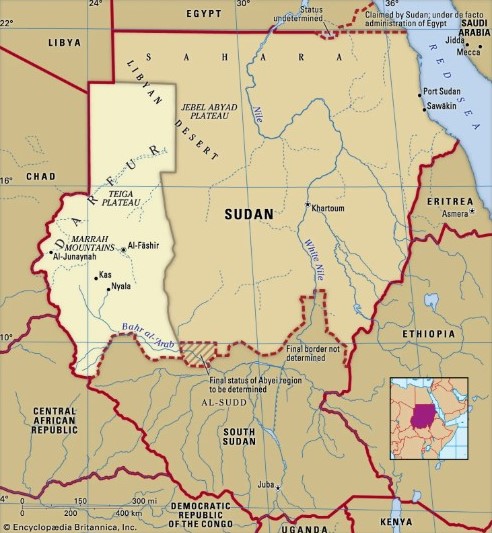
For over a year, El-Fasher has been bombarded, starved, and cut off — the most visible front in a United Arab Emirates (UAE) backed proxy war to dismantle Sudan. Armed with foreign-supplied weaponry, drones, and mercenaries, the Rapid Support Forces (RSF) militia has turned famine, massacres, and the targeting of hospitals into deliberate weapons of war. On August 11, 2025, the city repelled Attack No. 227 — the most ferocious assault since the siege began, with 543 combat vehicles thrown against its defenses. This battle underscored both the scale of foreign-backed aggression and the steadfast resistance of its defenders. El-Fasher is not the stage of a “civil conflict” but Gaza 2.0 in Africa — the Leningrad of Defiance, a blueprint for modern sieges where global silence serves as a green light for the next atrocity.
Background: Sudan’s War – A Militia Rebellion Against the State and Its People
Sudan’s current war erupted on April 15, 2023, when the RSF — the direct heirs of the Janjaweed militias responsible for the Darfur atrocities of the 2000s — launched a coordinated, premeditated coup against the Sudanese state. This was not a battle between rival security forces, but an armed rebellion aimed at toppling the constitutional order and dismantling Sudan’s sovereign institutions.
At the heart of the RSF’s offensive was an assault on the Sudanese Armed Forces (SAF) — the nation’s institutional, constitutional military entrusted with defending Sudan’s sovereignty, territorial integrity, and people. The rebellion’s objectives were clear: seize the political and economic centres of power, cripple the state’s defensive capacity, and subjugate the Sudanese population to militia rule.
From its opening hours, the RSF militia targeted cities, hospitals, markets, and humanitarian depots — committing mass killings, systematic sexual violence, and large-scale looting. In Darfur, the tactics mirrored the ethnic cleansing campaigns of two decades earlier, marking a continuation rather than a departure from the RSF’s origins. Foreign sponsorship transformed what might have been a short-lived mutiny into a sustained war of annihilation. Multiple UN and NGO reports accuse the UAE of funnelling arms, drones, mercenaries, and cash to the RSF via Chad and Libya, in direct violation of the Darfur arms embargo. This infusion of external resources turned a regional militia into a heavily armed transnational proxy force — making the conflict not a Sudanese civil war, but a foreign-directed assault on the Sudanese state and its citizens
Introduction: A Siege Built, Not Born
For more than 400 days, El-Fasher — the last government-held city in Darfur — has been encircled, bombarded, and starved in a calculated effort to break Sudan’s national resistance. This is not the chaotic fallout of political infighting; it is the most visible front of a foreign-backed coup designed to dismantle the Sudanese state from within.
The RSF enforces the siege, now reconstituted as a UAE-supplied proxy army. Abu Dhabi’s logistical airbridge, mercenary deployments, and diplomatic shielding have enabled the militia to sever the city’s lifelines and prolong its stranglehold.
Once a thriving hub of trade, culture, and governance, El-Fasher has been reduced to an open-air prison. Roads are sealed, supply lines severed, and humanitarian corridors deliberately blocked.
No food. No medicine. No escape.
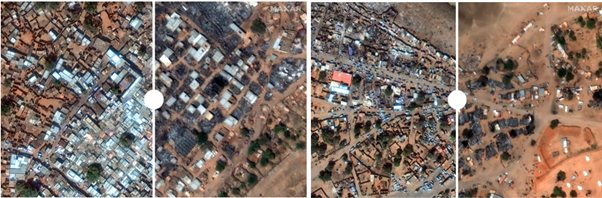
Since April 2024, the siege has reached catastrophic proportions: at least 782 civilians killed, more than 1,100 wounded, and thousands more buried in unmarked graves. In the Zamzam and Abu Shouk displacement camps, families survive on animal fodder as famine and disease claim lives daily. Following the RSF’s recent assault and seizure of Zamzam camp, more than 400,000 people have been newly displaced — compounding one of the most significant humanitarian disasters in Darfur’s history.
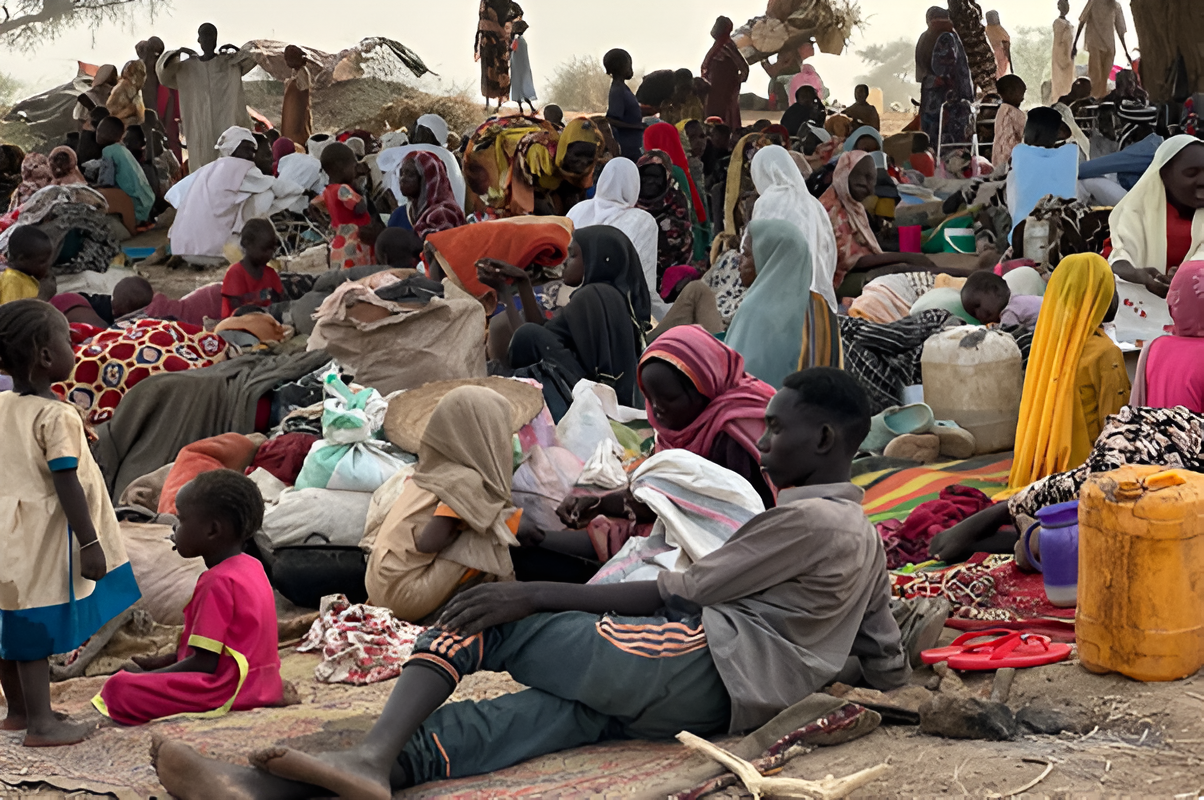
Yet, in the rhetoric of Western capitals and African Union (AU) communiqués, this atrocity remains reduced to “Sudan’s civil war” — a diplomatic distortion that erases the fact that El-Fasher is not the site of a domestic feud, but the target of a foreign-orchestrated campaign to destroy Sudan’s sovereignty. A deliberate distortion that shields the sponsors of the siege from accountability.
The UAE’s Role: Arming, Funding, and Shielding a Siege
This is not the turbulence of an internal feud allowed to spiral; it is a meticulously engineered foreign intervention — executed through a proxy militia and sustained by a covert yet exhaustively documented international supply chain. The evidence is substantive, consistent, and corroborated across multiple independent investigations, including, but not limited to:
- Aerial supply corridors and arms embargo violations : The UN Security Council Panel of Experts (S/2024/65, para 41–49) records credible evidence of weapons transfers from Abu Dhabi to RSF militia via Amdjarass in Chad and through Libya — in direct contravention of the Darfur arms embargo.
- Visual confirmation from operational hubs: Reuters-reviewed footage from Amdjarass depicts pallets of khaki munitions crates, some marked with UAE flags, being unloaded for RSF militia deployment.
- Forensic weapons tracing: Amnesty International’s analysis identifies advanced Chinese-manufactured weaponry, re-exported by the UAE, recovered from RSFmilitia positions in Khartoum and later redeployed in Darfur — incontrovertible proof of embargo breaches.
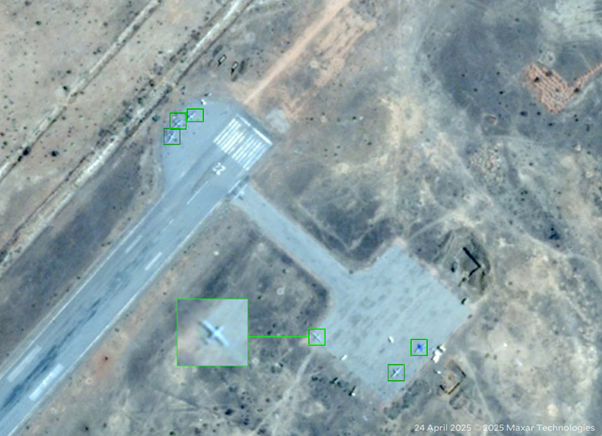
- Unmanned aerial systems and satellite-tracked routes: Satellite intelligence confirms the operation of advanced military drones along logistical pathways tied directly to UAE channels.
- Corroborated records of atrocities : The United Nations, Al Jazeera, The Guardian, and the Global Centre for the Responsibility to Protect have documented RSF militia perpetrated mass executions, assaults on displacement camps, and the deliberate targeting of medical infrastructure. The New York Times further reported that the UAE has exploited the UAE Red Crescent — a humanitarian front — to covertly channel weapons to the RSF militia, blurring the line between relief operations and the machinery of war.
- Deployment of foreign mercenaries: France 24 revealed the presence of Colombian mercenaries — contracted via UAE-linked entities — embedded within RSF militia formations in Zamzam camp, where they have fortified positions and overseen the training of child soldiers.
- Diversion of European armaments: France 24’s investigative work traces the procurement of European munitions by UAE-linked intermediaries, which were subsequently diverted to RSFmilitia control in violation of international transfer agreements.
El-Fasher Under Siege: Anatomy of a Manufactured Famine
El-Fasher — Sudan’s last government-held stronghold in Darfur — has been subjected to an unrelenting siege that has tightened steadily through 2024 and into 2025. Classified at IPC Phase 5 — the most severe famine designation — the city now stands on the brink of total humanitarian collapse.
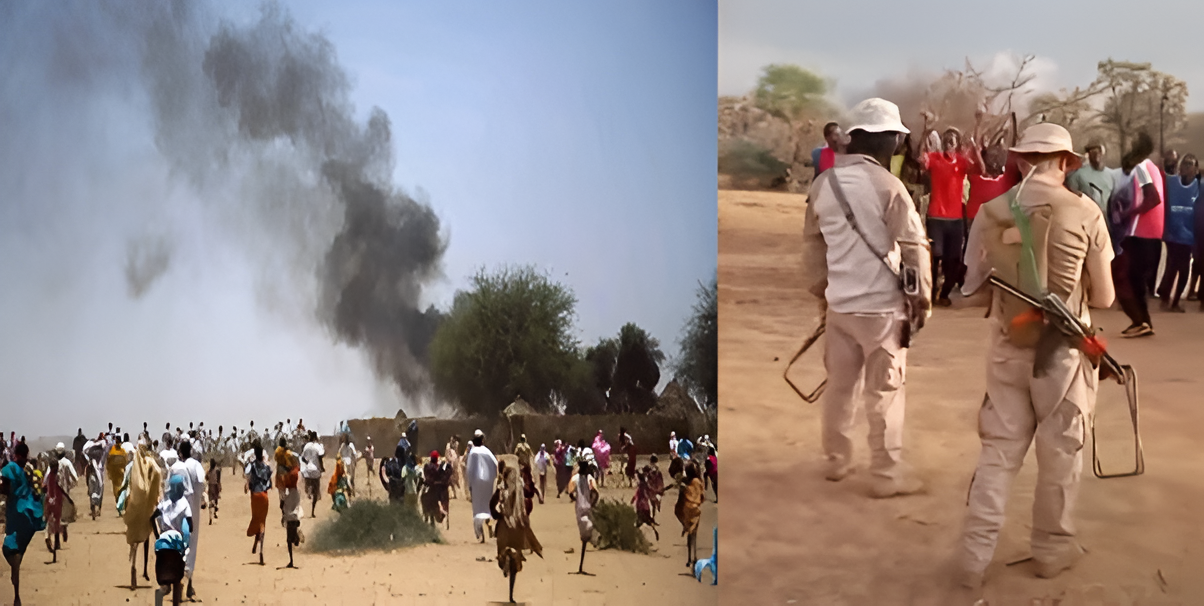
The RSF’s siege tactics are deliberate and methodical: sealing every road, obstructing aid convoys, launching precision drone strikes, and targeting healthcare facilities and displacement camps. Food, medicine, and electricity are virtually non-existent. More than 825,000 children are trapped; displacement camps have become killing grounds; residents survive on animal fodder while critical infrastructure lies in ruins. On January 24–25, 2025, a drone strike obliterated the Saudi Maternal Teaching Hospital, killing approximately seventy people — an attack condemned by the United Nations and the World Health Organization.
Even humanitarian corridors have been transformed into killing zones. In one such instance, the RSF militia ambushed the UN-escorted aid convoy near Al-Koma, leaving five dead and many more wounded. In the aftermath, cholera and other preventable diseases spread unchecked, compounding the toll on an already starving and besieged population.
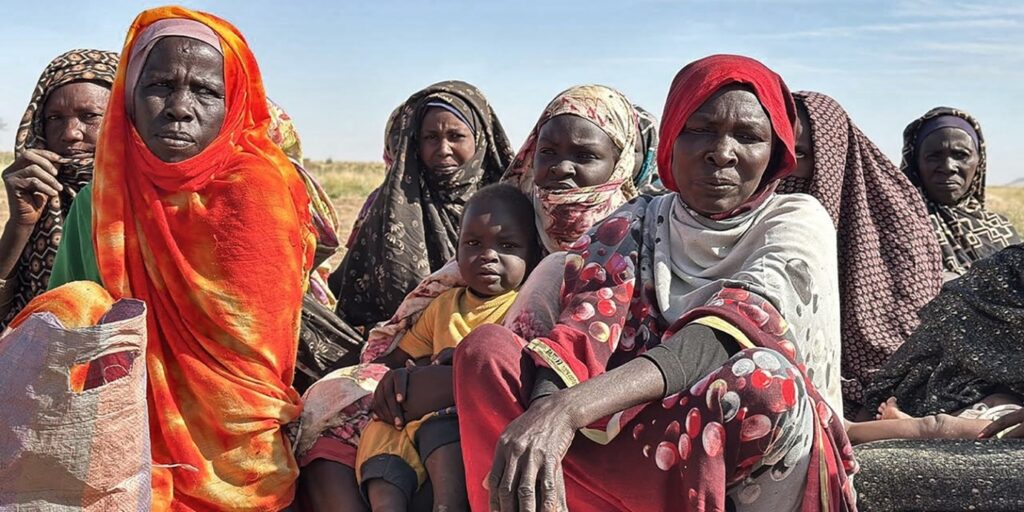
Massacres of staggering brutality have punctuated the siege. Between April 11 and 13, 2025, the Zamzam displacement camp was transformed into a killing ground, with estimates of 1,500 to 2,000 civilians slaughtered. Satellite imagery confirms the burn patterns left by the attack.
On August 11, 2025, the Abu Shouk displacement camp and the city of El-Fasher came under Attack No. 227 and counting— the most ferocious assault since the siege began. The RSF militia deployed approximately 543 combat vehicles, many of which were assembled weeks earlier in Zamzam Camp, a facility the militia had seized and converted into a fortified base. Despite the scale of the offensive, El-Fasher’s defenders repelled the assault, inflicting heavy losses: over 200 RSF fighters killed, 16 combat vehicles destroyed, and more than 30 captured intact.
Abu Shouk camp, caught in the crossfire, suffered devastating civilian casualties, with at least forty people killed and dozens wounded under sustained heavy fire. This failed offensive not only underscored El-Fasher’s steadfast resistance but also exposed the sheer magnitude of foreign-backed military resources sustaining the siege.
The conflict has also drawn in foreign fighters. In Nyala, capital of South Darfur, on August 6–7, 2025, a Sudanese airstrike killed multiple Colombian mercenaries and destroyed a suspected Emirati aircraft. In Zamzam, Spanish-speaking combatants — believed to be Colombian — remain embedded, with credible reports of minors being trained for combat.
Gaza 2.0: The African Parallel in Real Time
Calling El-Fasher “Gaza 2.0” is not hyperbole — it is a warning. The parallels are precise and chilling:
- Total blockade of aid and trade, severing every artery of survival.
- A civilian population trapped without safe passage, forced to choose between death under siege or the lethal risk of crossing sniper fire and minefields.
- Hospitals reduced to rubble, destroyed in deliberate defiance of international humanitarian law.
- Starvation and disease were weaponised and deployed as instruments of war to fracture the resilience of an entire population.
The difference lies not in the scale of suffering, but in the scale of visibility. Gaza commands daily headlines, emergency UN debates, and interventions from global powers. El-Fasher is left to die in the shadows — a genocide in slow motion, unfolding on a continent too often ignored until the graves are already full.
The lesson is stark: what is tolerated in El-Fasher will be repeated elsewhere. Silence here is not neutrality; it is a signal to every aspiring warlord and foreign patron that sieges, famines, and massacres can be executed with impunity.
Weaponising Famine, Erasing Witnesses
The famine in El-Fasher is not collateral damage; it is a weapon wielded with precision. Every supply route is sealed. Bakeries and clinics are shuttered. Aid convoys are attacked. Cholera spreads unchecked through a population already weakened by hunger.
An almost total information blackout exacerbates this humanitarian catastrophe. At least nine journalists have been killed since the war began. 90% of Sudan’s media infrastructure has been destroyed, and fewer than seventy journalists are still operating in conflict zones like Darfur.
Coverage disparity is staggering. On 20 March 2025, one media snapshot found:
- “Ukraine war” — 80 articles
- “Gaza war” — 57
- “Sudan war” — 23
What determines whose suffering the world sees — and whose it erases?
This silence is not accidental. It is structural — maintained by denial of access, intimidation of journalists, and a geopolitical reluctance to confront the financiers and architects of the siege.
A Call to Action: Confront the Perpetrators, Not the Symptoms
- Name the aggressor.
The African Union (AU) and the United Nations must state unequivocally: the Rapid Support Forces (RSF) are responsible for the siege of El-Fasher, the deliberate starvation of civilians, and systematic attacks on non-combatants and protected facilities. - Designate the RSF.
Formally classify the RSF under national and multilateral counterterrorism and violent extremism frameworks. Such a designation must criminalise its financing, recruitment, logistics, and propaganda networks, enabling targeted prosecutions and sanctions. - Name the sponsor.
Issue formal, public findings on the United Arab Emirates’ material support to the RSF — encompassing the provision of arms, drones, mercenaries, and financial flows. The United Kingdom, as the UN Security Council penholder for Sudan, Yemen, and Libya — three states destabilised by UAE-backed wars — must cease obstructing Sudan’s ability to present its case against the UAE. Continued British shielding of Abu Dhabi at the Council not only undermines accountability but also entrenches impunity for cross-border aggression. - Sanction the network.
Impose targeted sanctions not only on the RSF but on the carriers, brokers, UAV and dual-use technology suppliers, and conflict-gold traders sustaining its operations. Apply secondary sanctions to foreign enablers that maintain the UAE–RSF airbridge in defiance of international law. - End diplomatic shielding.
Confront and hold accountable the UAE — and other African states identified in UN reports — for enabling mass atrocities in Sudan. Abandon the practice of protecting these actors behind closed-door diplomacy and euphemistic language. - Correct the narrative.
End the false equivalence between Sudan’s constitutionally mandated national army (SAF) and a foreign-sponsored militia. Precision in language is not rhetorical — it determines the effectiveness of sanctions, interdictions, and legal designations.
To the AU: Stand With the Sudan.
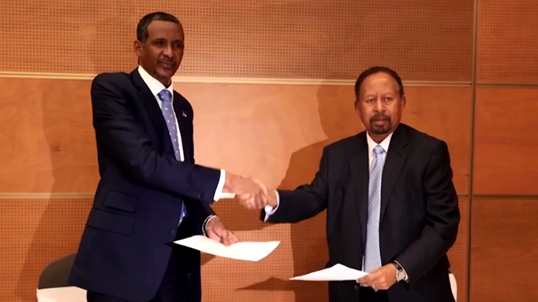
Retire the obsolete “October 2022 coup” framing — now a political tool to disguise a foreign-backed war and absolve its sponsors. Name the siege and its architects: the RSF as the besieging militia, and the UAE as its principal supplier. Reject narrative laundering by political fronts or public figures — including Abdalla Hamdok the resigned PM of Sudan, resident in the UAE — whose January 2, 2024 Addis Ababa Declaration with the RSF remains unrescinded and devoid of any explicit condemnation of its atrocities, and and whose recent international appearances — including in South Africa, where he dismissed mounting evidence of UAE involvement — are widely perceived in Sudan as granting diplomatic cover to Abu Dhabi’s complicity and the crimes of the RSF militia.
El-Fasher’s fate is not just Sudan’s test — it is a test of whether the international system will confront a modern siege sustained by a wealthy foreign sponsor or allow it to become the blueprint for the next war of annihilation.
About the Author
Sabah Al-Makki is a Sudanese writer and Assistant Editor at Brown Land News. Her work examines geopolitics, political violence, international law, cultural resistance, and social awareness through the lens of Sudan’s unfolding realities.
Sabah challenges dominant narratives by centering the voices of Sudanese citizens — both inside the country and across the diaspora — whose perspectives are often excluded from global discourse. Her writing interrogates the meaning of war, peace, and justice, insisting that true change begins with dismantling colonial paradigms.
Approaching journalism as a form of cultural, cognitive, and philosophical resistance, Sabah confronts the structures that sustain conflict and silence. She writes from within the storm.
Exclusively published by Brown Land News.
Where sovereignty is not negotiable, and truth defies revision.
Our Land. Our Voice. Our News