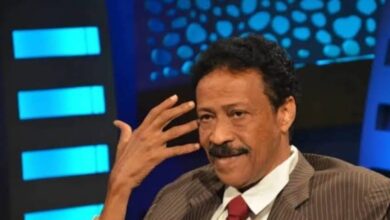
Osman Mirghani: The Sudanese political sector suffers from a lack of constructive political thought
Exclusive: Brownland
The Sudanese political scene, intertwined with a raging and destructive war, is undergoing a radical “re-engineering” process aimed at building a new political structure that keeps pace with regional and international shifts. This engineering is based on establishing unconventional alliances across all levels, seeking simultaneously to avoid international tutelage. Furthermore, it emphasizes the importance of rearranging constitutional entitlements, including the formation of a legislative council comprising political and social blocs supportive of the army, thereby placing foreign initiatives in their natural perspective.
Not far from this is the impact of war-time alignments with regional dimensions, aimed at fragmenting the region and redrawing the entire scene for the purpose of control. This comes amidst a complex intersection of interests and varying pressures (Jeddah platform, Geneva, humanitarian truce, civilian government).
Brownland delved into the depths of this complex engineering with Mr. Osman Mirghani, Editor-in-Chief of Al-Tayyar newspaper and political analyst, in a dialogue discussing the particulars of the Sudanese political situation “internally, regionally, and internationally.”
Interview by: Badreldin Abdulrahman
Q: Since independence, Sudan has not witnessed political stability. What is the fundamental reason for that?
Mirghani: The political sector suffers from the absence of “constructive political thought.” It adopts a methodology of “conflict” instead of political “competition,” which has led to turning power into a tool for acquisition and the consolidation of influence, rather than serving the interests of the nation and the citizen. Over generations, conflicts have increased, political thought has atrophied, and personal interests have inflated. Politics has become merely a tool for gaining wealth and prestige, far removed from productive work.
Q: The current Sudanese political scene is not rooted in elections, competence, or qualification, but rather mostly in military and tribal formations. How do you view this scene, and what is the solution in your opinion?
Mirghani: The current political scene reflects the level to which political practice has degraded. The capabilities of the current generation of politicians are weak, and the authorities exploit this to manipulate the political scene to express the interests of politicians more than those of the people.
Q: You have your own vision for how Sudan should be governed, which you have discussed in several contexts. What is this vision, and is it suitable for governing a country like Sudan under the current circumstances?
Mirghani: Yes. Based on our country’s political experience, from the beginning of the “second formation” in the 1920s until now, the cross-sectional image of the country seems clear for a true diagnosis. Based on this, I prepared a comprehensive political vision centered on a new formation of the state that I called the “Second Republic.” It includes strategic plan paths in terms of “buildings and meanings,” structures, and levels of the state, in addition to political thought and organization. In my estimation, the proposal I documented in several books—Who Lost Sudan, Sudan: The Second Republic, Engineering Sudanese Politics, Cell 23, and Al-Okaziah in Sudanese Political Discourse—attempted to detail this vision.
Q: Sudan has been fighting a grinding war entering its third year. In your view, what were the reasons that led to its outbreak, and what are the immediate solutions to end it?
Mirghani: The main reason is “political conflict,” which lasted for several years and then escalated significantly during the period from June to December 2022. This led to political polarization, which eventually evolved into seeking assistance from military forces.
Q: The current war is linked to intense regional and international interventions. Are these intersections, a conspiracy, or a pursuit of ambitions?
Mirghani: Some confuse the origin of the crisis with the management of the crisis. Negative external interventions result from attempts to manage the crisis by supporting the rebellion, which led to prolonging the war and its escalation both vertically and horizontally.
Q: Why did the “Quartet” fail to provide solutions to the current crisis?
Mirghani: International and regional efforts do not succeed unless they are combined with Sudanese political will. International initiatives, including the Jeddah platform, the Quartet, and others, have exerted efforts to cross Sudan to the shores of a peaceful solution, but it seems the Sudanese parties have not reached a conviction regarding a peaceful political solution.
Q: The United States promised to designate the Rapid Support Forces (RSF) as a “terrorist organization.” Why hasn’t that happened?
Mirghani: Perhaps because it hopes to reach a settlement that ends the war, and fears that the classification step might lead to weakening the mediation role.
Q: Current political blocs and parties have not provided what is required or expected of them. Many have accused them of failure, and others have accused them of being far from the important issues of the citizen and searching for narrow interests. How do you view that?
Mirghani: Political failure has dominated political activity since independence. Its reasons are:
- The absence of constructive political thought.
- Weak organizational structures of parties.
- Lack of planning in the political mindset and reliance on daily events.
- The absence of democracy within the walls of the parties themselves.
Q: What made Sudan’s neighboring countries (Chad, Ethiopia, Central African Republic) partners in supporting the current war, and why all this hostility against Sudan?
Mirghani: Neighboring countries suffer from political and economic crises, which makes them fragile and unable to manage long-term productive relations. Furthermore, the Sudanese state has suffered from internal atrophy, leaving it paralyzed externally and suffering from great isolation.
Q: Can the Saudi-American mediation that emerged recently be a reason for solving the current crisis?
Mirghani: Saudi Arabia and the United States were partners in facilitating the first negotiations between the Army and the RSF three weeks after the war broke out. Later, the rest of the Quartet members, Egypt and the UAE, joined them. Currently, it is the only initiative on the table, and I expect it to eventually succeed in ending this destructive war