When Checks Become Shells: How Abu Dhabi’s Banks Manage the Conflict in Sudan
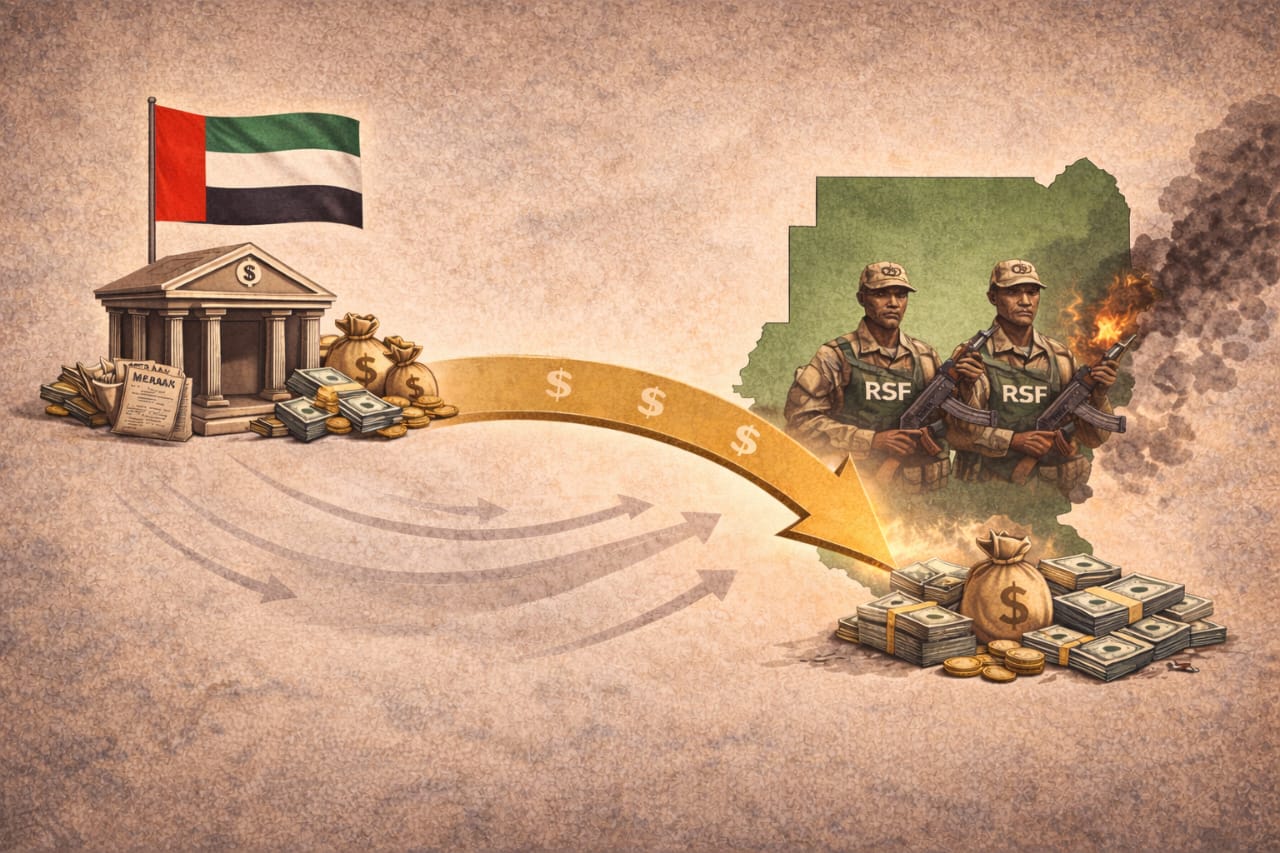
At the heart of the bloody Sudanese conflict, which has claimed tens of thousands of lives and displaced millions, operates a complex banking network linking the gleaming towers of Abu Dhabi to the devastated streets of Khartoum. Leaked banking documents and international investigations reveal how Emirati banks have transformed into a financial lifeline feeding the Rapid Support Forces (RSF), turning Islamic financial institutions into tools to prolong one of the 21st century’s deadliest civil wars.
Abu Dhabi’s expansion into the Sudanese banking sector was not merely a passing investment, but a strategic plan spanning two decades. The UAE exploited political and economic crises to consolidate influence and seize control of the country’s financial jugular.
According to banking documents obtained by the anti-corruption organization “Global Witness,” 50 million UAE dirhams ($13.6 million) flowed from the RSF to the Abu Dhabi-registered Tradive General Trading LLC in four installments between April and July 2019. This represents a clear model of the hidden financing machine driving the war. This financial network, stretching from Abu Dhabi to Khartoum, is not limited to a single company but encompasses an entire banking system acquired by the UAE over twenty years.
The Two-Decade Plan
The Emirati acquisition of the Sudanese banking sector was not accidental or a matter of fleeting investment opportunities. It was part of a calculated strategy over two full decades, during which Abu Dhabi and Dubai exploited every political and economic crisis Khartoum faced to tighten their grip on the country’s financial arteries.
The plan began under exceptional circumstances. In the mid-2000s, Sudan was reeling under suffocating international sanctions imposed by the United States and the European Union on Omar al-Bashir’s regime due to the Darfur crisis and his ties to extremist organizations. Western banks closed their doors to Khartoum, and international financial institutions cut ties, leaving a massive vacuum in the Sudanese banking sector.
Exploiting Circumstances
At that precise moment, the UAE stepped forward with “generous” offers. According to official financial reports, in 2005, the Sudanese government sold 60% of the shares of the Bank of Khartoum—Sudan’s largest and oldest bank—to Dubai Islamic Bank (Human Rights Research). This was not just a commercial deal; it was the launchpad for a long-term strategic control project. The Bank of Khartoum, established in 1913 during British colonial rule, represented a symbol of Sudanese financial sovereignty, but within a decade, it was transformed into a tool in the hands of regional powers.
This was not the only deal. Just one year later, according to Reuters reports, Dubai’s Emaar Properties and Al Salam Bank signed a deal to acquire 60% of the shares of El Nilein Industrial Development Bank for $80 million (Wikipedia). The message was clear: the UAE did not come to buy a single bank, but to redraw the map of the entire Sudanese banking sector.
Restructuring
The pattern was identical in every deal: target major, long-standing banks; provide immediate cash liquidity to a financially distressed government; and receive, in exchange, controlling stakes exceeding 60% in most cases. Then came the second phase: restructuring, appointing loyal executives, and linking these banks to the broader Emirati banking network.
According to Sudanese stock exchange records, in 2008, the Bank of Khartoum merged with the Emirates and Sudan Bank, resulting in Dubai Islamic Bank owning 28.4% of its shares directly, in addition to indirect stakes through subsidiaries. This merger was not merely an administrative process but a consolidation of control under one umbrella, allowing Dubai to control Sudan’s largest banking institution through a complex web of interlocking ownerships.
In 2012, the boldest move arrived. According to Central Bank of Sudan data, Abu Dhabi Islamic Bank opened its first foreign branch in Khartoum—a step indicating that the UAE was no longer content with controlling existing Sudanese banks but was now operating directly within the local market. This branch served as a spearhead for Emirati expansion, providing a direct channel for the flow of Emirati funds and investments into Sudan without the need for local intermediaries.
Shadow Companies
The decisive moment in this strategy came with the rise of the RSF as a military and economic force parallel to the state. At the heart of the banking system built by the UAE over two decades, a complex network of shell companies operates, linking Emirati banks to the RSF with nearly invisible financial threads.
According to the Global Witness investigation, the RSF maintains an account in its own name at the National Bank of Abu Dhabi (now part of First Abu Dhabi Bank), clear evidence of the militia’s financial independence from the Sudanese army years before the war erupted. This account was not just a banking service; it was a tacit recognition of the RSF’s financial autonomy from the Sudanese state and a preparation for the larger role the militia would play in the future.
According to information obtained by the organization from the Dubai Department of Economic Development, Al-Junaid Hamdan Dagalo, Hemedti’s brother, is the manager and ultimate beneficial owner of Tradive General Trading. This company, which bears an ordinary name and is headquartered in a typical Dubai commercial district, became a primary conduit for cycling money between the UAE and Sudan. According to leaked banking documents, Tradive paid 48 million dirhams to the RSF in July 2019. In one banking document, the purpose of the transfer was cryptically described as a “transfer to a sister company,” in an attempt to lend a veneer of legitimacy to the transaction.
RSF Accounts in Abu Dhabi
Sources confirm that Tradive itself holds an account at the Sudanese El Nilein Bank in Abu Dhabi, which is used to facilitate financial transfers for the RSF. This pattern of cross-transfers between banks and shell companies intentionally complicates the money trail, granting the militia a legal facade for its financial operations, where each transaction appears in isolation as a standard commercial transfer between sister companies. The Emirati-acquired banks have now become instruments for financing the war.
According to the same source, documents revealed Hemedti’s—the RSF commander—link to the Al Junaid Industrial Group, one of the largest gold companies in Sudan. The documents uncover a complex web of interlocking ownerships linking the militia leader to a massive mining empire extending from Darfur to the Blue Nile, and subsequently to Abu Dhabi.
Lethal Vehicles
However, the money does not remain as digits on computer screens. According to a leaked payment log obtained by Global Witness, the RSF received over 150 million UAE dirhams for “technical support,” using more than 111 million dirhams of it to purchase vehicles and communication equipment from dealers, companies, and car showrooms in Abu Dhabi. These vehicles leave Abu Dhabi ports as civilian SUVs and are subsequently converted into armed military vehicles that roam the streets of Khartoum, Omdurman, and Darfur, equipped with heavy machine guns and anti-aircraft cannons.
The cycle is complete: from a bank account in Abu Dhabi, to a car showroom in Dubai, to Port Sudan, then to a conversion workshop in RSF-controlled areas, ending as a combat vehicle shelling residential neighborhoods. The time elapsed between the bank transfer and the firing of bullets from these vehicles is often only a few weeks.
Communication equipment purchased with the same funds played a pivotal role in coordinating attacks and managing military operations. The encrypted communication networks linking militia leaders from Khartoum to El Fasher, passing through El Geneina and Nyala, were all purchased from suppliers in Dubai and paid for via bank transfers from accounts in Abu Dhabi.
The Most Bitter Irony
Abu Dhabi’s two-decade plan succeeded in turning Sudan into a state of near-total financial dependency. When the war broke out, the UAE effectively controlled the country’s financial infrastructure, granting it the ability to fund the conflict through seemingly “legitimate” channels.
In every banking transaction between Abu Dhabi and the RSF, fresh Sudanese blood is spilled. The gold extracted from Darfur returns as bullets, and the Emirati dirham is transformed into a shell piercing homes.
The most bitter irony is that all of this is executed in the name of “Islamic Banking,” which prohibits usury but permits the financing of wars and the killing of Sudanese people.
Source: Al-Watan Newspaper, Saudi Arabia