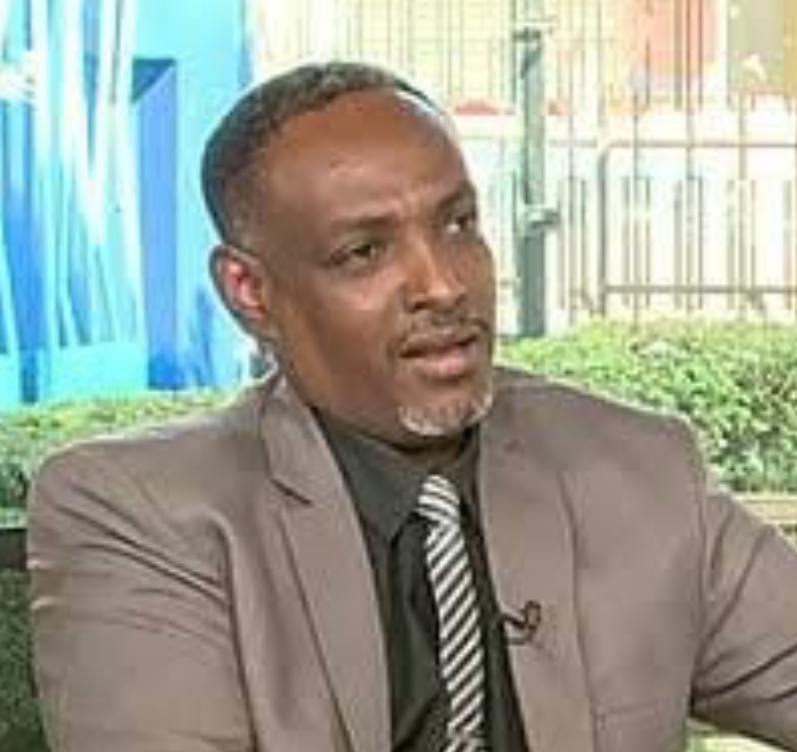
Dr. Muhammad Ahmed Khidr Yaqoub Tabaydi, one of the most prominent figures in the academic, media, and political arenas in Sudan.
Background and Family Heritage
Dr. Tabaydi was born in Omdurman, specifically in the Al-Rukabia neighborhood, and later moved to Umbeda. He grew up in an illustrious environment with deep historical roots, where his family was renowned for trading in gold and jewelry for centuries. This background played a role in shaping his personality as well as his patriotic and social spirit from an early age. It is also noted that his grandfather, Khidr Yaqoub Tabaydi, had a significant impact on his life—the mosque built in his grandfather’s house left an enduring mark on his commitment to charity and humanitarian work.
Educational Journey
Dr. Tabaydi began his educational path at the Al-Kamboni School in Omdurman and at the Kitabi Khalwa. He then completed his elementary studies at “Umbeda Al-Hara Al-Awwal” School (currently known as Badr Al-Kubra). Afterwards, he moved on to secondary education at the Institute of Education in Bakht Al-Rida in the city of Al-Duwim, where he forged his character through science and knowledge in homage to one of Sudan’s—and indeed the Middle East’s and Africa’s—most historic educational edifices. His scientific passion further expanded when he enrolled at the university: he studied at the Faculty of Arts at the University of Juba and then earned a Bachelor’s degree in Psychology from the Al-Jazeera Technical College. He continued his education by obtaining a Master’s degree in Psychological Guidance and Mental Health, and he capped his academic career with a PhD specializing in “The Fear of Death in Chronic Illnesses and Religious Beliefs.”
Professional and Academic Experience
Dr. Tabaydi has worked in several prestigious educational institutions, including:
Karari University: He participated in the educational and training processes since its inception.
Other Universities and Colleges: Such as Al-Ahfad University, Al-Dalanj University, Bahri College, and Al-Mashreq College, which provided him with extensive experience in higher education, private education, and both technical and vocational training.
He also held significant academic positions and contributed to establishing specialized centers and institutes, for example:
The Centers of the Rightly Guided Caliphs for Vocational Training and Human Resources Development, including the “Abu Bakr Al-Siddiq” Center located in Khartoum Bahri, Omdurman, Wad Madani (the capital of Al-Jazeera State), and several other states.
The Omar Al-Farouq Technical Institute in the locality of Jabal Awliya, south of Khartoum, and the “Noor Omdurman Training and Technology Academy” which later became Noor Omdurman College of Technology and Technology.
Military Career and National Service
Dr. Tabaydi joined the Sudanese Armed Forces, where he steadily rose through the ranks until his retirement in 2014 from Karari University. During his military service, he gained leadership and organizational skills that later contributed to his civic and national activities. He also served as a member of the Security Committee in the locality of Karari, reflecting his expertise in national security affairs.
Social and Humanitarian Activity
Throughout his life, Dr. Tabaydi has been remarkably active in volunteer and humanitarian endeavors, inspired by his family’s heritage of charity. He served as President of the National Union of Youth of the Revolution in Karari and as Director of the Training Department for Khartoum State, representing the youth on various national occasions. He also helped establish the Al-Tabaydi Charity Association, led the unions of private training centers in Sudan, supervised the Sudanese Association of Trainers in Khartoum State, and actively volunteered with several charitable organizations and associations.
Journalistic and Media Role
In addition to his academic and military career, Dr. Tabaydi is active as an amateur journalist writing for several Sudanese newspapers, which has earned him wide recognition in media circles. His writings highlight his perspectives on national, political, and economic issues and contribute to supporting the armed forces and popular resistance in the battle for honor and dignity. His nomination for high-ranking positions—such as an independent candidate for the role of Prime Minister in the transitional government—garnered widespread support in academic, media, and social circles, particularly among