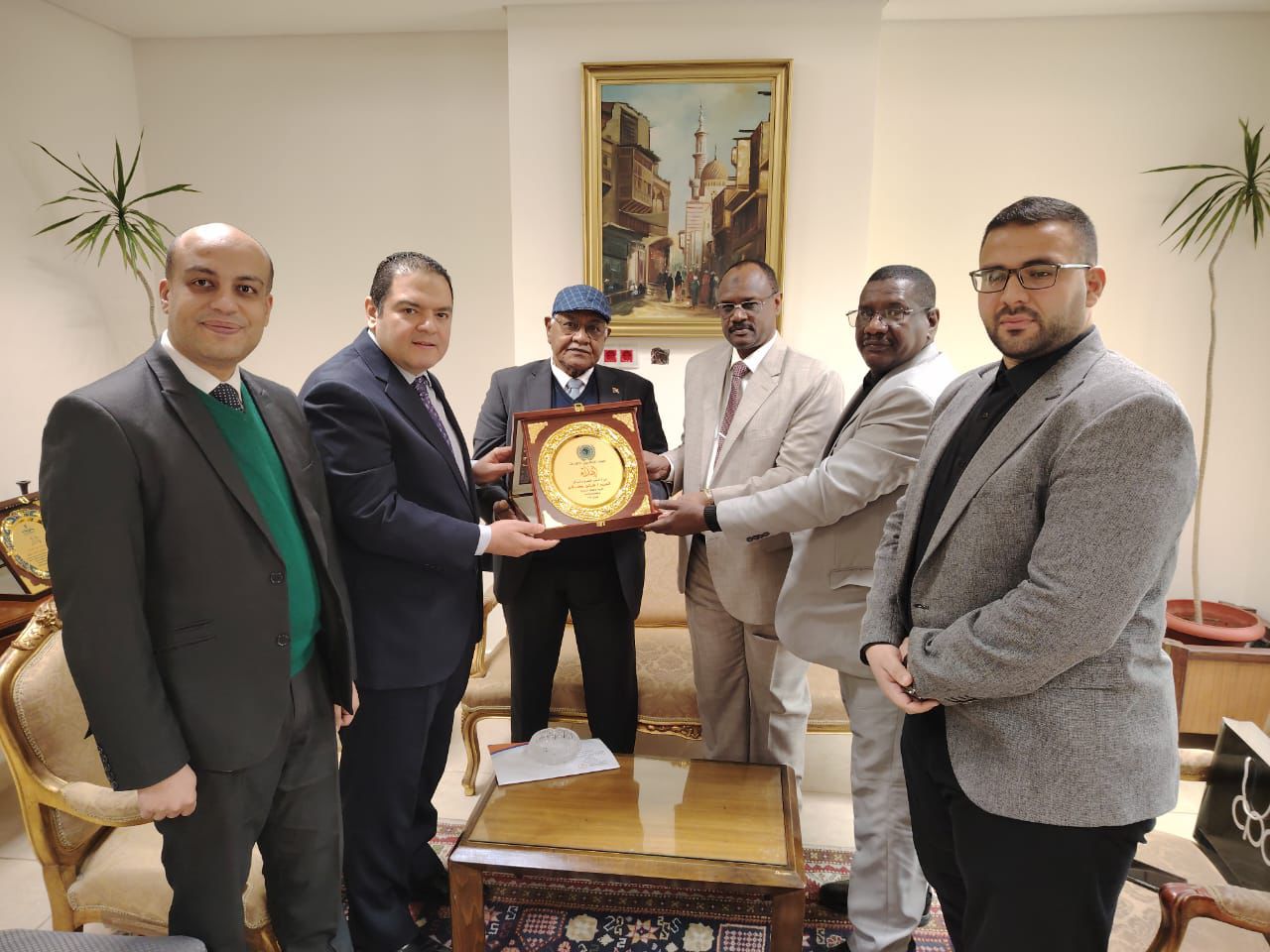
Inauguration of the “Shams” Egyptian-Sudanese Media Network: Building Bridges to Enrich Relations Between Peoples
Brown Land
Media is a fundamental tool and pillar in strengthening relations between peoples, not only as a transmitter of news but as a creator of public opinion and a bridge for cultural and civilizational communication. Media can be a tool for rapprochement or a cause for divergence, depending on the method of treatment and handling of issues. Therefore, adherence to a responsible media discourse that focuses on commonalities and stays away from sensationalism or the amplification of disputes becomes necessary, especially between peoples with deep historical ties such as Egypt and Sudan.
The Sudanese-Egyptian experience confirms that joint media coverage, talk shows, and the exchange of professional expertise among journalists have contributed to fostering a deeper understanding of shared issues, particularly in the fields of regional security, economic integration, education, and investment. Mr. Al-Sammani Awadallah told Brown Land:
“Media is considered one of the very important means in strengthening relations between countries and peoples, and also a means to destroy them and create tensions. Therefore, media must be directed positively to create positive relations between peoples, noting that the people are the foundation of any step.”
“Media has an important role not only in framing relations but in building the future of relations and drawing a roadmap for relations between peoples. Whenever this relationship is good, it contributes greatly to creating cooperation between countries, and thus encouraging countries to create relations that serve the two peoples.”
Relations between Egypt and Sudan are not born of the moment but are an extension of a long history of social, cultural, educational, and cultural overlapping. Mr. Al-Sammani Awadallah adds:
“Relations between peoples, especially between Egypt and Sudan, require conscious and promising media that looks at the glass as half full. Egypt played a positive role and opened its outlets to Sudanese fleeing the war; it did not open refugee camps for them but continued to treat them with dignity. This position alone drives us to reflect this image and not forget its favor upon us.”
Over the decades, media has contributed to conveying the bonds of the two countries to the public and enhancing a deeper understanding of shared history and mutual interests. One of the most prominent historical experiences in Egyptian-Sudanese media cooperation was the Wadi El-Nil Radio, which began as “Rukn Al-Sudan” (Sudan Corner) in 1949 with a weekly half-hour program, then expanded to half an hour daily, and transformed in 1984 into an independent radio station under joint ownership between Egypt and Sudan. Its programs covered diverse Sudanese-Egyptian topics, news bulletins, and heritage songs, with production distributed between Egypt and Sudan. Mr. Al-Sammani commented on this experience:
“There were major cooperations in the field of media, and that period witnessed a great flourish in relations. Among the most prominent of those cooperations was Wadi El-Nil Radio, which was heard in both countries with the voices of Egyptian and Sudanese announcers, as well as the printing of several Egyptian newspapers in Khartoum, which also stopped. We in ‘Shams’ strive to call for the resumption of Wadi El-Nil Radio, and also for Sudanese writers to write in major Egyptian newspapers, and for Egyptians to write and exchange ideas in the Sudanese media, alongside implementing joint media programs, media exchange, and conducting training courses in Khartoum and Cairo.”
In this framework, and to consolidate these bonds, the “Shams” Egyptian and Sudanese Media Network was launched as the first joint media entity bringing together media professionals from both countries, in the presence of the Commissioner for the Peace Commission, Dr. Sulaiman Al-Debailo, and several media and diplomatic figures. Dr. Abdullah Mohammed Ali Bilal, President of the Network, said:
“The establishment of ‘Shams’ came as a fruit of joint efforts exerted by media professionals from Egypt and Sudan, aiming to strengthen commonalities between the two peoples and support strategic relations between Khartoum and Cairo. The network will work on establishing a media discourse that reflects the depth of historical and cultural ties between the two countries.”
The objectives of the “Shams” network include enhancing joint media cooperation between the two countries, supporting training programs and professional qualification for media professionals in Cairo and Khartoum, opening new horizons for the exchange of professional expertise and knowledge, and organizing joint events and forums that serve bilateral issues. Al-Sammani Awadallah added:
“We began thinking about ‘Shams’ since last July. As media professionals, we continued to follow the positive role played by Egypt, and at the same time, we followed with great concern counter-campaigns to damage this relationship and incite discord between the two peoples. So, last August, we thought of the ‘Shams’ network of media professionals in the two countries who believe in the unity of common destiny and mutual benefits, alongside the fact that the popular relationship has deepened significantly. Thus, it was necessary to create a joint media entity, and we led movements here and there on the official level, where we found the green light from the official authorities in both countries. The importance of ‘Shams’ lies in it being a joint media tool; therefore, the efforts it exerts are more truthful and noble in direction because they emerge from a joint platform whose goal is to defend against misleading campaigns aimed at causing a rift between the two countries.”
It is worth noting that this cooperation is not limited to the media side only, as there is much of it on various economic, political, academic, and artistic levels. Art has played a pivotal role in strengthening the bonds of the two peoples throughout a long-term history and different experiences, most notably Umm Kulthum’s visit to Sudan and joint festivals. Also, plays that left a mark such as “The School of Mischief” (Madrasat Al-Mushaghibin). Such events contribute to enriching knowledge and cultures. In this context, the Union of Sudanese Artists’ Gathering in Egypt stands out, which recently organized activities titled “In the Presence of the Nile” in partnership with the “Sudani” Telecommunications Company and the Union of Arab Artists, aiming to spread Sudanese culture and transform the place into an artistic and social meeting point. A constellation of Sudanese and Egyptian artists, intellectuals, and musicians participated in these events, with musical and artistic performances and workshops, and a live broadcast for the public’s benefit. The Union also organized a celebratory tribute for Sudanese artists residing in Egypt, reflecting artistic and cultural cooperation and communication, and highlighting the artistic diversity of Sudan.
The Union works on organizing joint events with their Egyptian counterparts, supporting Sudanese artists in training, professional development, and promotion of their works, and enhancing communication with artistic and cultural institutions in Sudan. The Union’s primary goal is to promote unity and solidarity among artists, highlight the cultural and artistic diversity of Sudan, and consolidate understanding and cooperation between different cultures in a way that reflects the bonds of friendship between the two peoples at the artistic and cultural levels.
We point out that such media and artistic initiatives and others are important at a time when the media faces great challenges in confronting disinformation and hate speech, especially after the spread of misleading information via social media platforms following recent crises. We find that official media platforms always fight these phenomena and emphasize the importance, depth, and kindness of relations between Egypt and Sudan, in continuous confirmation from various officials. We see this in the statement of Sudanese Prime Minister Kamil Idris in the speech he delivered upon his return from Egypt, expressing Sudan’s appreciation for Egypt for hosting the children of Sudan, stressing the strength of bilateral relations. Meanwhile, Khalid Al-Eisir, the Sudanese Minister of Culture and Information, pointed out that relations between Egypt and Sudan extend to popular, cultural, and social bonds, and work must be done to develop them in a way that serves the interests of the two peoples. Mr. Al-Sammani added in this regard:
“Media platforms in Sudan have begun to play an important role after April 2023, as the war stopped all official and popular media outlets except for social media platforms, which continued to play an important role in refuting rumors and spreading positives. Media, when it adheres to professional standards, becomes a tool for building bridges, not for destroying them, and a source of reassurance, not anxiety.”
Thus, we can point out that joint initiatives such as the “Shams” network, Wadi El-Nil Radio, and the Union of Sudanese Artists in Egypt contribute to consolidating cultural and human bonds and enhancing mutual understanding. The necessity of adherence to professionalism and historical awareness of the role of media and art proves that they can be effective tools for building trust and rapprochement, turning challenges into opportunities for cooperation, and consolidating the bonds of friendship between peoples