From the exposé series: “Narrative as Strategy — How the U.S. Reframed Sudan’s War”
By Sabah Al-Makki, Assistant Editor

A Forensic Exposé of the U.S. Congressional Hearing on Sudan
In moments of international rupture, when war converges with diplomacy, it is no longer arms alone that shape outcomes—but language. When narrative supersedes legal precision and testimonial rhetoric is accorded greater weight than substantiated evidence, the result is not merely a distortion of events but a fundamental recasting of legitimacy itself. Within such environments, foreign-sponsored insurgencies are not condemned as violations of sovereignty but subtly reframed as political stakeholders. Conversely, constitutionally mandated state institutions—tasked with defending national order—are rendered morally equivalent or quietly expunged from the framework of international engagement.
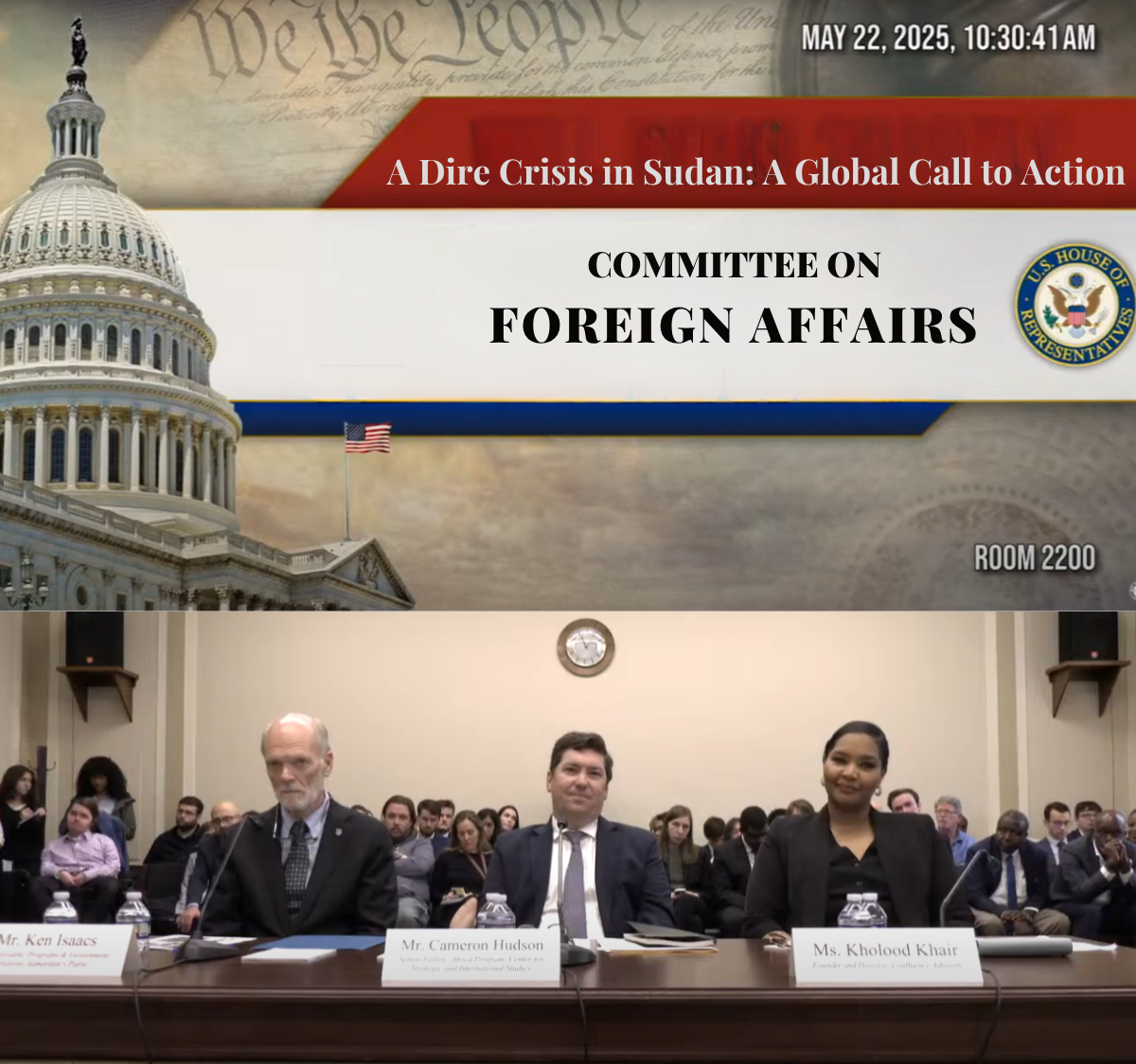
This inaugural installment of Brown Land News’ critical exposé comprehensively examines the U.S. House Foreign Affairs Subcommittee on Africa’s congressional hearing held on May 22, 2025, titled “A Dire Crisis in Sudan: A Global Call to Action.” While ostensibly convened to address a humanitarian emergency, the hearing became a crucible for narrative engineering. This discursive pivot blurred the line between a sovereign national army and a foreign-financed paramilitary force credibly accused of ethnic cleansing and systemic violence.
Drawing from the full spectrum of witness testimonies, this analysis scrutinizes the substance of the statements offered and the structural choreography of their presentation—how they were curated, amplified, and institutionally received. Each voice is situated within a broader ecosystem of externally aligned diplomacy, from international policy consultants to humanitarian officials. The cumulative effect reveals a quiet repurposing of humanitarian discourse—where rhetorical proximity to donor agendas eclipses legal asymmetry, battlefield reality, and the sovereign right to self-defense.
This is not a mere semantic critique. It is a sober inquiry into how language can become a vehicle for geopolitical reconfiguration when decoupled from law and context. At stake is not only the integrity of international legal standards but also the ability of postcolonial states to assert their legitimacy in a global system increasingly governed by optics, not obligations. This exposé is both a diagnostic and a warning: that when testimony replaces law and neutrality becomes performance, the first casualty is truth—and the next, sovereignty.
One Hearing, Two Realities
How a Congressional Forum Became a Narrative Weapon
On May 22, 2025, the U.S. House Foreign Affairs Subcommittee on Africa convened a hearing titled “A Dire Crisis in Sudan: A Global Call to Action.” Though framed as a humanitarian intervention, the session evolved into something more deliberate: a calibrated narrative operation designed to align U.S. positioning with diplomatic ambiguity, not legal clarity.
What emerged was not moral discernment but a perilous false equivalence. This dangerous narrative equates Sudan’s Armed Forces (SAF)—the constitutionally mandated military of a sovereign republic—with the Rapid Support Forces (RSF), a paramilitary militia group armed and financed by the United Arab Emirates (UAE), and credibly accused of genocide, systematic sexual violence, and the plunder of Sudanese resources. The urgency of correcting this false equivalence cannot be overstated, demanding immediate attention and action.
Under the guise of neutrality, the legal asymmetry between a sovereign military and a foreign-sponsored militia was erased. The result was not an oversight but a strategic reframing that concealed the geopolitical architecture of aggression through narrative laundering, highlighting the need for transparency in such proceedings.
The hearing featured three witnesses: humanitarian veteran Mr. Ken Isaacs, policy analyst Mr. Cameron Hudson, and Ms. Kholood Khair, a civil society figure affiliated with Sudan’s former transitional administration and a prominent critic of the SAF. Chairman Rep. Chris Smith (R-NJ) chaired the session, and Rep. Sara Jacobs (D-CA) led the rhetorical charge.
What unfolded was not a forum for inclusive engagement but a curated platform, structurally insulated from Sudanese voices. The hearing did not simply omit context; it displaced it. Law was subordinated to optics. The principle was replaced by perception. In this reengineered discourse, aggression became abstract, and sovereignty became negotiable.
The Fiction of Parity
How Testimony Collapsed the Distinction Between State and Militia
Chairman Rep. Chris Smith (R-NJ)
Chair, U.S. House Foreign Affairs Subcommittee on Africa
Chairman Rep. Chris Smith opened the hearing with a solemn indictment of Sudan’s descent into a humanitarian catastrophe—citing mass displacement, systemic violence, and international inertia. Drawing from decades of engagement, including a 2005 visit to Darfur where he met sexual violence survivors and then-President Omar al-Bashir, Smith positioned himself as a veteran advocate for justice. These encounters, he said, informed his authorship of the Darfur Peace and Accountability Act of 2006.
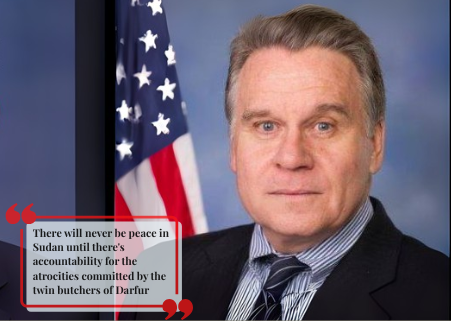
Rep. Smith denounced Sudan’s two military leaders—Lt. General Abdel Fattah al-Burhan of the SAF and Mohamed Hamdan Dagalo (Hemetti), commander of the RSF militia—branding them “the twin butchers of Darfur.” He accused both of war crimes, including sexual violence, child soldier recruitment, and gold smuggling through UAE-linked routes.
Though he explicitly criticized the RSF’s foreign backing and the UAE’s complicity, his broader framing introduced legal ambiguity. Rep. Smith collapsed the fundamental distinction between a sovereign army and a foreign-funded insurgency by assigning symmetrical blame to both actors.
Though he explicitly criticized the RSF’s foreign backing and the UAE’s complicity, his broader framing introduced legal ambiguity. Rep. Smith collapsed the fundamental distinction between a sovereign army and a foreign-funded insurgency by assigning symmetrical blame to both actors. This framing advanced what may be termed the fiction of parity: the portrayal of two fundamentally unequal entities as morally and legally indistinguishable. It blurred principles enshrined in international law, differentiating between state defense and non-state aggression.
Rep. Smith also condemned the Arab League’s inaction, implicitly pointing to the UAE’s role. He concluded with a stark warning:
“There will never be peace in Sudan until there is accountability for the atrocities committed by the twin butchers of Darfur.”
To be clear, the SAF, like all national militaries, warrants scrutiny—but it remains the recognized military organ of a sovereign state. The RSF, by contrast, is a militia credibly accused of systematic atrocities and operating under foreign patronage. Collapsing this distinction not only obscures culpability—it dismantles the very architecture of legitimacy.
But when moral outrage is expressed without legal precision, the foundations of justice are weakened. By conflating a state army with a proxy militia, the hearing subordinated law to optics and accountability to theater.
Between Rhetoric and Restraint
Rep. Sara Jacobs (D–CA) and the Limits of Moral Realignment
Member of the House Foreign Affairs Subcommittee on Africa; rhetorically led the session focusing on humanitarian and foreign aid policy.
Rep. Sara Jacobs delivered one of the hearing’s sharpest critiques of U.S. policy. She attributed Sudan’s worsening crisis to a legacy of ‘strategic neglect‘—particularly under the Trump administration. This neglect, she argued, was evident in the absence of diplomatic envoys, the erosion of humanitarian infrastructure, and the continuation of arms sales to the UAE, which she identified as a primary sponsor of the RSF militia.
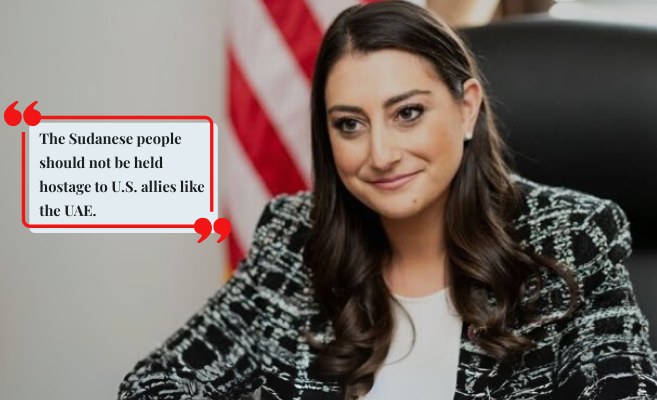
In response, Rep. Jacobs introduced the Stand Up for Sudan Act, which aimed to halt U.S. arms transfers to the UAE. This marked a rare congressional move to name and challenge a U.S. ally’s involvement in proxy warfare. Rejecting the civil war narrative, Rep. Jacobs characterized Sudan as “the world’s largest humanitarian crisis”—a proxy war involving the UAE, Egypt, Saudi Arabia, Turkey, and Russia. She emphasized the human cost: over 25 million in need, 13 million displaced.
Rep. Jacobs condemned the deliberate use of famine as a military tactic and highlighted the collapse of local relief systems—especially the Emergency Response Rooms (ERRs), which once functioned as grassroots aid networks with USAID support. She accused the SAF of repressing ERR volunteers but stopped short of acknowledging the RSF infiltration of these same networks.
While her rhetorical clarity was notable—especially in naming the UAE—her policy prescriptions remained diplomatically restrained. She did not call for sanctions, legal proceedings, or structural reassessment of U.S. alliances.
Her conclusion was unflinching: “The Sudanese people should not be held hostage to U.S. allies like the UAE.” Yet the mechanisms of accountability remained deferred. The indictment was sharp; the remedy, cautious.
Eyewitness Truths in a War of Perception
Mr. Ken Isaacs and the Ground Truths that Defy Policy Narrativesaacs
Witness 1 – Vice President of Programs & Development, Samaritan’s Purse; former USAID official with over three decades of operational engagement in Sudan
Mr. Ken Isaacs delivered what was arguably the hearing’s most experientially grounded testimony. With over thirty years of field engagement across Sudan—including direct interaction with Lt. General Abdel Fattah al-Burhan and SPLM-N leaders—Isaacs diagnosed collapse across all dimensions: political, economic, social, medical, and security.
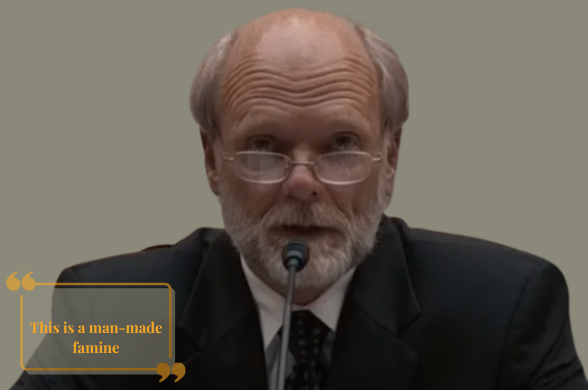
Drawing on verified humanitarian assessments, Mr. Isaacs confirmed that parts of Sudan had entered IPC Phase 5—officially designated famine conditions—while an estimated 8.1 million people remain trapped in Phase 4 emergency food insecurity. Rejecting any attribution to natural causes, he described the crisis as a deliberately engineered catastrophe, quoting, “This is a man-made famine,” to emphasize its political and military origins. He presented harrowing firsthand accounts and photographic evidence from South Kordofan and the Nuba Mountains, where children had died after being forced to consume grass in a desperate attempt to survive.
Crucially, Mr. Isaacs challenged the prevailing narrative that Sudan is inaccessible to aid. He testified that Samaritan’s Purse had successfully negotiated humanitarian corridors—including airdrops—through direct engagement with the SAF and SPLM-N authorities. Contrary to depictions of uniform obstruction, he described SAF-held areas as relatively stable and operationally cooperative. In Gedaref, a Samaritan’s Purse field hospital treated over 9,000 patients and delivered more than 500 births—funded almost entirely through private channels.
Mr. Isaacs was unequivocal in his condemnation of the RSF, describing it as “Janjaweed 2.0”—a brutal, decentralized force lacking command unity or political legitimacy. He emphasized that across Sudan, public sentiment toward the RSF is overwhelmingly hostile due to its orchestration of atrocities, manufactured famine, and forced displacement. In his view, the RSF has forfeited any legitimate role in Sudan’s future.
Though he had previously criticized the SAF, Mr. Isaacs now presented a pragmatic reassessment: that the SAF remains the only institution with sufficient command structure, territorial reach, and logistical capacity to preserve national coherence until a viable civilian transition emerges. He did not idealize the SAF—but regarded it as functionally indispensable.
His recommendation departed from abstract moral frameworks. He called for appointing a senior U.S. envoy—reporting directly to the President—empowered to bypass bureaucratic inertia and confront regional enablers of the war, particularly the UAE, with strategic clarity and urgency.
Proxy Designs, Strategic Evasions
Mr. Cameron Hudson and the Geopolitical Cartography of a Manufactured War
Witness 2 – Senior Fellow, CSIS Africa Program; former Director for African Affairs, U.S. National Security Council
Mr. Cameron Hudson offered a sweeping geopolitical analysis, presenting Sudan not as a failed state but as a deliberately fractured battlefield—an open-air proxy arena in which foreign rivalries converge. He described the crisis as “the world’s most neglected,” not because of its lack of complexity but because of its uncomfortable geopolitical implications.
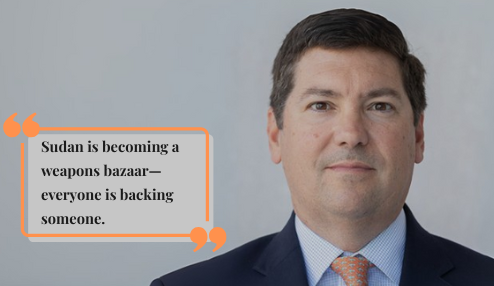
Mr. Hudson argued that Sudan’s conflict has become fully internationalized since it entered its third year. “Sudan is becoming a weapons bazaar,” he cautioned, “everyone is backing everyone.“ Neither the SAF nor the RSF relies on domestically sourced armaments. The battlefield is now shaped by drone warfare, sustained by an intricate web of foreign supply chains.
Mr. Hudson cited a recent episode in which Turkish-manufactured drones, reportedly operated by the SAF, were said to have resulted in the deaths of Emirati personnel in Darfur. In apparent retaliation, the RSF reportedly launched drone strikes targeting Port Sudan, the country’s temporary administrative capital, using Chinese-manufactured systems—strikes that, he noted, may have originated from a UAE-administered base along the Red Sea. If substantiated, such claims would underscore the strategic depth and operational complexity of Emirati involvement.
He emphasized that such operations would be impossible without sustained logistical, financial, and technical sponsorship from foreign states—foremost among them, the UAE. Mr. Hudson observed that the RSF lacks the indigenous capacity to conduct such precision strikes independently, positioning the UAE not as a peripheral actor, but as a central architect of the RSF’s battlefield viability.
Yet, despite mapping this transnational infrastructure in granular detail, Mr. Hudson’s diplomatic framework introduced a consequential equivalence. He advocated for U.S. engagement with all regional powers—Egypt, Saudi Arabia, Turkey, the UAE, Russia and China—not as neutral observers but as “invested patrons.” In doing so, he blurred a vital legal distinction: between states interacting with a sovereign national army and those materially supporting a non-state militia credibly accused of atrocity crimes.
This framing collapses a foundational legal asymmetry into a false equivalence of strategic parity. Engagement with the SAF by states such as Egypt, Saudi Arabia, or Turkey occurs within the framework of internationally recognized, sovereign-to-sovereign relations. In stark contrast, the UAE’s continued support to the RSF—a non-state paramilitary entity formally dissolved by republican decree—constitutes material sponsorship of an outlawed militia implicated in cross-border destabilization and egregious violations of international humanitarian law. To treat these disparate relationships as morally or legally interchangeable is to erode the normative bedrock of international order and normalize impunity under the guise of neutrality.
Mr. Hudson further asserted that a negotiated internal resolution is unviable. In his view, the SAF and RSF remain locked in a zero-sum calculus, while no civilian actor currently possesses the legitimacy or capacity to lead a transition. As such, he urged Washington to pivot away from direct engagement with Sudanese military leaders and instead mobilize its Middle East envoy architecture to pressure regional sponsors. Absent such recalibration, he warned, Sudan faces the real prospect of state collapse, Red Sea destabilization, maritime insecurity, and the resurgence of transnational extremist threats.
The Language of Legitimacy
Ms. Kholood Khair and the Reconstitution of Narrative Authority
Witness 3 — Founder of Confluence Advisory; former advisor to Sudan’s transitional government; two-time United Nations Security Council briefer
Ms. Kholood Khair delivered the hearing’s most rhetorically assertive yet narratively asymmetrical testimony. A prominent figure during Sudan’s transitional period, Ms. Khair founded Insight Strategy Partners (ISP) in 2020—a policy consultancy established to advise Prime Minister Abdalla Hamdok’s administration and to support donor-backed state-building efforts. ISP worked closely with UNITAMS, the now-defunct UN mission widely criticized for advancing externally engineered governance models in Sudan.
Ms. Khair has addressed the United Nations Security Council on two occasions: first, during the Hamdok-led transitional government as a civil society representative, and more recently, in August 2024, where she reiterated pointed accusations against the SAF. Her framing closely mirrored dominant donor narratives—foregrounding critiques of the SAF while relegating atrocities committed by the RSFmilitia and the material role of foreign sponsors, particularly the UAE, to the analytical periphery. Her congressional testimony followed this established trajectory. Though delivered with confidence and rhetorical fluency, it ultimately reflected the posture of a transnational policy entrepreneur—one whose influence is derived less from democratic legitimacy or proximity to wartime realities than from alignment with international stakeholders and donor-centric paradigms.
In her testimony, Ms. Khair cast the conflict as an internal reckoning—a counterrevolutionary struggle between two branches of Sudan’s post-Bashir security architecture. She portrayed the SAF and RSF as moral and institutional equivalents, accusing both of weaponizing hunger, deploying ethnic violence, and operating with systemic impunity. While she acknowledged the RSF’s genocidal campaigns in West Darfur and beyond, she maintained an analytical symmetry, depicting the two forces as structurally indistinguishable. She further argued that the UN’s recognition of the SAF as the de facto authority compromised humanitarian neutrality and implicated international institutions in exacerbating the country’s food crisis.
Ms. Khair accused the SAF of obstructing famine declarations, deploying barrel bombs and chemical agents, and employing starvation as military doctrine—invoking the phrase “hunger is cheaper than bullets” as illustrative of SAF conduct. However, many of her claims leaned more heavily on historical grievance than contemporary forensic evidence, drawing from two-decade-old narratives rooted in the Nuba Mountains and early Darfur conflicts. In doing so, she blurred the line between past atrocities and present accountability. Responding to Mr. Ken Isaacs’s account of his meeting with Lt. Gen. Abdel Fattah al-Burhan, she cast doubt on the SAF’s credibility, suggesting their statements should be treated with deep skepticism.
Ms. Khair lauded ERRs—grassroots humanitarian structures formerly funded by USAID—and accused the SAF of detaining ERR volunteers. Yet she omitted reference to credible reports documenting ERR infiltration by RSF-aligned operatives and the militia’s exploitation of aid networks as instruments of propaganda and territorial control. The result was a selective moral framing that privileged externally supported civic initiatives while downplaying the complex entanglements shaping humanitarian realities.
At its most consequential, Ms. Khair’s testimony advanced a profound reconfiguration of political legitimacy in Sudan. While she acknowledged that the SAF and RSF finance their operations through gold trafficking, her analysis elided the structural and geopolitical asymmetry between state-mediated resource mobilization and the RSF’s illicit gold-for-weapons nexus with the UAE. By subordinating the SAF’s constitutional status and elevating donor-supported civic platforms as the rightful custodians of national legitimacy, Ms. Khair articulated a paradigm in which non-state actors—and externally aligned initiatives—supersede sovereign institutions in determining Sudan’s political future. In this reframing, insurgency becomes reform, and sovereignty is an impediment.
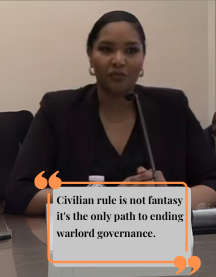
She concluded her testimony with an unequivocal rejection of any negotiated settlement involving neither the SAF nor RSF, branding both as “warlords” and asserting, “Civilian rule is not a fantasy—it is the only path to dismantling warlord governance.” In place of political compromise, she called for appointing a high-level U.S. envoy with direct access to former President Donald Trump, tasked with exerting pressure on Gulf actors, chiefly the UAE. Ms. Khair further advocated for expanded investment in mutual aid networks, community-based media, and internationally supported civil society platforms, positioning these as the foundational architecture for Sudan’s postwar reconstruction.
On the Question of Neutrality: Who Speaks for Sudan?
Though presented as a civil society voice, Ms. Kholood Khair cannot plausibly be regarded as a neutral arbiter of Sudan’s political reality. Her proximity to foreign-sponsored reform agendas and transnational governance networks is neither incidental nor opaque. Rather than emanating from a democratic mandate or embedded wartime experience, her testimony reflected a perspective shaped by sustained engagement with internationally anchored policy architectures and normative donor frameworks.
This raises a more fundamental inquiry—not whether civil society should be consulted, but which voices are conferred legitimacy and under what criteria. Whose experience is considered authoritative, and whose is rendered peripheral? Why were no testimonies solicited from actors within Sudan’s social and institutional core—particularly those resisting externally financed insurgency and donor-engineered political models?
A hearing that purports to interrogate the complexity of Sudan’s war but excludes those directly entangled in its consequences risks collapsing inquiry into curation. When the discursive space is occupied by interlocutors in exile or policy circuits abroad, the invocation of “neutrality” ceases to be an ethical principle and becomes a rhetorical instrument that obscures the asymmetries of power, proximity, and voice.
In such contexts, neutrality is not merely performed—it is prescribed.
A Narrative Shift
What transpired during the hearing was not merely the presentation of testimony—it was the orchestration of narrative. Beneath the humanitarian lexicon lay the quiet architecture of perception management: a deliberate reframing in which the legal and moral asymmetry between a sovereign national army and a foreign-backed insurgency was strategically obscured. Through rhetorical ambiguity, civil society discourse, and ethical relativism, categorical distinctions were not clarified—they were collapsed.
The hearing, ostensibly convened under the banner of humanitarian urgency, functioned instead as a stage for discursive realignment. Terms like famine, genocide, and repression—once employed as tools for forensic accountability—were repurposed into instruments of narrative recalibration. The effect was not illumination but distortion: a reframing that re-centered the optics of balance over the substance of legality.
This subtle shift marked a departure in U.S. positioning—from a principled stance grounded in sovereignty and international law to a posture increasingly shaped by performative neutrality. Testimony did not simply inform; it constituted strategy. What unfolded was not just a hearing on Sudan—it was the soft launch of a new discourse, wherein Sudan’s war is not just fought on its soil but also over its narrative.
In Part II, we interrogate how this rhetorical collapse reverberates through policy: the uneven application of sanctions, the elevation of proxy actors under the guise of civil inclusion, and the erosion of international legal norms. The question is no longer whether Sudan is at war but who retains the authority to define the contours of peace and at what cost to sovereignty.
🔎 New to this Series?
Start with the introduction to understand how Sudan’s war was redefined through narrative, not just arms.
👉 Read the Series Introduction – “Narrative as Strategy: How the U.S. Reframed the Sudan’s War”
👉 Read Part II: When Law Collapses and Narrative Prevails
Unpacks how congressional testimonies weaponized unverified claims to dismantle legal categories, equate state institutions with militias, and legitimize external interference, turning narrative into a tool of lawfare against Sudan’s sovereignty.
About the Author
Sabah Al-Makki is a Sudanese writer and Assistant Editor at Brown Land News. Her work explores political violence, international law, cultural resistance, and social awareness through the lens of Sudan’s unfolding realities. She challenges dominant narratives by centering the voices of Sudanese citizens—both within the country and across the diaspora—whose perspectives are often excluded from global discourse.
Her writing interrogates the definitions of war, peace, and justice, insisting that true change begins with dismantling colonial paradigms. Sabah confronts the structures that sustain conflict, silence, and imposed transitions through cultural, cognitive, and philosophical resistance.
She writes from within the storm.
Exclusively published by Brown Land News.
Where sovereignty is not negotiable, and truth defies revision.
Our Land. Our Voice. Our News