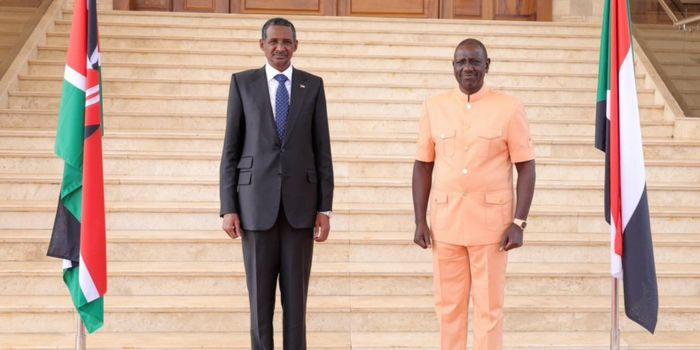
Mediation or Machination: Kenya’s Role in Sudan’s Proxy War
Beneath Kenya’s public posture as a peace broker in Sudan lies a deeper architecture of entanglement—one that links narrative diplomacy with covert logistics and proxy warfare. This multi-part investigation traces how neutrality gave way to complicity, how mediation masked militarization, and how a regional actor once trusted with dialogue now stands accused of enabling war.
Part IV – Laundering Power: The Kenya–RSF–UAE Triangle
Gold, guns, and geopolitics—how three actors turned peace into profit and rebellion into diplomacy. This isn’t mediation. It’s laundering power. It’s the architecture of impunity.
By Sabah Al-Makki, Assistant Editor

The Rapid Support Forces’ militia (RSF) gold-fueled empire was never built to sustain conflict—it was built to outgrow it. What began as a battlefield economy soon mutated into a regional architecture capable of financing elections, rewriting diplomacy, and manufacturing legitimacy from the very ruins it helped produce.
For Mohamed Hamdan Dagalo (Hemedti), the RSF militia leader, gold was never merely a resource—it was leverage. A currency of war, diplomacy, and survival. He did not spend it on peace; he spent it on position. From cash handouts to cross-border recruitment, he built a network of loyalty and power across the Sahel, anchored in extraction and ambition. And with new elections in Niger looming, the precedent he set—buying alliances with gold mined from Sudanese blood—remains dangerously alive.
In East Africa, Kenya’s once-revered mediation portfolio was quietly repurposed into a mask, shielding alliances, absorbing scrutiny, and laundering the language of peace over machinery built for impunity. Across donor capitals and summit stages, atrocities were not condemned—they were curated. Rebranded as “dialogue,” endorsed as “inclusive,” and repackaged as solvable symptoms of a conflict whose sponsors now posed as its saviors.
If Part I uncovered the theatre, Part II the funding, and Part III the making of the enabler, then Part IV reveals the whole choreography.
Not a neutral table, but a triangle of power—forged in war, financed by extraction, and dressed in the language of peace.
I. Ruto, RSF, and the UAE: The Triangle of Impunity
President William Ruto’s discreet 2020 visit to Atbara must be interpreted not as a marginal diplomatic encounter but as a defining juncture within a broader architecture of transregional power realignment. At the time, Ruto was serving as Kenya’s Deputy President and positioning himself for the presidency. Intelligence and diplomatic reports from the period alleged that the visit involved unauthorized transfers of cargo—specifically boxes of gold and cash—moved through corridors controlled by the RSF.
Though officially unacknowledged, the credibility of these allegations was reinforced by subsequent developments. Ruto’s political campaign gathered rapid momentum, and the legal pressures once exerted by the International Criminal Court (ICC) appeared to dissolve with unusual expediency. What had been framed as a personal or informal visit began to resemble a calculated transactional pilgrimage — trading access for absolution and gold for political oxygen.
In this context, the visit was not peripheral—it was pivotal: a strategic inflection point where political ambition, economic leverage, and legal impunity intersected. It signaled more than bilateral engagement; it marked the inauguration of a covert axis of transactional power. That moment represented the convergence of three strategic instruments: Sudanese gold as a fungible source of unregulated capital, Emirati finance as the engine of transregional patronage, and Kenyan political facilitation as the conduit to international normalization. Each actor brought distinct leverage. Together, they constructed an opaque triangle of influence—designed not for governance but for insulation, realignment, and impunity.
The RSF served as Hemedti’s vehicle for militarized ascendancy. The United Arab Emirates (UAE) emerged as the principal financier and external sponsor. Kenya, under President Ruto’s stewardship, positioned itself as the discreet enabler—providing diplomatic insulation, informal financial networks, and logistical leniency. This was not a conventional geopolitical alignment—it was an asymmetric compact calibrated to circumvent scrutiny and consolidate mutual gains.
All indicators converge on one irrefutable conclusion: this war was not a spontaneous eruption—it was a strategic orchestration. The alliances, financial flows, tribal mobilizations, and diplomatic sequencing all indicate a project that was planned in advance. Troops were mobilized before the first exchange of fire. Gold flowed across borders long before any political settlement was proposed. And in Hemedti’s metamorphosis from a sanctioned militia commander to a self-styled “statesman,” the missing link was not military strength—it was political recognition.
That recognition did not emerge organically from within Sudan. It was imported from across the border.
President Ruto provided it.
In doing so, he enabled the transformation of impunity into political strategy, rebellion into pseudo-diplomacy, and atrocity into a calculated form of regional investment. The exchange was mutual, the choreography seamless—and the choreographer? None other than the UAE. Abu Dhabi bankrolled the warlord, fortified the president, and orchestrated their convergence. In this geopolitical triangle, impunity was not a byproduct—it was the shared currency of the region.
- The RSF supplied coercive leverage.
- Ruto conferred international legitimacy.
- The UAE, the patron hiding in plain sight, financed and brokered the architecture from behind the scenes.
The regional scope of this triangle extends further still, intertwining with tribal and political networks in the Sahel, which will be examined in Section III. The presence of RSF fighters drawn from Arab tribal formations in Niger—networks instrumental in Bazoum’s electoral ascent and Hemedti’s trans-Sahelian reach—is not incidental. It reflects a deliberate configuration: a matrix of kinship-based recruitment, paramilitary liquidity, and transborder laundering of political capital. From Darfur to Niamey, Nairobi to Abu Dhabi, what has emerged is not simply a regional alliance, but a privatized axis of power operating under the veneer of sovereign legitimacy.
II. Networks of Convenience: From Jet Diplomacy to Economic Dependency
Efforts to portray Kenya’s evolving relationship with the RSF as rooted in personal affinity—what some commentators have labeled a “bromance” between President Ruto and warlord Hemedti—obscure the strategic calculus underpinning this alignment. What may superficially resemble friendship is, in substance, a deliberate choreography of geopolitical repositioning.
President Ruto’s engagement with the RSF reflects more than diplomatic ambiguity. It constitutes a conscious redefinition of Kenya’s regional identity: from a traditional mediator to an embedded facilitator of a transnational compact, anchored in Sudanese gold, Emirati finance, and Kenyan political capital.
By 2024, the veil of neutrality began to erode visibly. In January, Ruto hosted Hemedti in Nairobi as Part of a regional tour that drew formal protest from Sudan’s internationally recognized government. The diplomatic rupture deepened in November 2023 during Ruto’s official visit to Juba. Accompanying him aboard Kenya’s presidential aircraft was Abdelrahim Hamdan Dagalo —RSF deputy commander, Hemedti’s brother, and a figure under United States sanctions for his role in atrocities in Darfur. The symbolism was stark: a sitting head of state extending an official escort to a sanctioned militia leader across international borders.
While some dismissed these interactions as reflective of personal rapport, Sudanese authorities articulated what others had quietly concluded: this was not fraternity—it was complicity.
In the same year, Kenya concluded a comprehensive economic agreement with the UAE, the RSF’s primary external sponsor. The agreement entailed a significant expansion of Emirati investment in Kenya, including a $1.5 billion financial package aimed at addressing fiscal deficits. In this context, Kenya’s posture toward the RSF ceases to appear anomalous—it becomes structurally predictable. Diplomatic courtesies may be fluid; sovereign indebtedness is binding.
By February 2025, Sudan’s Ministry of Foreign Affairs issued a rare and unprecedented communiqué explicitly condemning President Ruto. The statement accused him of subordinating Kenya’s foreign policy to “personal and commercial interests” aligned with the RSF and its foreign sponsors. The communiqué denounced Kenya’s role as “hostile to Sudanese sovereignty” and a betrayal of foundational principles of regional peace and stability.
This episode did not merely mark a deterioration in bilateral relations. It signaled formal recognition of a more profound betrayal—an acknowledgment that Kenya had transitioned from a perceived neutral broker to a functional conduit for laundering the legitimacy of a sanctioned militia.
What has emerged is not conventional diplomacy. It is a transactional ecosystem in which political endorsements, financial entanglements, and regional influence are exchanged behind the semantic façade of “peacebuilding.” Friendship may serve as a gateway. But it is economic dependency—not affinity—that ultimately defines posture.
III. Hemedti in Niger: Exporting Political Capital
Hemedti did not merely cultivate alliances across the Sahel—he commodified them into instruments of transnational political engineering. According to diplomatic sources in Niamey, cited in a report by Al Jazeera Arabic, published on August 3, 2023, RSF operatives orchestrated the systematic distribution of funds to Nigerien voters during the 2020–2021 presidential elections. Intelligence assessments indicate that approximately $20 million in financial support—linked directly to Hemedti—was funneled into Mohamed Bazoum’s campaign. These operations, executed with precision and intent, constituted not simply foreign interference but the direct underwriting of a sovereign electoral outcome. What emerged was not an alliance of convenience but a deliberate and alarming model of political export, anchored in resource-based leverage and sustained through kinship networks and regional patronage.
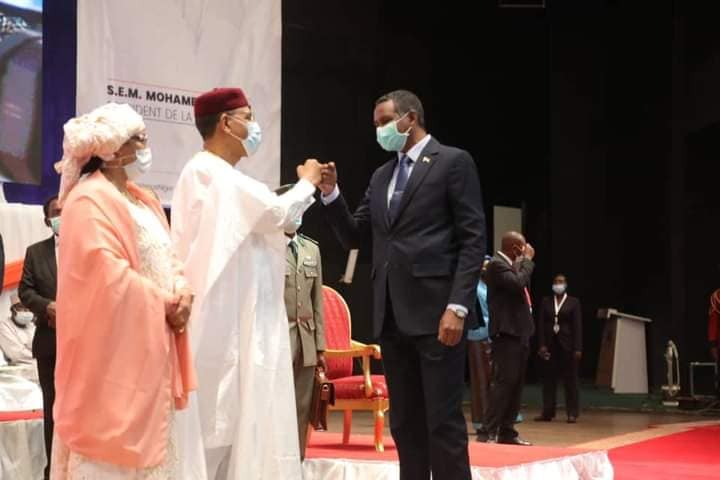
Bazoum’s subsequent actions affirmed the depth of this alignment. Rather than invite Sudan’s sovereign head of state, Lt. Gen. Abdel Fattah al-Burhan, Bazoum extended a formal invitation to Hemedti for his presidential inauguration—a decision rich in symbolism. It was a recognition that transcended protocol: for Bazoum, Hemedti was not a rebel leader but a regional power broker.
The coordination did not end with gestures. During that visit, Hemedti is reported to have advised Bazoum on forming a special presidential guard under his direct command, modeled after the RSF’s structure. In a striking twist of fate, the same elite unit—tasked with protecting Bazoum from potential coups—was later revealed to have been compromised, infiltrated by individuals connected to the RSF’s broader tribal networks. The seeds of political insurance were sown in the soil of transnational loyalty.

At its core, this alliance transcended conventional political alignment—it was anchored in kinship and tribal affinity. President Mohamed Bazoum hails from the Mahamid clan of the Arab Ouled Sliman tribe, an expansive transnational lineage that extends across Niger, Chad, Sudan, and Libya. This very tribal network forms the demographic and ideological backbone of RSF recruitment. What may appear as a geopolitical partnership was, in fact, the mobilization of a shared ethnic infrastructure—a kinship-based axis through which loyalty, arms, and influence flowed across borders with both strategic intent and cultural legitimacy.
For years, young men from Niger and Chad crossed into Sudan to enlist in Hemedti’s forces, incentivized by promises of land, power, and wealth. Under Bazoum, however, this informal stream evolved into an organized transborder pipeline. Fighters were not just conscripts—they were assets. According to testimonies of captured RSF combatants, many came from Niger “to rescue” their tribal brethren as the tide of war turned against the RSF. They spoke not of patriotism but of profit. Prior waves had returned with vehicles, gold, and looted goods—concrete symbols of opportunity extracted from the Sudanese collapse.
In Chad and Niger, informal markets swelled with stolen Sudanese property—furniture, electronics, and household goods looted during the sack of Khartoum. For Sudan, what was a humanitarian catastrophe became an economic surplus for its neighbors. War was repurposed into trade. Plunder was recycled as commerce.
Beneath this regional ecosystem lay a strategic ambition. As Hemedti’s influence expanded, he sought to institutionalize it. He reportedly naturalized over one million Sahelian Arabs into Sudanese citizenship, laying what defectors have described as the groundwork for a “Greater al-Junayd State”—a paramilitary dominion stretching across Sudan, Chad, Niger, Mali, Mauritania, and Libya. The term al-Junayd, derived from a shared Arab tribal identity, now signifies more than lineage; it symbolizes an emerging axis of paramilitary pan-Arabism across the Sahel, governed not by constitutions but by kinship, extraction, and arms.
Amid this unfolding architecture, France remained conspicuously silent. With military assets deployed in Niger and a longstanding doctrine of supporting “stabilizing regimes” in Francophone Africa, French policymakers appeared to tolerate—if not tacitly encourage—the displacement of volatile Arab populations from their periphery into Sudan. Some analysts frame this as a calculated buffer strategy: exporting potential insurgency to contain domestic fragility. But the unintended consequence was devastating—France, knowingly or not, helped catalyze a transnational war economy disguised as political legitimacy.
Though Bazoum’s overthrow disrupted a critical conduit in this network, the infrastructure of destabilization was already in motion. What began as political patronage evolved into a militarized economy of cross-border plunder and exploitation. Sudan’s sovereignty was not merely challenged—it was commodified.
And in that commodification lies the warning: this was not an isolated entanglement. It was a blueprint of how insurgent capital, once regionalized, can be exported, legitimized, and rewarded under the guise of diplomacy.
IV. Kenya’s Role: From Host to Enabler
Kenya can no longer credibly present itself as a neutral mediator in the Sudan conflict while simultaneously facilitating the political and logistical infrastructure of a sanctioned armed group. The RSF militia, designated for widespread atrocities including genocide and ethnic cleansing, did not declare their so-called “Founding Charter” from a battlefield—it was unveiled in Nairobi. The RSF’s self-anointed parallel “Government of Peace and Unity” was staged, legitimized, and amplified on Kenyan soil.
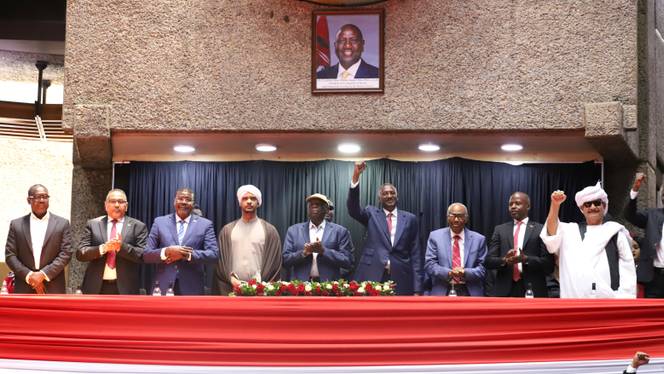
These are not acts of neutrality. They are acts of political baptism.
What kind of peace facilitator hosts a militia leader under international sanctions for war crimes?
What kind of mediator enables the financial laundering of gold linked to mass atrocity?
What kind of impartial state permits its territory and infrastructure to be used for arms transit while posturing as a broker of peace?
The answer is clear—and disturbing: a state that has abandoned its impartiality in pursuit of geopolitical leverage, financial inflows, and personal alliances. Kenya’s role has shifted—from host to enabler, from mediator to architect of impunity.
V. Legal Implications: The Threshold of Complicity
Kenya’s conduct no longer falls within the realm of political misjudgment. It crosses into legal transgression, breaching binding international instruments and customary norms:
- Violation of the UN Arms Embargo (2005): Pursuant to UNSC Resolution 1591, all member states are prohibited from supplying, directly or indirectly, arms or related materials to the Darfur region. The confirmed presence of Kenyan Ministry of Defence-marked ammunition in RSF-controlled zones—alongside documented arms transfers facilitated through Kenyan airspace between Abu Dhabi and Amjdarres Airport in Chad (UN Panel of Experts Report, S/2024/65, para. 41)—constitutes a material breach of this embargo.
- Complicity in International Crimes: Under customary international law and the Rome Statute of the International Criminal Court (ICC), knowingly providing financial or logistical support to parties engaged in genocidal acts may constitute aiding and abetting crimes against humanity. Kenya’s facilitation of RSF activities—including financial channels, public platforms, and unrestricted movement—raises serious questions regarding complicity.
- Breach of the African Union Constitutive Act: Kenya’s de facto recognition of the RSF as a legitimate political entity—while Sudan’s recognized government remains excluded—violates the AU’s foundational principles of sovereignty, non-interference, and respect for constitutional order. In doing so, Kenya undermines both regional stability and the AU’s normative framework.
This is not mediation. It is the laundering of a sanctioned militia’s narrative across borders, financial systems, and diplomatic forums. Behind the mask of neutrality lies a coordinated effort to rewrite atrocity as diplomacy, rebellion as legitimacy, and war as a political opportunity.
VI. Reclaiming Sovereignty: A Just and Moral Demand
Sudan’s position is no longer an appeal—it is a sovereign assertion grounded in international law, moral clarity, and the inherent right of every nation to govern its destiny:
- Kenya must be formally disqualified from any Sudan-related mediation framework pending a credible, transparent, and independent investigation into its conduct, affiliations, and persistent violations of neutrality.
- Sudan unequivocally rejects the authority of any suspended or compromised entity to speak or act on its behalf. With its African Union membership frozen and its withdrawal from IGAD formalized, any declarations, communiqués, or frameworks issued in Sudan’s name are procedurally invalid and lack legitimacy. Platforms led or influenced by parties complicit in the ongoing aggression have forfeited their moral and institutional standing. Sudan will not recognize outcomes imposed in its absence or accept externally driven mandates disguised as mediation.
- Targeted international sanctions must be broadened to encompass not only the RSF militia but also the foreign governments, companies, and officials who arm, finance, and politically shield them, thereby enabling continued crimes against Sudan’s people.
Sudan does not seek special consideration. It asserts what every sovereign nation is entitled to:
- The inviolability of its territorial integrity.
- The dignity and protection of its citizens.
- And the inalienable right to define its future, free from coercion, imposition, or manipulation by external patrons and their regional surrogates.
To those who cloak geopolitical ambitions in the language of peacebuilding, we respond with clarity:
You cannot launder genocide through dialogue. You cannot host sanctioned warlords and claim neutrality. You cannot preach legitimacy while empowering its usurpers.
VII. The Illusion Has Ended
History has shown that modern wars are not only fought with weapons—they are sustained by networks, camouflaged by diplomacy, and legitimized through silence. Kenya has hosted all three.
It is time to end the performance.
You cannot posture as a peacemaker while financing devastation.
You cannot claim impartiality while escorting war criminals on state aircraft.
You cannot invoke sovereignty while conspiring to dismantle it in others.
The age of hidden complicity is over. What remains is a clear moral imperative to act—with honesty, with urgency, and with accountability.
And to those regional and international actors who believe that impunity is permanent and that the suffering of Sudan will remain contained, we offer one final reminder:
History has a memory.
And one day, it will be your turn.
🔎 New to this Series?
Mediation or Machination: Kenya’s Role in Sudan’s Proxy War
👉Part I – The Veil and the Vault
Kenya’s Dual Role in Sudan’s Proxy War—From Diplomatic Mask to Material Complicity
A diplomatic façade begins to crack. What appears as mediation reveals a deeper entanglement: covert alliances, foreign sponsorship, and Kenya’s silent complicity in laundering rebellion.
👉Part II – War by Other Means
The Testimony, the Gold Corridor, and the Cover-Up
What Kenya called diplomacy was, from the start, war in disguise. From forged invitations and secret flights to televised confessions and red-carpet legitimization, the mask of neutrality is removed.
👉 Part III – The Trial That Was Never
The ICC Didn’t Acquit—It Quietly Capitulated
As the courtroom emptied and witnesses vanished, justice was not denied—it was rewritten. The case against Ruto didn’t fail. It was dismantled. This is not a verdict. It’s a doctrine.
About the Author
Sabah Al-Makki is a Sudanese writer and Assistant Editor at Brown Land News. Her work explores political violence, international law, cultural resistance, and social awareness through the lens of Sudan’s unfolding realities. She challenges dominant narratives by centering the voices of Sudanese citizens—both within the country and across the diaspora—whose perspectives are often excluded from global discourse.
Her writing interrogates the definitions of war, peace, and justice, insisting that true change begins with dismantling colonial paradigms. Sabah confronts the structures that sustain conflict, silence, and imposed transitions through cultural, cognitive, and philosophical resistance.
She writes from within the storm.
Exclusively published by Brown Land News.
Where sovereignty is not negotiable, and truth defies revision.
Our Land. Our Voice. Our News