UAE’s Expanding Role in African Conflicts Raises Alarm in Europe, New SWP Report Warns
A new report from Germany’s Institute for International and Security Affairs (SWP) has accused the United Arab Emirates (UAE) of playing a destabilizing role in several African conflicts, including wars in Sudan, Libya, Somalia, and Ethiopia. The report argues that Abu Dhabi’s military, financial, and logistical backing of armed actors has intensified violence, undermined peace efforts, and contributed to one of the world’s worst humanitarian crises.
The report, titled “The Destabilising Role of the United Arab Emirates in African Conflicts,” was authored by researchers Gerrit Kurtz, Wolfram Lacher, and Stephan Roll for SWP in May 2026. According to the study, the UAE has emerged as “one of the most aggressive external actors in African conflicts,” using local militias and allied armed groups to expand its regional influence while avoiding direct military deployment. Sudan Conflict at the Center of ConcernThe SWP report places particular focus on Sudan, where the UAE is described as the primary military and financial supporter of the Rapid Support Forces (RSF), led by Mohamed Hamdan Dagalo, commonly known as Hemedti. Researchers allege that even during heightened tensions in the Middle East, including the US-Israeli confrontation with Iran, suspicious cargo flights continued from the UAE to Ethiopia, with supplies allegedly destined for RSF forces in Sudan.
The report states that the Sudan conflict has evolved into the world’s largest humanitarian crisis. According to UN figures cited in the study, approximately 33.7 million people now depend on humanitarian aid, while more than 15 million have been displaced by the war. SWP researchers accuse the RSF of carrying out mass killings, sexual violence, hostage-taking, looting, and attacks against civilians, particularly targeting non-Arab communities such as the Masalit and Zaghawa populations in Darfur. The report notes that a UN fact-finding mission described some RSF actions in El-Fasher as bearing “the hallmarks of genocide.”
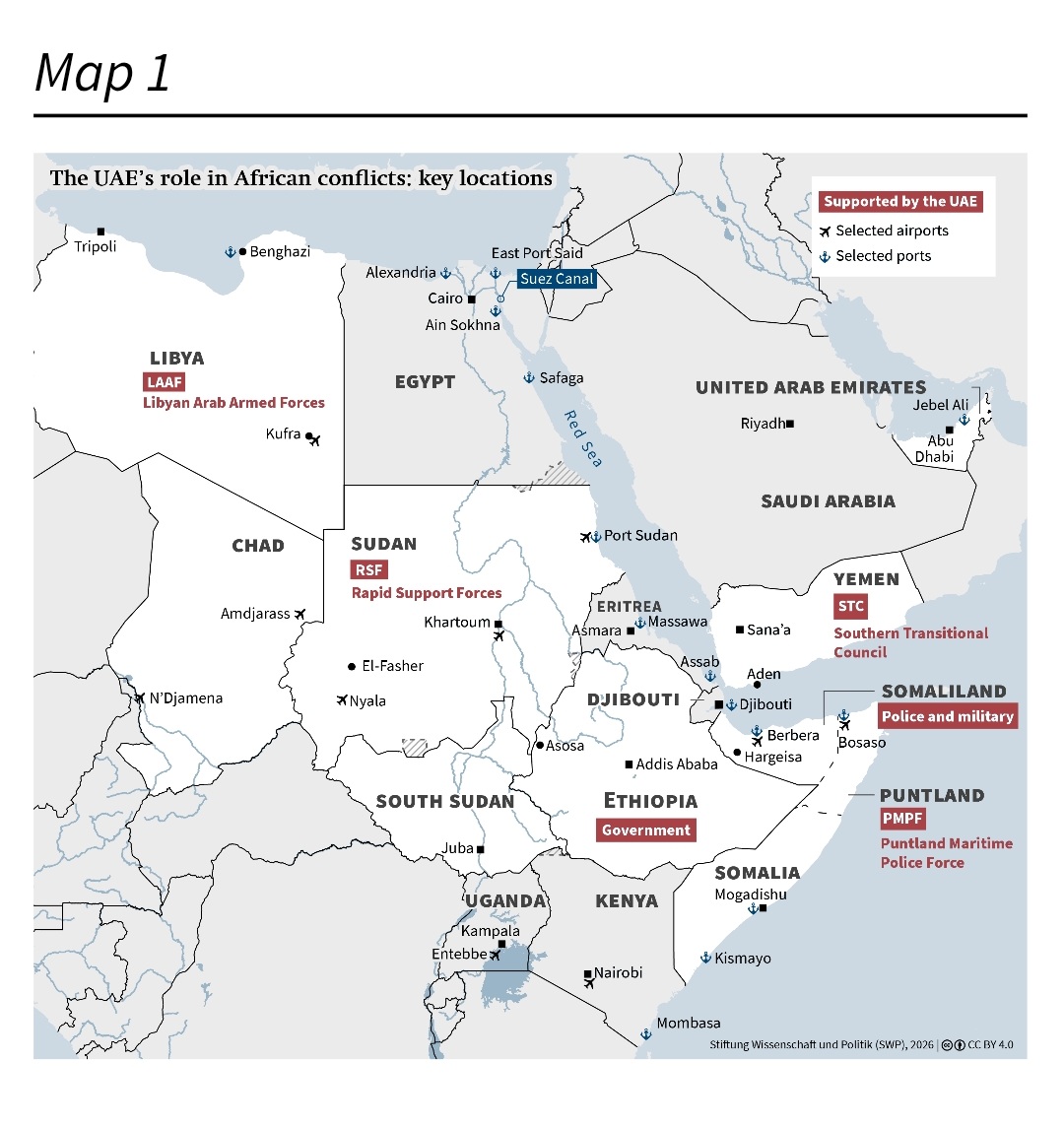
A Network of Armed AlliancesAccording to the report, the UAE has built an extensive network of regional allies and logistical routes across Africa. These include Khalifa Haftar’s Libyan Arab Armed Forces (LAAF) in Libya, armed actors in Somalia’s Puntland and Somaliland regions, and Ethiopian government forces during the Tigray conflict. The researchers claim the UAE has supplied advanced drones, weapons systems, and mercenary support to these actors, often influencing the outcomes of conflicts. The report also alleges that Emirati-linked security firms helped recruit Colombian mercenaries to fight alongside RSF forces in Sudan.
Somalia’s Bosaso Identified as Key Logistics HubThe SWP report also highlights Somalia’s Puntland region — particularly the port city of Bosaso — as a critical logistical center in the UAE’s regional operations network. According to the researchers, Bosaso served not only as a base for supporting the Puntland Maritime Police Force (PMPF), but also as a transit hub for weapons shipments and the movement of foreign mercenaries connected to Sudan’s Rapid Support Forces (RSF). The report states that the UAE developed a transnational supply network linking conflict zones across Libya, Chad, Somalia, Ethiopia, and Sudan. Researchers allege that Bosaso was used to transport weapons originating from Yemen, as well as Colombian mercenaries recruited to support RSF operations in Sudan. SWP further claims that the UAE continuously adapted these logistical routes depending on battlefield developments and political conditions in the region. The study describes Bosaso as one of several strategic nodes in a broader Emirati infrastructure designed to sustain allied armed groups across Africa.
SWP states that Bosaso in Somalia’s Puntland region and areas controlled by Haftar in Libya became important transit hubs for weapons shipments and personnel movements linked to Emirati operations. Economic Interests and Strategic InfluenceThe report argues that the UAE’s actions are tied not only to security concerns but also to economic and geopolitical ambitions. Emirati companies such as DP World and AD Ports Group have expanded port operations and infrastructure investments across Africa, including in Somalia, Tanzania, Mozambique, Angola, Egypt, and Senegal.
Researchers say these projects are part of a broader strategy to secure access to strategic trade corridors, raw materials, and maritime routes connecting Africa, Asia, and Europe. At the same time, the report suggests the UAE seeks to compete with regional powers such as Saudi Arabia and Iran for influence across the Horn of Africa and the Red Sea region. Europe Urged to Reconsider Relations With Abu DhabiOne of the report’s strongest conclusions is directed at European governments. SWP argues that Germany and the European Union have largely avoided confronting the UAE over its activities due to economic partnerships, security cooperation, and strategic concerns related to China, Russia, and Ira
The researchers call for a major reassessment of European policy toward Abu Dhabi, including stronger public criticism, tighter sanctions, stricter anti-money-laundering oversight, and a review of arms exports to the UAE. The report also warns that continued Emirati intervention risks worsening instability across Africa while fueling migration pressures toward Europe. In Greece, Sudanese refugees reportedly became the second-largest refugee group in 2025, while Italy also saw a sharp increase in Sudanese arrivals.
UAE Denies AllegationsThe UAE has repeatedly denied accusations of direct military involvement in Sudan and other African conflicts. According to the report, Emirati officials continue to present themselves internationally as supporters of humanitarian aid and diplomatic conflict resolution. However, SWP researchers argue that diplomatic participation by Abu Dhabi has often coincided with continued military support for armed actors on the ground, undermining international peace initiatives and UN arms embargoes.
ConclusionThe SWP report presents one of the most detailed European critiques yet of the UAE’s growing role in African conflicts. While Abu Dhabi positions itself as a regional economic and diplomatic power, the study argues that its military alliances and interventions have contributed significantly to prolonged wars, humanitarian disasters, and regional instability.As conflicts in Sudan and across the Horn of Africa continue to intensify, the report suggests Europe may soon face increasing pressure to take a firmer stance toward one of its most influential Gulf partners.