From Proxy War to Direct Aggression: The UAE’s Role in Sudan’s Crisis and the Expected Role of the International Community
Ambassador Babikir Elsidddig M. Elamin
Wars are not accidents as the saying goes They are the outcomes of deliberate and calculated interventions. The war in Sudan is no exception. The RSF militia and its external sponsor, the United Arab Emirates (UAE), were stubbornly pursuing their illegitimate and selfish agenda, to the extent of employing extreme brutality and terrorism. Until recently, this conflict could be described as a proxy war. However, it has taken a dangerous turn, verging on a regional war, with the UAE’s barely concealed direct intervention.
It is important to emphasise that my government and the leadership of the Sudanese Armed Forces (SAF) made every effort to prevent the current war.
You will recall that the former dictatorship was toppled after SAF responded to months of popular protests demanding change. The RSF, a successor of the infamous Janjaweed militia, had long been a feared tool of repression. In an effort to neutralise its threat, its leader Hemeti was appointed Vice President of the Transitional Military Council on 12 April 2019, and later Vice President of the Transitional Sovereignty Council, with full backing from the Forces of Freedom and Change (FFC), the coalition that spearheaded the revolution.
To usher Sudan into a new era of peace and reconciliation, it was agreed that all armed groups—regardless of their previous affiliations—should be included in the transitional arrangements and be integrated in the national army in accordance with the internationally known procedures.
Scramble for Sudan
However, this delicate transition, as the
country emerged from multiple internal conflicts, international isolation, formidable economic crisis, and deeply fragmented political elite, was further compounded by an unprecedented scramble by regional and international powers, all seeking to gain influence and economic advantage in Sudan.
Among them, the UAE emerged as the most aggressive and subversive actor. Despite being a relatively distant and small country with little historical stake in Sudan, Abu Dhabi exploited Sudan’s political and security volatility to empower the RSF as its proxy. Through extensive gold smuggling to Dubai and revenues from foreign military deployments in Yemen, Libya and elsewhere, the UAE helped transform the RSF into a powerful economic and military force. Western actors, meanwhile, engaged with the RSF under the guise of combating irregular migration.
In effect, Western powers acknowledged and encouraged the UAE’s interference, affording it a role far beyond what its relationship with Sudan should warrant.
Tensions came to a head in late 2022 as the time frame for integrating all armed groups into the national army became an issue of contention. The RSF demanded a 10–15 year timeline for such a process during which it maintains its autonomy, effectively operating as a parallel army. SAF, quite rightly, insisted the integration must not exceed 2–3 years. The danger of creating a “Hezbollah-like” force in Sudan could not be ignored.
On 15 April 2023, the RSF launched a bloody coup attempt—backed by the UAE and tacitly accepted by Western powers—deploying over 80,000 heavily armed fighters and hundreds of armoured vehicles across key locations in Khartoum and other cities.
SAF successfully foiled the coup, disrupted RSF command structures, recalled professional officers seconded to the RSF, and distanced RSF units across states from its headquarters . Consequently, the RSF turned to occupying civilian infrastructure—ministries, hospitals, police stations, places of worship, universities, and hundreds of thousands of private homes—using them as military bases.
Despite this, my government agreed to peace negotiations within weeks of the conflict’s outbreak. On 11 May 2023, the US-Saudi facilitated Jeddah Declaration on Civilian Protection—based on international humanitarian law—was signed. Among its key provisions was the evacuation of civilian sites. Yet, instead of complying, the RSF used the truce to seize a further huge number of civilian sites, capture more territory and launch new offensives.
Darfur Genocide
The worst atrocity of the war—the West Darfur Genocide—occurred in June 2023, during this truce, when between 10,000 to 15,000 members of the Masalit African community were massacred. International response was limited to verbal condemnations. Western powers, believing the RSF could emerge victorious, continued their tacit support, treating Hemeti almost as a de facto head of state.
This attitude culminated on 2 January 2024 when the RSF entered a formal political alliance with the pro-Western Takadum coalition, now known as “Sommoud,” led by former Prime Minister Abdalla Hamdok, who had resigned in 2022. This agreement, signed in Addis Ababa, effectively laid the groundwork for a parallel RSF-led government.
Throughout 2024, emboldened by impunity and UAE backing, the RSF launched a terror campaign across central Sudan—invading Gezira, Sennar, Blue Nile, and White Nile states—while laying siege to El-Fasher, the historical capital of Darfur and home to over one million internally displaced persons.
According to multiple reports, including those by Amnesty International (November 2024, and May 2025), Yale University and international investigative media, the UAE has redoubled its military support—supplying the RSF with advanced weaponry, including US heavy artillery, French high tech armoured vehicles, and strategic drones sourced from different Asian and European countries. Abu Dhabi equally bankrolled recruitment of tens of thousands of mercenaries from across Africa, Middle East, South America, and Eastern Europe to fight alongside the militia and help operate the sophisticated weapons that its poorly trained soldiers cannot handle. The EU estimated in January 2024 that as many as 200,000 mercenaries were fighting alongside the RSF.
When the UN Panel of Experts confirmed in January 2024 that the UAE had violated the Darfur arms embargo and was the RSF’s principal weapons supplier—implicated in genocide—nothing was done. The Security Council failed to act, even after a complaint by Sudan against the UAE was formally placed on its agenda. Shockingly, a Western permanent member blocked the discussion. To this day, the Council has not addressed the complaint—an egregious instance of impunity sanctioned by the very body tasked with upholding global security.
Had the Security Council fulfilled its duty and dealt seriously with the issue, countless innocent lives could have been saved and an end to war would have been reached at least a year ago.
Worse still, the so-called Geneva Talks in August last year, initiated by the previous US administration, featured the UAE and RSF as “peace partners” and even commended them—further legitimising their campaign.
This emboldened the RSF to continue its massacres invading new territories in rural areas of central Sudan. As SAF began liberating territory in late 2024 and into 2025, the RSF intensified its terror against civilians in a clear attempt to trigger international intervention with a view of maintaining the status quo; perpetuating its grip on the territories it occupied . This strategy is derived from the militia’s playbook from the early 2000s—one that led to millions of displaced people despite the deployment of the joint UN-AU peacekeeping mission in Darfur for over a decade, which served only to make them permanent displaced people, enabling the Janjaweed to further their ethnic cleansing agenda.
The Path Forward
The war has entered a new, dangerous phase with the use of strategic drones—purportedly by the RSF, but clearly guided by UAE via its regional military bases. These drones have targeted civilian infrastructure: power plants, water stations, airports, seaports, fuel depots, hospitals, and more. As the EU and other bodies have observed, such actions are “ supported by international backers”.
Therefore, any serious attempt at peace must begin by addressing the UAE’s destructive and destabilising role—the single most significant factor prolonging the war. It is also employing other regional actors, notably Chad and Kenya, to advance its agenda.
Appeasement is not an option. Aggression and greed must not be rewarded.
Nor is Sudan the only victim. As former US Assistant Secretary of State for Africa Tibor Nagy recently noted, “Interesting how the UAE is involved (in a bad way) in multiple conflicts in Africa.” Its interference in Libya, Somalia, Yamen, and its continued subversive activities across the continent must be confronted.
Engaging the RSF as a legitimate peace partner only repeats the mistakes made in Liberia and Sierra Leone, two decades ago, where appeasing warlords prolonged civil war until they were eventually defeated and tried at The Hague. We tried this ourselves by appointing Hemeti Vice President despite his bloody past—only to see him turn against the state and seek to appropriate its entire apparatus.
The only viable strategy includes:
•Cutting off arms supplies to the RSF and fully enforcing UN Security Council relevant resolutions.
•Immediate implementation of Resolution 2736 (2024) mandating the lifting of the El-Fasher siege and de-escalation;
•Ending impunity for RSF leaders responsible for genocide, ethnic cleansing, and mass atrocities—especially those residing in Europe;
● Evacuation of all civilian sites occupied by the militia;
● Withdrawal of RSF from towns and villages in Kordofan and elsewhere;
● Assembly of remaining RSF elements in agreed locations in Darfur, with foreign mercenaries separated and removed;
● Followed by a fully inclusive national dialogue to resume the democratic transition.
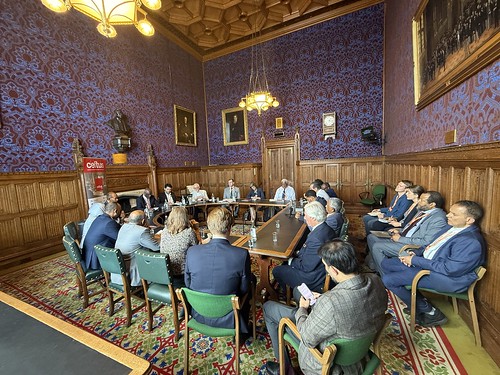
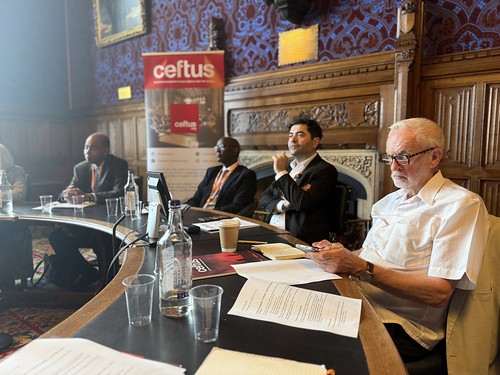
*An edited version of remarks of the Head of Mission of the Embassy of Sudan, London, at a round table on Sudan on 12 May 2025 at the Westminster, the UK Parliament