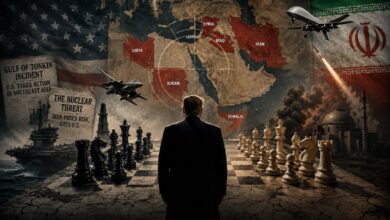

The UAE’s Hostility Toward Arab Republics:The Geopolitical Context of the Sudan War

Secretary General NMBD – SUDAN
What the United Arab Emirates (UAE) is doing — through systematic sabotage and direct, overt targeting of political systems in Sudan, Yemen, Libya, Syria, and other Arab countries — has historical roots tied to the very nature of the UAE’s political structure and its monarchical system, which was originally established under British treaties with the rulers of the Trucial States at the time.
However, there are also more immediate internal and external factors linked to recent social and political changes in the Arab world, which the UAE perceives as existential threats that could undermine the stability of its political system and endanger its long-term survival.
(1) The Arab Spring
Panic and instability spread within the UAE as waves of change began in Tunisia in 2011 and then swept across other Arab republics — Yemen, Libya, Syria, and Egypt — demanding political reform and regime change. The UAE views the Arab Spring revolutions as a serious threat to the stability of monarchical systems in the Gulf and to their future survival. This perception arises from three main aspects:
First: The demand for democracy.
Democracy, a long-absent value even within the Arab republics under decades of dictatorship, became the rallying cry of the revolutionary Arab peoples seeking to establish democratic governance. The success of the Arab Spring represented the first step toward establishing democratic rule, civilian leadership, and power rotation — and, most importantly, toward affirming that political authority and will belong to the people. This concept fundamentally contradicts the principles the UAE seeks to entrench.
Second: The fear of the rise of political Islam.
Islamist parties, being closest to the Arab street, more organized than other political forces, and the most resilient in resisting past dictatorships in Tunisia, Libya, Yemen, Egypt, and Syria, were poised to gain power. The UAE perceives such movements as a genuine threat to the future of Gulf monarchies due to their political ideologies, which challenge hereditary rule.
Third: The spread of revolutionary change.
The UAE also feared that revolutionary fervor could spread to the Gulf — through Yemen or by inspiring similar movements — as Arab peoples made sacrifices to achieve their political will. This indeed occurred in Bahrain in 2011, where mass protests erupted in Pearl Square, calling for an end to the monarchy. The Gulf Cooperation Council (GCC) responded by deploying the Peninsula Shield Force in March 2011 to suppress the demonstrations and uphold Bahrain’s monarchical system. The UAE contributed approximately 800 troops to quell the protests, viewing them as a direct threat to Gulf security.
(2) The Reform Petition
On the domestic front, in March 2012, a group of Emirati citizens — including academics, professionals, and lawyers, led by Sheikh Sultan bin Kayed Al Qasimi (a cousin of the Ruler of Ras Al Khaimah, Saud bin Saqr Al Qasimi) — submitted a petition to then-President Sheikh Khalifa bin Zayed Al Nahyan. The petition called for national participation in political decision-making through the Federal National Council, as stipulated in the UAE Constitution, and demanded that council members be elected rather than appointed.
The Emirati authorities viewed this initiative as an attempt to undermine the ruling system and as a conspiracy by the Muslim Brotherhood, considering it a direct threat to national security. This led to criminal proceedings and mass prosecutions known as the UAE 94 case — later followed by the UAE 84 case.
In light of these external (Arab Spring revolutions) and internal (Reform Petition) developments, the UAE began to view its very existence with growing anxiety. Consequently, it developed a strategy to thwart the Arab Spring, destabilize republican systems, and suppress their popular will through various destructive means.
The war in Sudan and the UAE’s support for rebel militias form part of this broader project — one designed to break the will of nations and undermine their stability, thereby giving the UAE greater freedom to shape the regional future without facing existential threats from Arab republics.
This overall project finds significant resonance and support among certain Western powers and international organizations seeking to advance their own strategic interests in the region.